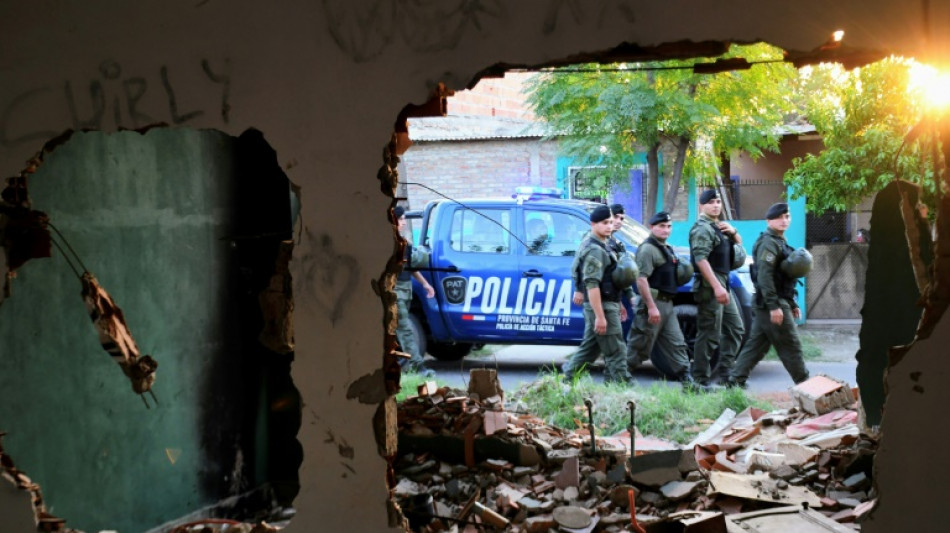
Argentina's narco capital sees mysterious drop in murders / Photo: - - AFP/File

 Two dead as Istanbul endures heaviest rainfall in 80 years

 After latest Nepal flood, survivors fear for future

 EU leaders clash over budget as spectre of French elections looms

 'No place to breathe': life in Indonesia's fire epicentre

 'Can't sleep': Spain's housing crunch upends lives

 Musk calls on Ukraine's Zelensky to 'go' after satellite slowdown row

 Still smiling at 117, Albanian may be world's oldest woman

 Pope has 'good night' in hospital: Vatican

 China's economy seen missing target as global shocks bite: AFP poll

 Costa Rica opens jail inspired by El Salvador mega-prison

 Same-sex couple takes fight for equality to Slovakian court

 'High hopes' as Indonesian women get a football league, again

 'Expectations high' for Bordeaux-Begles' Champions Cup hat-trick bid, says Depoortere

 Rennie urges All Blacks to stay focused against 'hurting' Wallabies

 Palmeiras beat Fluminense 2-1 in Libertadores semi-final first leg

 Brewers blasts leave Dodgers on brink

 Tech stock lead rout after US inflation fuels rate hike bets

 Al-Fayed survivors say UK police missing 'bigger picture'

 Online 'witch hunt' sweeps up Asians misidentified as US rape accused

 Prospect of Bolsonaro win looms large over Brazil's Indigenous

 Freed from Belarus, founder of Lady Gaga's biggest fan site tells his story

 Behind AI's carbon footprint, a potential climate tool

 Trump's new press secretary faces scrutiny over credentials

 PSG 'got lucky' to win Man City thriller, says Luis Enrique

 Real Madrid comeback stuns Roma as Mourinho enjoys happy reunion

Argentina's most violent city, Rosario -- best known as the hometown of soccer star Lionel Messi -- has in recent months seen a drastic, and some say suspicious, fall in murders.
Authorities boast the change is the result of a crackdown on drug-trafficking gangs, both on the streets and in prisons.
However, some believe a tacit pact between the government and criminal groups may explain the turnaround.
Rosario has a key port on South America's second-longest river after the Amazon -- the Parana -- which has made it a hotspot for the movement of drugs from Bolivia, Brazil and Paraguay headed for Europe and Asia.
The city, Argentina's third-largest, has long had a murder rate standing at around five times the national average, with up to 260 killings per year.
Even the families of famous residents like Messi, or fellow football player Angel Di Maria have received violent threats or attacks by criminal organizations.
But everything seems to have changed since the end of 2023, when President Javier Milei took office, vowing zero tolerance for crime.
At the same time, the province of Santa Fe, where Rosario is located, got a new governor, Maximiliano Pullaro.
Pullaro immediately imposed harsher conditions on prisoners, particularly gang bosses, publishing photos of jail raids and subdued prisoners.
His actions earned him around 30 death threats in his first months in office and prompted a backlash from gangs, who killed four civilians in March.
Milei then sent federal police and troops into Rosario.
- 'Tacit deal' -
According to a report from the national security ministry, Rosario's murder rate dropped 62 percent between January and August compared to the same period last year.
"We have the lowest number of homicides in 17 years in Rosario," said Security Minister Patricia Bullrich.
"We said that we were going to put order in prisons and order in the street. And that is what we did," added Pullaro, who has been accused of emulating the harsh gang-busting tactics of El Salvador's popular President Nayib Bukele.
Yet experts are skeptical that these measures alone led to the rapid decline in murders.
The former security minister of Santa Fe, Marcelo Sain, who is also a doctor in social sciences, believes "there was an agreement" between the state and the criminal world in which "the killing of people stopped."
"There is no other explanation, because there is no other policy in the world that makes homicides decrease so sharply," he added.
Ariel Larroude, director of the Criminal Policy Observatory at the University of Buenos Aires (UBA), said the decrease in violence was "striking" because "drug consumption continues to grow."
"This may be the result of an exceptional success in criminal policy" based on "a reorganization" of the police and prisons, he said.
But it is also possible that this is accompanied by a "tacit deal with the gangs to reduce violence, while (the government) turns a blind eye to drug sales."
Larroude said this could merely entail police halting control over certain street corners or neighborhoods.
On the ground, feelings are mixed.
"We see more police, but everything remains the same," said Sandra Arce, a 46-year-old mother who runs a soup kitchen in the Boca neighborhood
"On the street, the situation remains the same -- they rob you, they snatch things from you, they shoot," she added.
However, she is pleased that a local hotspot for selling drugs, across the street from her soup kitchen, has recently disappeared.
N.Shalabi--SF-PST

