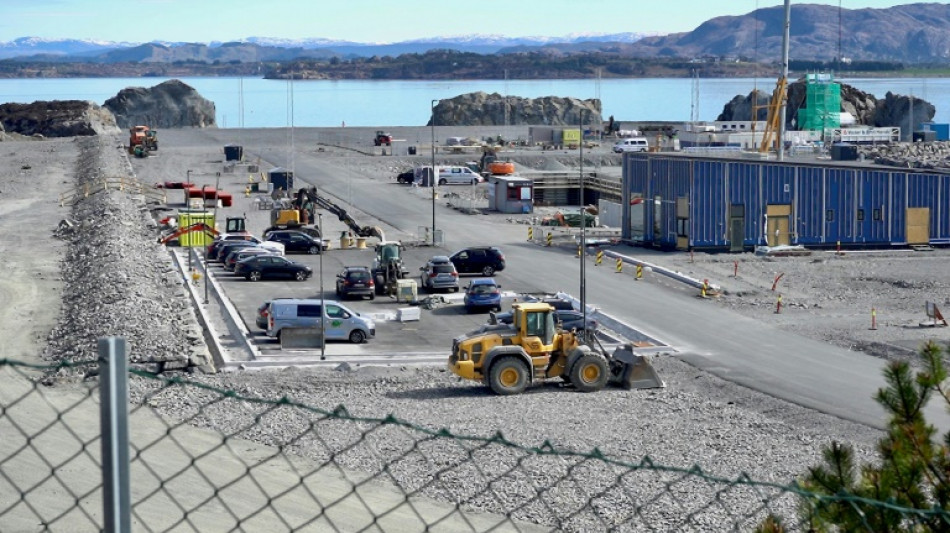
World's first CO2 storage service soon ready in Norway / Photo: Alexiane LEROUGE - AFP/File

 Two dead as Istanbul endures heaviest rainfall in 80 years

 After latest Nepal flood, survivors fear for future

 EU leaders clash over budget as spectre of French elections looms

 'No place to breathe': life in Indonesia's fire epicentre

 'Can't sleep': Spain's housing crunch upends lives

 Musk calls on Ukraine's Zelensky to 'go' after satellite slowdown row

 Still smiling at 117, Albanian may be world's oldest woman

 Pope has 'good night' in hospital: Vatican

 China's economy seen missing target as global shocks bite: AFP poll

 Costa Rica opens jail inspired by El Salvador mega-prison

 Same-sex couple takes fight for equality to Slovakian court

 'High hopes' as Indonesian women get a football league, again

 'Expectations high' for Bordeaux-Begles' Champions Cup hat-trick bid, says Depoortere

 Rennie urges All Blacks to stay focused against 'hurting' Wallabies

 Palmeiras beat Fluminense 2-1 in Libertadores semi-final first leg

 Brewers blasts leave Dodgers on brink

 Tech stock lead rout after US inflation fuels rate hike bets

 Al-Fayed survivors say UK police missing 'bigger picture'

 Online 'witch hunt' sweeps up Asians misidentified as US rape accused

 Prospect of Bolsonaro win looms large over Brazil's Indigenous

 Freed from Belarus, founder of Lady Gaga's biggest fan site tells his story

 Behind AI's carbon footprint, a potential climate tool

 Trump's new press secretary faces scrutiny over credentials

 PSG 'got lucky' to win Man City thriller, says Luis Enrique

 Real Madrid comeback stuns Roma as Mourinho enjoys happy reunion

Norway is set to inaugurate Thursday the gateway to a massive undersea vault for carbon dioxide, a crucial step before opening what its operator calls the first commercial service offering CO2 transport and storage.
The Northern Lights project plans to take CO2 emissions captured at factory smokestacks in Europe and inject them into geological reservoirs under the seabed.
The aim is to prevent the emissions from being released into the atmosphere, and thereby help halt climate change.
On the island of Oygarden, a key milestone will be marked on Thursday with the inauguration of a terminal built on the shores of the North Sea, its shiny storage tanks rising up against the sky.
It is here that the liquified CO2 will be transported by boat, then injected through a long pipeline into the seabed, at a depth of around 2.6 kilometres (1.6 miles), for permanent storage.
The facility, a joint venture grouping oil giants Equinor of Norway, the Anglo-Dutch Shell and TotalEnergies of France, is expected to bury its first CO2 deliveries in 2025.
It will have an initial capacity of 1.5 million tonnes of CO2 per year, before being ramped up to five million tonnes in a second phase if there is enough demand.
"Our first purpose is to demonstrate that the carbon capture and storage (CCS) chain is feasible," Northern Lights managing director Tim Heijn told AFP.
"It can make a real impact on the CO2 balance and help achieve climate targets," he said.
- Prohibitive cost -
CCS technology is complex and costly but has been advocated by the UN's Intergovernmental Panel on Climate Change (IPCC) and the International Energy Agency (IEA), especially for reducing the CO2 footprint of industries like cement and steel, which are difficult to decarbonise.
The world's overall capture capacity is currently just 50.5 million tonnes, according to the IEA, or barely 0.1 percent of the world's annual total emissions.
In order to limit global warming to 1.5 degrees Celsius since the pre-industrial era, CCS would have to prevent at least one billion tonnes of CO2 emissions per year by 2030, the IEA says.
The technology is still in the early stages, and has been slow to develop because of prohibitive costs -- compared to the price companies have to pay for CO2 emission quotas, for example.
It therefore depends heavily on subsidies.
"Public support was and will be crucial to help such innovative projects to advance, especially as CCS costs are still higher than the costs of CO2 emissions in Europe," said Daniela Peta, public affairs director at the Global CCS Institute.
The Norwegian government has financed 80 percent of the cost of Northern Lights, which has been kept confidential.
The Scandinavian country is Western Europe's largest oil and gas producer.
The North Sea, with its depleted oil and gas fields and its vast network of pipelines, is an ideal region to bury unwanted greenhouse gases.
- Greenwashing? -
Northern Lights is part of an ambitious 30-billion-kroner ($2.9 billion) scheme dubbed "Longship" -- after the Viking ships -- of which the state has provided 20 billion kroner.
The plan initially included the creation of two CO2 capture sites in Norway.
While the Heidelberg Materials cement factory in Brevik is expected to begin shipping its captured emissions to the site next year, snowballing costs have forced the waste-to-energy plant Hafslund Celsio in Oslo to review its plans.
In addition, Northern Lights has also secured cross-border deals with Norwegian fertiliser manufacturer Yara and energy group Orsted to bury CO2 from an ammonia plant in the Netherlands and two biomass power stations in Denmark.
Some environmentalists worry the technology could provide an excuse to prolong the use of fossil fuels and divert funds needed for renewable energies.
They have also raised concerns about the risk of leaks.
"Northern Lights is 'greenwashing'," said the head of Greenpeace Norway, Frode Pleym, noting that the project was run by oil companies.
"Their goal is to be able to continue pumping oil and gas. CCS, the electrification of platforms and all of these kinds of measures are used by the oil industry in a cynical way to avoid doing anything about their enormous emissions," he said.
K.Hassan--SF-PST

