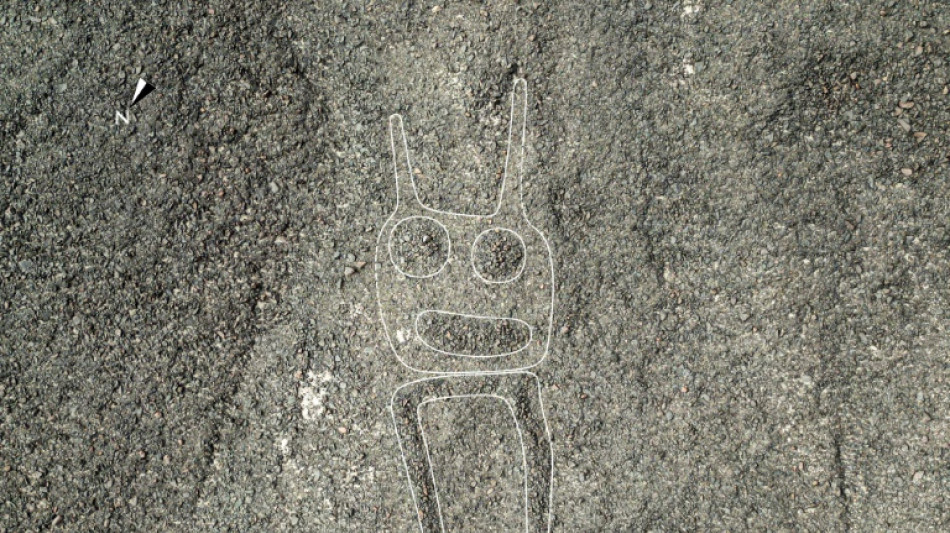
AI research uncovers 300 ancient etchings in Peru's Nazca desert / Photo: Handout - Yamagata University Institute of Nasca/AFP

 'Severe drought' declared in parts of UK

 IUX Announces New Web Client Portal Built for Enhanced Browser-Based Trading

 School roof collapse kills teacher, 32 children in NW Pakistan

 Inter skipper Martinez facing month out with thigh injury

 Spanish prosecutors back abuse probe into Julio Iglesias

 Tech sell-off deepens as US inflation sparks AI jitters

 Southgate does not forsee a return to management

 Two dead as Istanbul endures heaviest rainfall in 80 years

 After latest Nepal flood, survivors fear for future

 EU leaders clash over budget as spectre of French elections looms

 'No place to breathe': life in Indonesia's fire epicentre

 'Can't sleep': Spain's housing crunch upends lives

 Musk calls on Ukraine's Zelensky to 'go' after satellite slowdown row

 Still smiling at 117, Albanian may be world's oldest woman

 Pope has 'good night' in hospital: Vatican

 China's economy seen missing target as global shocks bite: AFP poll

 Costa Rica opens jail inspired by El Salvador mega-prison

 Same-sex couple takes fight for equality to Slovakian court

 'High hopes' as Indonesian women get a football league, again

 'Expectations high' for Bordeaux-Begles' Champions Cup hat-trick bid, says Depoortere

 Rennie urges All Blacks to stay focused against 'hurting' Wallabies

 Palmeiras beat Fluminense 2-1 in Libertadores semi-final first leg

 Brewers blasts leave Dodgers on brink

 Tech stock lead rout after US inflation fuels rate hike bets

 Al-Fayed survivors say UK police missing 'bigger picture'

Japanese scientists have used artificial intelligence to uncover 303 new etchings in Peru's Nazca desert -- doubling the amount of known geoglyphs made some 2,000 years ago by a pre-Inca civilization.
The fabled Nazca lines, a series of massive incisions on the desert floor depicting animals, plants, imaginary beings and geometric figures, have fascinated scientists ever since they were first discovered around a century ago.
Best viewed from the air, the lines situated some 220 miles (350 kilometers) south of Lima are one of Peru's top tourist attractions.
Announcing the new discoveries in Lima on Monday, archaeologist Masato Sakai, from Yamagata University, said: "The use of AI in research has allowed us to map the distribution of geoglyphs in a faster and more precise way."
He said the findings were the fruit of collaboration between his university's Nazca Institute and the research division of the technology company IBM.
"The traditional method of study, which consisted of visually identifying the geoglyphs from high-resolution images of this vast area, was slow and carried the risk of overlooking some of them," he added.
The study was also published on Monday in the prestigious Proceedings of the National Academy of Sciences (PNAS) journal, describing how AI can be used to accelerate discoveries in archeology even in well-known sites.
The paper said it had taken nearly a century to discover 430 figurative Nazca geoglyphs.
Using AI, scientists found 303 more during only six months of field surveys.
The AI model was particularly good at picking up smaller relief-type geoglyphs which are harder to spot with the naked eye.
Among the new figures discovered were giant linear-type geoglyphs, mainly representing wild animals, but also smaller ones with motifs of abstract humanoids and domesticated camelids, a mammal from the camel family.
Scientists used AI to analyze a vast amount of geospatial data produced by aircraft to identify areas where they might find more geoglyphs.
The people that formed the Nazca civilization lived in the area of southwestern Peru from 200 BC to 700 AD.
What drove them to create the lines, designated a UNESCO World Heritage site, is a mystery.
Some scientists believe they have astrological and religious significance.
The first geoglyphs were discovered in 1927.
I.Yassin--SF-PST