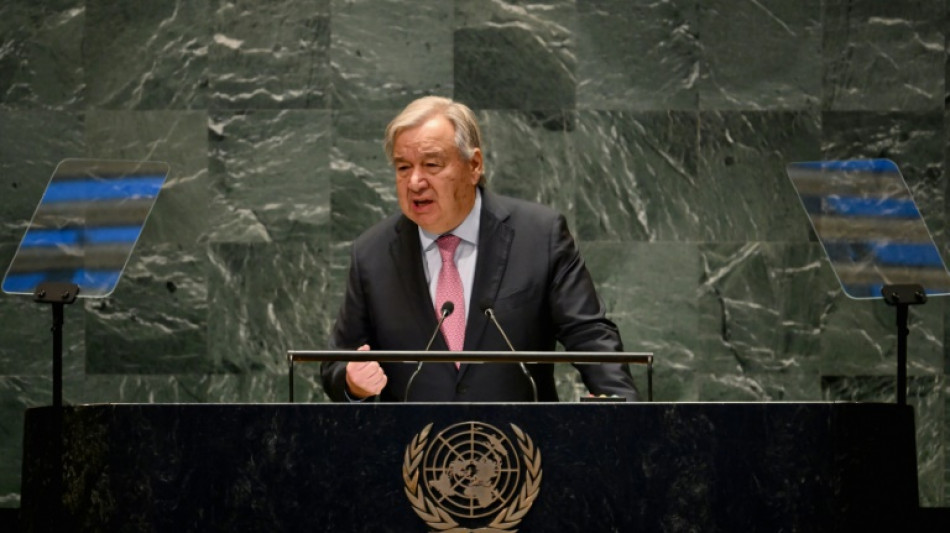
UN adopts pact to tackle volatile future for mankind / Photo: ANGELA WEISS - AFP

 'Severe drought' declared in parts of UK

 IUX Announces New Web Client Portal Built for Enhanced Browser-Based Trading

 School roof collapse kills teacher, 32 children in NW Pakistan

 Inter skipper Martinez facing month out with thigh injury

 Spanish prosecutors back abuse probe into Julio Iglesias

 Tech sell-off deepens as US inflation sparks AI jitters

 Southgate does not forsee a return to management

 Two dead as Istanbul endures heaviest rainfall in 80 years

 After latest Nepal flood, survivors fear for future

 EU leaders clash over budget as spectre of French elections looms

 'No place to breathe': life in Indonesia's fire epicentre

 'Can't sleep': Spain's housing crunch upends lives

 Musk calls on Ukraine's Zelensky to 'go' after satellite slowdown row

 Still smiling at 117, Albanian may be world's oldest woman

 Pope has 'good night' in hospital: Vatican

 China's economy seen missing target as global shocks bite: AFP poll

 Costa Rica opens jail inspired by El Salvador mega-prison

 Same-sex couple takes fight for equality to Slovakian court

 'High hopes' as Indonesian women get a football league, again

 'Expectations high' for Bordeaux-Begles' Champions Cup hat-trick bid, says Depoortere

 Rennie urges All Blacks to stay focused against 'hurting' Wallabies

 Palmeiras beat Fluminense 2-1 in Libertadores semi-final first leg

 Brewers blasts leave Dodgers on brink

 Tech stock lead rout after US inflation fuels rate hike bets

 Al-Fayed survivors say UK police missing 'bigger picture'

UN members adopted a blueprint for the future Sunday to tackle the myriad wars, environmental threats and technological challenges facing humanity that was hailed by the organization as "groundbreaking" but panned by critics as unambitious.
Secretary-General Antonio Guterres, who championed the "Pact for The Future" and its components, billed them as "landmark agreements -- a step-change towards more effective, inclusive, networked multilateralism."
As an opener for the annual high-level week of the UN General Assembly, which begins Tuesday, dozens of heads of state and government gathered for the adoption, which faced last-minute opposition from Russia and its allies.
Leaders pledged to bolster the multilateral system to "keep pace with a changing world" and to "protect the needs and interests of current and future generations" facing "persistent crisis."
"We believe there is a path to a brighter future for all of humanity," the document says.
The pact outlines 56 "actions," including commitments to multilateralism, upholding the UN Charter and peacekeeping.
- Russian objections -
It also calls for reforms to international financial institutions and the UN Security Council, along with renewed efforts to combat climate change, promote disarmament, and guide the development of artificial intelligence.
The adoption of the text faced a brief delay when Russia's deputy minister of foreign affairs, Sergey Vershinin, introduced an amendment emphasizing the "principle of non-interference in the internal affairs of states" and urging the UN to avoid duplicating efforts.
Russia's objections were backed by allies Belarus, North Korea, Iran, Nicaragua and Syria, but its amendment was overwhelmingly dismissed in a motion to take no action.
"It was somewhat irritating that, in the end, Russia once again tried to stop the whole process and did not want to go down the path that the whole world had taken," said German Chancellor Olaf Scholz, co-sponsor of the text, after the adoption.
- 'I challenge you' -
Passage of the text was never a guarantee, and sources said Guterres had prepared three separate versions of his speech for the potential outcomes of the vote.
During the negotiations phase, the UN Secretary-General had urged nations to show "vision" and "courage," calling for "maximum ambition" to strengthen international institutions that struggle to respond effectively to today's threats.
But while there are some "good ideas," the text "is not the sort of revolutionary document reforming the whole of multilateralism that Antonio Guterres had originally called for," Richard Gowan of the International Crisis Group told AFP.
"Ideally, you would hope for new ideas," said one diplomat.
The fight against global warming was one of the sticking points in the negotiations, with references to the "transition" away from fossil fuels having disappeared from the draft text weeks ago, before being re-inserted.
"The real test will be the delivery of these" goals, said environmental campaign group 350.org.
Despite criticism of the pact, it is still "an opportunity to affirm our collective commitment to multilateralism, even in the difficult current geopolitical context," one diplomat said, emphasizing the need to rebuild trust between the Global North and South.
"This pact gives us hope and inspiration for a better future," said Sierra Leone's President Julius Maada Bio, who has been a keen advocate for the Global South at the UN through his country's membership of the Security Council.
Developing countries have been particularly vocal in demanding concrete commitments on the reform of international financial institutions, aiming to secure easier access to preferential financing, especially considering the impacts of climate change.
The text does indeed include "important commitments on economic justice and reforming the international financial architecture," Human Rights Watch (HRW) commented, while also praising "the centrality of human rights."
Regardless of its content, the pact and its annexes -- a Global Digital Compact and a Declaration on Future Generations -- are non-binding, raising concerns about implementation, especially as some principles such as the protection of civilians in conflict are violated daily.
"Now it is our common responsibility to walk through it. That demands not just agreement, but action. I challenge you to take that action," Guterres said following the adoption.
V.Said--SF-PST

