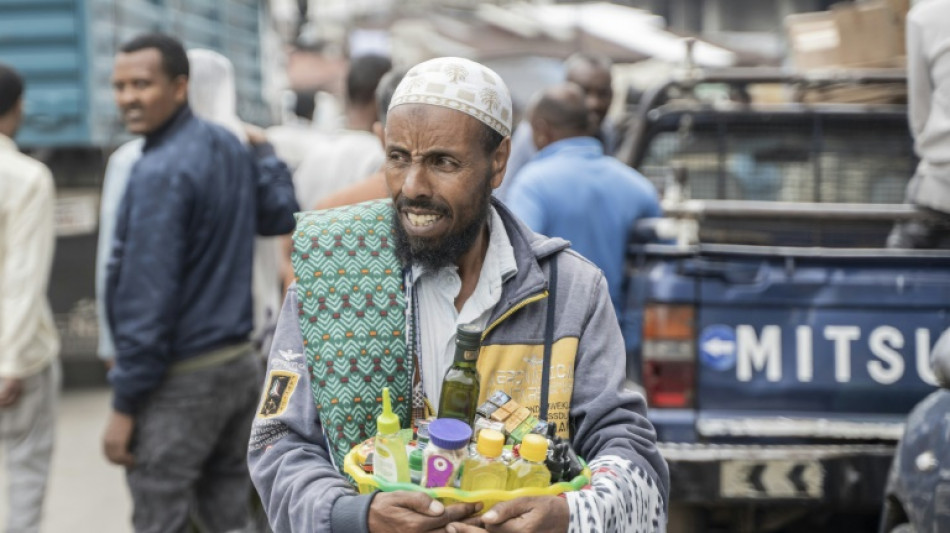
Ethiopians struggle with bitter pill of currency reform / Photo: Amanuel Sileshi - AFP

 'Severe drought' declared in parts of UK

 IUX Announces New Web Client Portal Built for Enhanced Browser-Based Trading

 School roof collapse kills teacher, 32 children in NW Pakistan

 Inter skipper Martinez facing month out with thigh injury

 Spanish prosecutors back abuse probe into Julio Iglesias

 Tech sell-off deepens as US inflation sparks AI jitters

 Southgate does not forsee a return to management

 Two dead as Istanbul endures heaviest rainfall in 80 years

 After latest Nepal flood, survivors fear for future

 EU leaders clash over budget as spectre of French elections looms

 'No place to breathe': life in Indonesia's fire epicentre

 'Can't sleep': Spain's housing crunch upends lives

 Musk calls on Ukraine's Zelensky to 'go' after satellite slowdown row

 Still smiling at 117, Albanian may be world's oldest woman

 Pope has 'good night' in hospital: Vatican

 China's economy seen missing target as global shocks bite: AFP poll

 Costa Rica opens jail inspired by El Salvador mega-prison

 Same-sex couple takes fight for equality to Slovakian court

 'High hopes' as Indonesian women get a football league, again

 'Expectations high' for Bordeaux-Begles' Champions Cup hat-trick bid, says Depoortere

 Rennie urges All Blacks to stay focused against 'hurting' Wallabies

 Palmeiras beat Fluminense 2-1 in Libertadores semi-final first leg

 Brewers blasts leave Dodgers on brink

 Tech stock lead rout after US inflation fuels rate hike bets

 Al-Fayed survivors say UK police missing 'bigger picture'

In a small fashion store in Ethiopia's capital, Medanit Woldegebriel's dresses have almost doubled in price in the past two months, sending customers fleeing.
"Business is slow," admits a downhearted Woldegebriel, whose shop in the sprawling Merkato market of Addis Ababa imports clothes from Turkey and the United Arab Emirates.
On July 30, Ethiopia took the painful decision to let its currency float freely against the dollar, and the birr lost a third of its value overnight.
The decline has continued since then -- it now takes 112 birr to buy $1, compared with 55 birr before the change.
The government had little choice. Its exports (primarily flowers, tea and coffee) brought in just $11 billion last year, compared to imports (food, machinery and fuel) that cost $23 billion.
On the eve of the currency reform, Ethiopia had only enough dollars to pay for two weeks of imports.
International investors had long argued that pegging the birr to the dollar was unsustainable.
A $3.4 billion aid programme from the IMF and $1.5 billion financing plan from the World Bank were held back until Ethiopia accepted the inevitable and liberalised the currency.
But for regular Ethiopians, a third of whom live below the poverty line of $2.15 a day, the impact has been tough.
Buying a few tomatoes and some school books for his children, one shopper in Merkato said prices were up by a third across the board.
"We have family who live abroad who can send us foreign currency," said Abrish, a civil servant whose name has been changed due to his concerns about criticising the government.
"Without it we could not survive."
- 'Hard to swallow' -
The country of 120 million was already suffering high inflation -- peaking at 30 percent in 2022 -- due to combined impact of the Covid-19 pandemic, the war in Ukraine, a severe drought and its own devastating conflict in the Tigray region.
Tewodros Makonnen Gebrewolde, an economist with the International Growth Center (IGC), admits "the pill is hard to swallow in the short term".
But he says it was the only option.
The reforms will make exports more competitive and include new rules that will give more businesses access to dollars, which were previously reserved for key strategic sectors.
The old restrictions meant many businesses were operating far below full capacity because they were unable to import raw materials and machinery.
"The authorities have promised better access to foreign currency for companies, which will allow them to increase their productivity and thus be able to produce more," said Gebrewolde.
Prime Minister Abiy Ahmed has called the reforms "critical to relieving (foreign currency) shortages, removing constraints to private sector investment and growth."
Closing the gap between the official dollar rate and the black market -- which was around double before the reform -- should also help undermine smugglers, bringing more trade back into official channels, said Gebrewolde.
But after years of economic problems and rising prices, shoppers like Abrish have lost faith.
"I don't see the situation improving," he said.
I.Yassin--SF-PST

