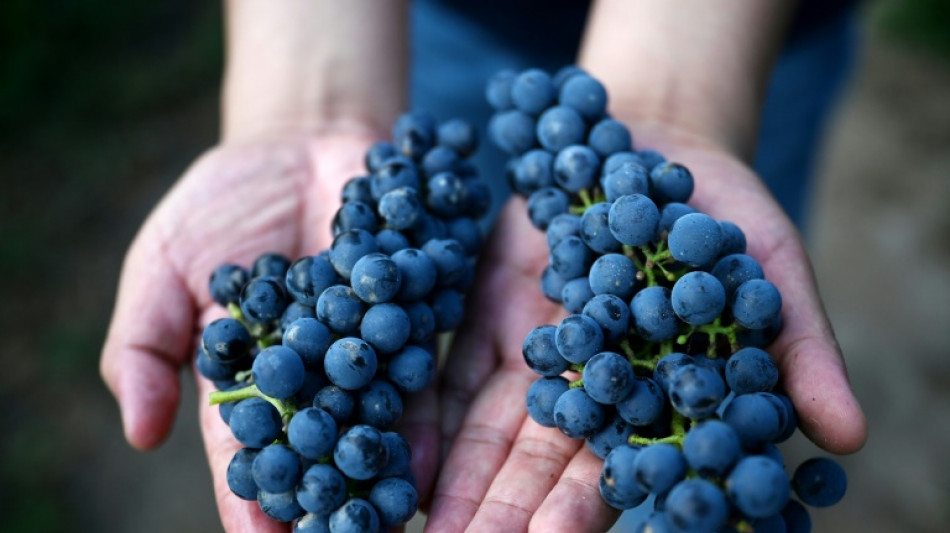
Women drive innovation, evolution of Chinese wine industry / Photo: GREG BAKER - AFP

 El Nino a 'terrifying' threat to coral reefs: UN biodiversity expert

 Barcola must get used to Liverpool highs and lows, says Iraola

 Versus Trade Wins Best ECN/STP Broker APAC 2026, Marking Third UF Awards Recognition

 Three dead as Istanbul sees heaviest rainfall in 80 years

 US producer prices see biggest jump since 2022 in added challenge to Trump

 Swiatek avoids seed exodus to breeze into Wuhan last eight

 PM condemns 'chaos' as violent protests grip Albania

 'I couldn't breathe', Russell Brand's alleged rape victim says

 Pope's cancer operation already reshaping papacy

 Zverev cruises past De Minaur to reach Shanghai semi-finals

 Ukraine's Zelensky defies Trump with Russian refinery strikes

 Holders Australia edge New Zealand 24-22 to open Rugby league World Cup

 'Ocarina of Time': Nintendo gives Zelda classic a modern makeover

 France charges teen shooter citing revenge for bullying in school

 Martinez blames 'anger' for dig at Man Utd hierarchy

 Crowds build as Albanian PM tours protest aftermath

 China-North Korea bridge opens, 12 years late

 Asian Cup in Saudi Arabia could be postponed but 'no hurry' to decide: AFC

 Conrad wields axe after South Africa loss to Australia

 School roof collapse kills teacher, 27 children in NW Pakistan

 Haze turns Indonesia skies orange, shuts schools in East Timor

 California puts first US billionaire tax to the vote

 School headscarf ban meets resistance in Austria

 World's top cocoa producer aims for a climate-tough bean

 Why is Shell facing lawsuits over climate disasters in Brazil and the Philippines?

As the female winemaker who put Chinese vintages on the map for the first time, Zhang Jing of Helan Qingxue winery is a trailblazer, but no anomaly.
From the dusty vineyards of China's outback to its chic metropolitan bars, women are at the forefront of the country's increasingly vibrant wine scene, spurring innovation at every stage of the production -- and consumption -- process.
Helan Qingxue sent shockwaves through the industry in 2011 when it produced the first Chinese wine to win top honours at the industry's most prestigious competition, even provoking unsubstantiated claims of fraud.
Over a decade later, Zhang is one of many Chinese women internationally recognised for their boutique, world-class bottles, as the fledgling sector continues to evolve.
"It's a very strong female-dominated industry here," Chinese wine expert Fongyee Walker told AFP.
"I don't think there's been any statistics done. But when I think about a lot of China's most famous wineries, they're run by women."
That's true in Zhang's home region, northern Ningxia, where tens of thousands of hectares of vines have been nestled into the terracotta earth beneath the Helan mountain range over the last few decades.
Aside from Helan Qingxue, many of its best-known producers -- Silver Heights, Kanaan Winery, Jade Vineyard -- are women-led.
"There are more and more excellent female winemakers (worldwide) now," Zhang said as she showed AFP around the winery's cool, dim cellar.
"But it's very interesting in Ningxia... Female owners and winemakers, female marketing staff and female receptionists probably make up more than 60 percent (of the workforce), so this proportion is quite large."
- 'Not a traditional industry' -
The Chinese industry's youth has helped women get a foothold, compared to more established wine-producing countries.
In the West, the sector "is very much dominated by male (figures) because it's a traditional industry", said Walker.
"For China, wine is not a traditional industry... It is a very safe sphere to open a company in if you're a woman."
In Ningxia, enthusiastic state support for the sector has meant an abundance of opportunities for anyone interested.
Zhang met her co-founders, former officials, when they worked together in local government.
When the two men asked Zhang -- then still in her twenties -- to be a winemaker for their retirement passion project, she agreed on the condition they send her abroad to study.
Many other young women did similarly, said Zhang, and when they returned, were among the best qualified to take advantage as the domestic wine scene picked up pace.
- 'Yin flourishing' -
Silver Heights' Emma Gao was one of the first Chinese women to obtain a degree in oenology. These days, her wines are served by President Xi Jinping to European leaders at state dinners.
Gao was sent to France's Bordeaux wine region by her father, who founded the vineyard.
"I think China is very tolerant of women, and we're even seeing a little bit of yin (the feminine force) flourishing and yang (the masculine) declining," Gao laughed.
Silver Heights' angular modern buildings are emblematic of its boundary-pushing nature.
It is China's first biodynamically certified vineyard, using natural techniques such as fertiliser made from manure-filled cow horns.
As well as more familiar tall metal cylinders, Gao's fermentation room contains smaller egg and vase-shaped vessels made of Ningxia clay.
"China is a relatively new production area, that is, its direction has not yet been determined," said Gao as she sampled her experiments, nodding approvingly.
"So we can try different planting methods, brewing methods, and fermentation in different containers."
That spirit of exploration has paid off.
A sparkling wine that incorporates local rice wine became a sell-out hit: "What every girl should have in her bag to take to a house party, because it has a good story to tell," Gao said.
- 'Living for themselves' -
Telling compelling stories about wine is influencer Zhu Lili's domain.
Livestreaming into three cameras in a Beijing restaurant, she described bottle after bottle with easy expertise -- her mother runs another award-winning winery.
Pop-up links allowed those of her two million followers watching to make immediate purchases.
Online sales are a significant source of revenue for producers -- and streamers like Zhu are key to capturing new consumers.
"Middle-aged mothers really love my videos because that's the life that they didn't have time to explore," said Zhu.
Learning about wine feels like "living for themselves".
China's classic alcohols -- beer and baijiu, a potent grain spirit -- are largely associated with and consumed by men.
But "the cultural way that wine is promoted here, it's very much a sophistication" that appeals to women, Walker said.
Female students are the overwhelming majority on wine courses, Walker and Zhang both noted.
Though men still buy more wine, said Zhu, women were more open to trying new things.
"For me, it's like how Chinese men and women treat fashion," said Sophie Zhou, who runs a trendy specialist bar among Beijing's historic alleyways.
Just as women are more likely to try out new season looks, her female customers "usually go for different glasses, so they can try different styles and tastes".
U.AlSharif--SF-PST