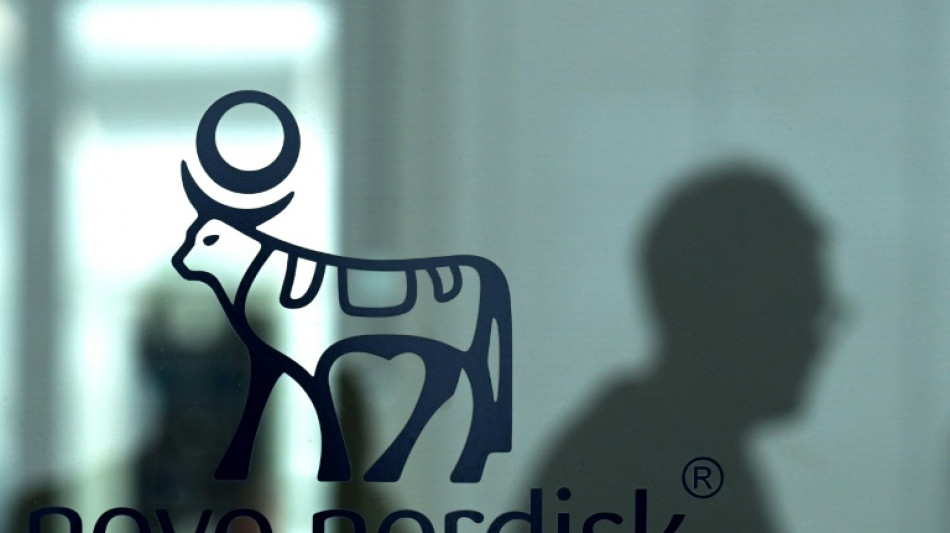
Weight loss drug safe, effective for under-12 kids: study / Photo: Sergei GAPON - AFP/File

 Lyon down Palace in Europa League, Sunderland leave it late

 UniCredit says receives ECB green light for Commerzbank takeover

 New York City pension fund asks Anthropic to delay IPO

 Venezuela's Maduro denies US torture charges as 'false accusations'

 Somalia sets May presidential election despite insecurity

 Chelsea's Caicedo eager to be more of a leader

 Rahm reaches separation deal with LIV in bankruptcy court

 UN chief urges nations to end 'war on nature'

 Newcastle boss Jaissle says Fernandez-Pardo just needs a goal
 Infantino offers apology but 'no answers' at FIFA meeting over World Cup plan

 Don't exclude Turkey from 'Made in Europe' plan: minister to AFP

 French duo Justice to score 'GTA VI': game maker

 El Nino a 'terrifying' threat to coral reefs: UN biodiversity expert

 Barcola must get used to Liverpool highs and lows, says Iraola

 Versus Trade Wins Best ECN/STP Broker APAC 2026, Marking Third UF Awards Recognition

 Three dead as Istanbul sees heaviest rainfall in 80 years

 US producer prices see biggest jump since 2022 in added challenge to Trump

 Swiatek avoids seed exodus to breeze into Wuhan last eight

 PM condemns 'chaos' as violent protests grip Albania

 'I couldn't breathe', Russell Brand's alleged rape victim says

 Pope's cancer operation already reshaping papacy

 Zverev cruises past De Minaur to reach Shanghai semi-finals

 Ukraine's Zelensky defies Trump with Russian refinery strikes

 Holders Australia edge New Zealand 24-22 to open Rugby league World Cup

 'Ocarina of Time': Nintendo gives Zelda classic a modern makeover

A weight loss drug has been found to be broadly safe and effective for children under 12 with obesity, according to a small study on Wednesday that was cautiously welcomed by outside experts.
A new class of weight loss drugs called GLP-1 agonists have become hugely popular across the world in the last couple of years, sparking stock shortages and widespread off-label use despite steep prices.
But little research has been conducted on how these new drugs work on young children.
Obesity in children and adolescents has quadrupled since 1990, according to the World Health Organization. Yet there are no regularly prescribed drugs which treat obesity in children.
The study looked at an older GLP-1 agonist called liraglutide, sold under the brand name Saxenda by Danish pharmaceutical giant Novo Nordisk, which also makes the blockbuster semaglutide drugs Ozempic and Wegovy.
The US-based phase 3 trial, which was funded by Novo Nordisk, was the first to investigate liraglutide's effect on under 12s.
It involved 82 children aged six to 12 with obesity, some of whom were randomly assigned a daily injection of liraglutide, while others received a placebo. The children were also encouraged to exercise and eat healthily.
After a little over a year, 46 percent of the children receiving the drug saw their body mass index (BMI) shrink by at least five percent, according to the study.
Only nine percent of the placebo group had such a reduction in BMI, which also takes into account height and was used because children at these ages grow quickly.
Some children taking the drug also reported side effects such as vomiting and nausea, which was in line with those experienced by adults, the researchers said.
Lead study author Claudia Fox of the University of Minnesota said that kids living with obesity are currently told to just "try harder with diet and exercise".
But these findings raise hopes that a drug could one day help these children "live healthier, more productive lives," she said in a statement.
- Stunted growth fear -
Stephen Burgess, a statistician at the University of Cambridge not involved in the research, said the study showed that drugs could "help change the trajectory of weight gain in young children".
"While receiving weight loss injections is clearly not the ideal solution to childhood obesity, reductions in body mass index for trial participants were sustained even beyond the duration of the treatment course," he told AFP.
Simon Cork, a researcher at the UK's Anglia Ruskin University, said that "the evidence that liraglutide is both safe and effective in children is positive".
But one concern about children taking weight loss drugs such as GLP-1 agonists which work by suppressing appetite is that this could risk stunting growth, he warned.
The new study showed no evidence this had occurred.
But Cork said that "further studies over longer time periods will need to be undertaken to ensure that appetite suppression in these children does not have unforeseen negative consequences later in their development".
The study was presented at the European Association for the Study of Diabetes being held in Madrid, and was also published in the New England Journal of Medicine.
B.Mahmoud--SF-PST