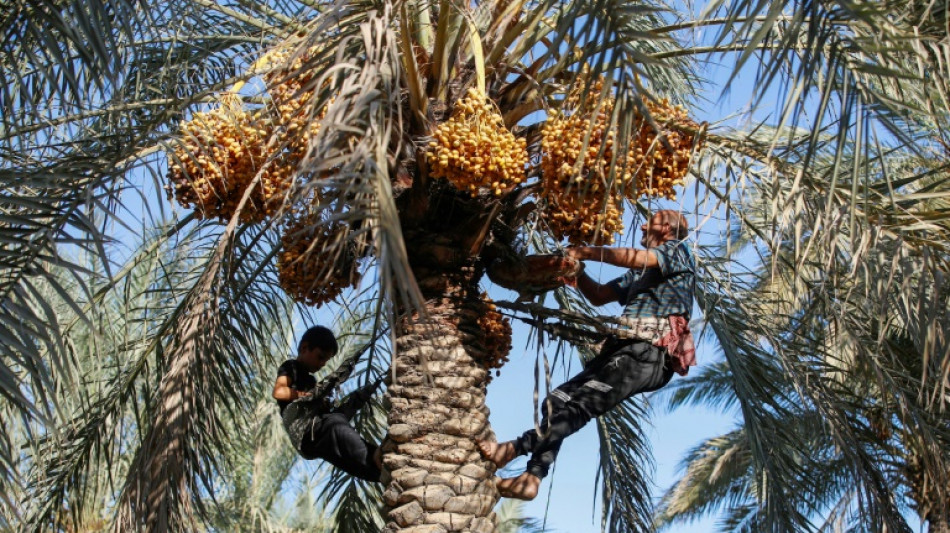
Iraqi date farmers fight drought to protect national treasure / Photo: AHMAD AL-RUBAYE - AFP

 Lyon down Palace in Europa League, Sunderland leave it late

 UniCredit says receives ECB green light for Commerzbank takeover
 New York City pension fund asks Anthropic to delay IPO

 Venezuela's Maduro denies US torture charges as 'false accusations'

 Somalia sets May presidential election despite insecurity
 Chelsea's Caicedo eager to be more of a leader

 Rahm reaches separation deal with LIV in bankruptcy court

 UN chief urges nations to end 'war on nature'

 Newcastle boss Jaissle says Fernandez-Pardo just needs a goal

 Infantino offers apology but 'no answers' at FIFA meeting over World Cup plan
 Don't exclude Turkey from 'Made in Europe' plan: minister to AFP

 French duo Justice to score 'GTA VI': game maker

 El Nino a 'terrifying' threat to coral reefs: UN biodiversity expert
 Barcola must get used to Liverpool highs and lows, says Iraola

 Versus Trade Wins Best ECN/STP Broker APAC 2026, Marking Third UF Awards Recognition

 Three dead as Istanbul sees heaviest rainfall in 80 years

 US producer prices see biggest jump since 2022 in added challenge to Trump
 Swiatek avoids seed exodus to breeze into Wuhan last eight
 PM condemns 'chaos' as violent protests grip Albania

 'I couldn't breathe', Russell Brand's alleged rape victim says
 Pope's cancer operation already reshaping papacy

 Zverev cruises past De Minaur to reach Shanghai semi-finals

 Ukraine's Zelensky defies Trump with Russian refinery strikes

 Holders Australia edge New Zealand 24-22 to open Rugby league World Cup

 'Ocarina of Time': Nintendo gives Zelda classic a modern makeover

Bare feet pressed against the rough trunk of a palm tree, his back supported by a metal and fabric harness, Ali Abed begins the climb to the dates above.
In Iraq, the date palm and its bounty are national icons, but they are being battered by drought.
Once known as the country of "30 million palm trees", Iraq's ancient date-growing culture had already suffered from upheaval, especially during the 1980-88 war with Iran, before climate change became a major threat.
In the still lush countryside of central Iraq, near Janajah village in Babylon province, hundreds of date palms stand tall and majestic, surrounded by vines and fruit trees.
During harvest season, the branches are heavy with clusters of yellow and red dates.
Rising at dawn to avoid the searing heat, harvesters climb the palms using only their upper body strength, aided by a harness and rope wrapped around the trunk.
"Last year, the orchards and the palm groves were thirsty; we almost lost them. This year, thanks to God, we had good water and a good harvest," said Abed, a 36-year-old farmer from Biramana, a village a few kilometres (miles) from Janajah.
Once at the top, they pick the ripe dates, filling baskets that are lowered to the ground and emptied into basins, which are then loaded onto lorries.
Abed noted, however, that the harvest is much smaller now -- about half of what it used to be. He once collected more than 12 tonnes but now brings in just four or five.
Abed criticised the lack of government support, saying aerial insecticide campaigns are not enough.
- 'Used to be paradise' -
Iraq has spent over a decade trying to revive the date palm, a vital economic asset and national symbol.
Authorities and religious institutions have launched programmes and mega-projects to encourage tree planting and growth.
An agriculture ministry spokesperson told the official INA news agency last month that, "for the first time since the 1980s", the number of date palms had risen to "more than 22 million", up from a low of just eight million.
During the Iran-Iraq War, palm groves were razed in vast areas along the border to prevent enemy infiltration.
Today, dates are Iraq's second-largest export product after oil, which dominates export revenues and generates more than $120 million, according to the World Bank.
In 2023, Iraq exported around 650,000 tonnes of dates, official statistics show.
Yet around Janajah, many palm trees lie dead and decapitated.
"All these palm trees are dead due to the drought; the whole region is suffering", said 56-year-old farmer Maitham Talib.
"Before, we had water. People irrigated abundantly. Now, we need complicated machinery", he said, observing the harvest.
The United Nations has labelled Iraq one of the five countries in the world most vulnerable to some of the effects of climate change.
The country has endured four consecutive years of drought, though this year saw some relief with winter rainfall.
Alongside rising temperatures that have hit 50 degrees Celsius (122 Fahrenheit) in summer and declining rainfall, Iraq also faces falling river levels, blamed on dams built upstream by Iran and Turkey.
Kifah Talib, 42, lamented the slow devastation wrought by the drought.
"It used to be paradise: apple, pomegranate, citrus trees and vines -- everything grew here", he said.
B.Khalifa--SF-PST