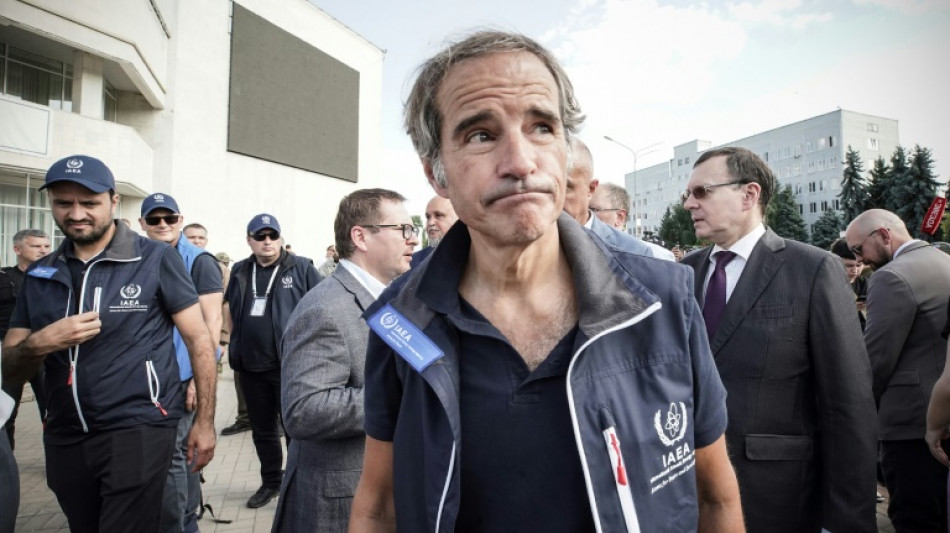
UN nuclear head at Russian plant warns over fighting / Photo: TATYANA MAKEYEVA - AFP

 'Multiple victims' in Oregon elementary school shooting: police
 ChangeNOW Announces NOW AI After Resolving Website Integration Vulnerability

 Argentine demonstration over education cuts ends in clashes
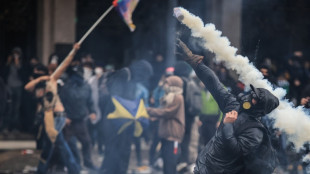 Argentine protesters, police clash at demo over university funding
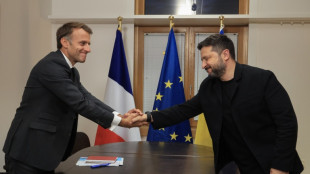
 US stocks end higher as AI shares stabilize
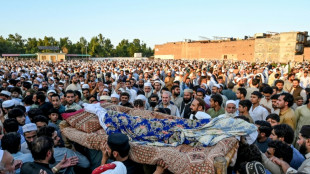 School roof collapse kills 32 children, teacher in Pakistan
 Lyon down Palace in Europa League, Sunderland leave it late

 UniCredit says receives ECB green light for Commerzbank takeover
 New York City pension fund asks Anthropic to delay IPO

 Venezuela's Maduro denies US torture charges as 'false accusations'

 Somalia sets May presidential election despite insecurity
 Chelsea's Caicedo eager to be more of a leader
 Rahm reaches separation deal with LIV in bankruptcy court
 UN chief urges nations to end 'war on nature'
 Newcastle boss Jaissle says Fernandez-Pardo just needs a goal

 Infantino offers apology but 'no answers' at FIFA meeting over World Cup plan
 Don't exclude Turkey from 'Made in Europe' plan: minister to AFP

 French duo Justice to score 'GTA VI': game maker
 El Nino a 'terrifying' threat to coral reefs: UN biodiversity expert
 Barcola must get used to Liverpool highs and lows, says Iraola

 Versus Trade Wins Best ECN/STP Broker APAC 2026, Marking Third UF Awards Recognition

 Three dead as Istanbul sees heaviest rainfall in 80 years

 US producer prices see biggest jump since 2022 in added challenge to Trump
 Swiatek avoids seed exodus to breeze into Wuhan last eight
 PM condemns 'chaos' as violent protests grip Albania

UN nuclear watchdog head Rafael Grossi on Tuesday warned during a visit to Russia's Kursk nuclear plant that its proximity to ongoing fighting was "extremely serious" following Ukraine's unprecedented cross-border offensive.
Grossi said his tour enabled him to "look at the most important parts" of the plant, which is less than 50 kilometres (30 miles) from fighting between Russian and Ukrainian forces.
"A nuclear power plant of this type so close to a point of contact or military front is an extremely serious fact," Grossi said after visiting the plant.
"The fact we have military activity a few kilometres, a few miles away from here, make it an immediate point of attention," he added.
"At the end of the day, again, this may sound common sense and simple: Don't attack a nuclear power plant."
He said he was in "close contact" with Russian authorities and would visit Kyiv next week to talk to Ukrainian President Volodymyr Zelensky, adding it was "important to talk" and "keep dialogue".
He added the Kursk power plant currently was "operating in a very close to normal conditions".
The International Atomic Energy Agency (IAEA) has repeatedly warned of the dangers of fighting around nuclear plants following Russia's full-scale military offensive into Ukraine in February 2022.
In the first days of the conflict, Russian forces seized the Zaporizhzhia nuclear plant in southern Ukraine, and also briefly held the decommissioned Chernobyl plant in the north.
Ukraine launched its surprise incursion into Kursk on August 6 and has said it is making advances, even as Russian forces move deeper into eastern Ukraine.
Russian President Vladimir Putin last week accused Ukraine of trying to attack the Kursk nuclear power plant, with drone fragments found near its spent nuclear fuel storage facility.
"I was informed about the impact of drones, I was shown some of the remnants of those, signs of impact they had," Grossi said on Tuesday.
- 'Like building across street' -
Before his mission, Grossi had said he wanted to "independently assess what is happening" at the plant, "given the serious situation".
The plant lies some 60 kilometres from the Russia-Ukraine border, next to the Seym river, and less than 50 kilometres away from Kursk city, the region's capital with a population of around 440,000.
The plant has four reactor units -- in addition to two under construction -- though only two are operational. Two others have been shut down.
All four reactors are the same type as Ukraine's Chernobyl nuclear power plant, without a protecting dome around them.
"Equating Chernobyl with Kursk is an exaggeration. But this is the same type of reactor and there is no specific protection," Grossi said.
"This is unlike other reactors in the world, where you have the typical dome. This is completely different, this is like the building across the street -- with all this nuclear material."
He also warned as the plant was operating "the temperature is much higher and if there was the case of an impact or something that could affect it there would be serious consequences".
In 1986, a reactor at Chernobyl exploded during a botched safety test, resulting in the world's worst nuclear accident that sent clouds of radiation across much of Europe and forced tens of thousands of people to evacuate.
Tariq Rauf, a former IAEA official, said these types of reactors have since undergone "significant safety upgrades".
Robert Kelley, a former IAEA director of inspections, said: "The possibility of a Chernobyl-type incident with the reactor blowing up and burning for days is zero."
But he added that an errant bomb or large artillery strike on spent fuel storage ponds could damage the fuel and release radioactive gases and particles.
- 'Maximum restraint' -
Russia has repeatedly sounded the alarm over a possible hit since Ukrainian troops and tanks stormed into Kursk.
The IAEA urged both Russia and Ukraine to exercise "maximum restraint" to "avoid a nuclear accident with the potential for serious radiological consequences".
Zelensky has said Ukrainian forces have captured dozens of settlements and continue to make advances in Kursk. More than 130,000 people have been displaced so far.
Kyiv has said the offensive aims to prevent cross-border strikes from Russia into its Sumy region and to force Russia to the negotiating table "on our own terms".
E.Qaddoumi--SF-PST