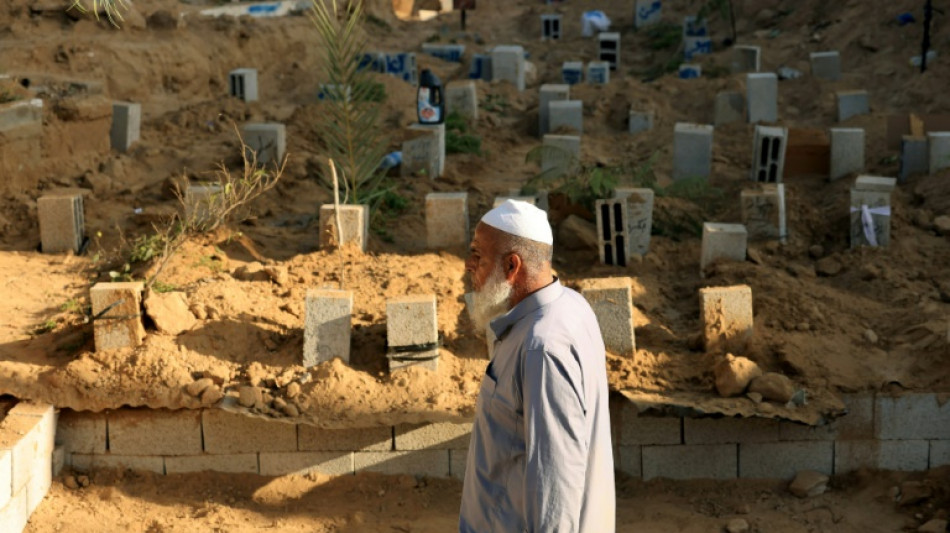
Gaza's overwhelmed undertakers stack 'graves on top of graves' / Photo: MAHMUD HAMS - AFP

 Man Utd teetering towards crisis as Man City cloud hangs over Premier League

 Trump's new press secretary defends 'lawyer' title

 Wallabies coach has 'faith' as All Blacks juggernaut awaits

 Ailing UK director Mike Leigh wishes he could make '100 more films'

 Pixagram Announces Free Account Creation for 250 New Users Daily Through 2026
 Macron warns urgent to strike EU budget deal before French vote runup
 Zelensky rallies European allies as Trump ties slump

 Guardians edge Rays to seize MLB playoff series lead
 Trump scraps plan to livestream execution after fierce backlash

 Martinez apologises for outburst at Man Utd hierarchy

 Houthis launch deadly attack on presidential palace in Yemen's Aden

 Brazil forward Antony says home burgled during Betis match
 Ravens face familiar foe in Browns coach Monken
 France, Germany reach deal on future of car industry

 Carney campaigns for Canadian unity before Alberta secession vote

 ATP proposes rankings system changes, extra player bonuses

 Russell Brand was 'monster-like', alleged victim tells UK court

 Crowded Launches Crowded MCP, Bringing Nonprofit Financial Operations Into ChatGPT and Claude

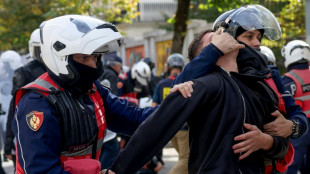 Albanian PM condemns 'chaos' as violent unrest spreads

 Italian football suffers new blow with Champions League misery

 Trump scraps plan to livestream execution after broad backlash

 Seven missing off Romania after latest Black Sea drone attacks

 ARKBRIDGE Outlines Jonathan Morelli’s “Picks and Shovels” AI Infrastructure Investment Strategy

 Tech sell-off rolls on as hot inflation data stokes rate worries
 McIlroy makes 'solid' start in rain-hit Delhi as Norgaard leads

Undertakers are working like bricklayers in a Gaza cemetery, piling cinder blocks into tight rectangles, side by side, for freshly dug graves.
More than 10 months into the Gaza war, so many bodies are arriving at the cemetery in Deir el-Balah that the men, working in the hot sun, hardly have space to bury them.
"The cemetery is so full that we now dig graves on top of other graves, we've piled the dead in levels," says Saadi Hassan Barakeh, leading his team of gravediggers.
Barakeh, 63, has been burying the dead for 28 years. In "all the wars in Gaza", he says he has "never seen this".
Previously, Barakeh also oversaw burials at the nearby Ansar cemetery, which covers 3.5 hectares (8.6 acres).
But now "the Ansar cemetery is completely full. There were too many dead", he says, his clothes smeared in dirt from digging graves.
He now handles just the Al-Soueid cemetery, with its 5.5 hectares of graves. Yet even with one cemetery instead of two, he works "every day, from six in the morning to six in the evening".
"Before the war, we had one or two funerals per week, maximum five," he says, wearing a white prayer cap that matches his long beard.
"Now, there are weeks when I bury 200 to 300 people. It's unbelievable."
- 'I can't sleep' -
Gaza's death toll of just over 40,000 in more than 10 months of war, according to the Hamas-run territory's health ministry, is straining its people as well as its cemeteries.
Barakeh bears daily witness to the tragedies. Hoe in hand, he gives encouragement to his 12 workers as they prepare and close dozens of graves every day.
At night, however, some images are hard to forget.
"I can't sleep after seeing so many mangled children's bodies and dead women," he said, adding: "I buried 47 women from one family."
The October 7 Hamas attack which triggered the war resulted in the deaths of 1,198 people, mostly civilians, according to an AFP tally of Israeli official figures.
Militants also seized 251 people, 111 of whom are still held in Gaza, including 39 the military says are dead.
Israel's retaliatory military offensive has killed at least 40,005 people in Gaza, according to the health ministry, which does not provide a breakdown of civilian and militant deaths.
"I buried a lot of women and children, and only two or three guys from Hamas," says Barakeh.
- 'Why the children?' -
If Israelis "have a problem with (Yahya) Sinwar, why do they harm children?" he adds, referring to the alleged October 7 attacks mastermind who is now Hamas's overall leader.
"Let them kill Sinwar and all the others, but why the women and children?"
Mounds of freshly dug soil are reminders of recent burials. Graves with white headstones fill nearly all the available space, while men dig new holes in the few vacant areas.
The team forms a human chain to carry the cinder blocks, whose price has soared since Gaza's factories closed due to a lack of fuel and raw materials.
"One shekel ($0.27) before the war, 10 or 12 today," he lamented.
Besides gravediggers and the workers carrying cinder blocks, hardly anyone comes to funerals anymore, Barakeh says.
"Before the war, there were sometimes 1,000 people at one funeral; today there are days when we bury 100 people and there aren't even 20 to lay them to rest."
High above his head, the constant hum of an Israeli surveillance drone serves as a reminder of the aerial threat creating a steady stream of bodies.
N.Shalabi--SF-PST