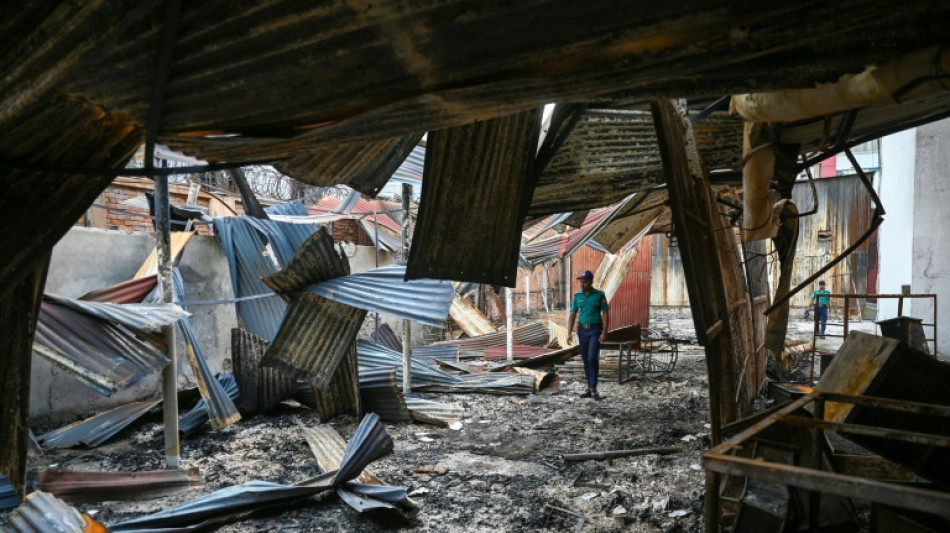
Burned TV station showcases anger at Bangladesh PM / Photo: Munir UZ ZAMAN - AFP

 Trump's new press secretary says China lacked 'proper' toilets
 India closes down New Delhi park ahead of 'cockroach' movement rally
 'Let us build': World Bank chief outlines jobs-led development agenda
 Broncos top Super Bowl champion Seahawks in overtime
 Brilliant Brewers sweep Dodgers to reach World Series

 Brewers complete Dodgers sweep to reach World Series
 High-flying Freiburg try to shut out the noise as fairytale run continues
 Flamengo secure 0-0 draw in La Plata in Copa Libertadores semi
 The final lap? Two days on the campaign trail with Trump
 Asian stocks rise as tech bounces from rout, eyes on Warsh
 Saudi organisers say 2027 Asian Cup 'on schedule' after attacks
 Right-wing Brazil influencers on 'mission' to seal Bolsonaro win

 Using AI to help find Mexico's legions of missing children

 Fiji to deploy solar-powered Australian military drones at sea
 'Multiple victims' in Oregon elementary school shooting, police say
 'Multiple victims' in Oregon elementary school shooting: police
 ChangeNOW Announces NOW AI After Resolving Website Integration Vulnerability

 Argentine demonstration over education cuts ends in clashes
 Argentine protesters, police clash at demo over university funding
 US stocks end higher as AI shares stabilize

 School roof collapse kills 32 children, teacher in Pakistan
 Lyon down Palace in Europa League, Sunderland leave it late

 UniCredit says receives ECB green light for Commerzbank takeover
 New York City pension fund asks Anthropic to delay IPO

 Venezuela's Maduro denies US torture charges as 'false accusations'

Torn portraits of Bangladesh's independence hero litter a ransacked state television station -- a pointed expression of public fury against his daughter, who just witnessed the worst unrest of her premiership.
Prime Minister Sheikh Hasina addressed the nation on Bangladesh Television (BTV) last week to appeal for calm, just as a police crackdown on student protests was poised to tip into violent disorder.
The next day a mob of hundreds stormed the state broadcaster and set fire to an office building, along with dozens of other government and police posts around the capital Dhaka.
They also attacked a gallery hosting around 150 portraits of the premier's father Sheikh Mujibur Rahman, who led the country after its devastating 1971 liberation war with Pakistan until his assassination four years later.
"This is a war zone," Bangladeshi information minister Mohammad Ali Arafat told reporters invited by the government and BTV to survey the destruction on Wednesday.
He gestured to oil paintings of Rahman strewn on the ground, disfigured by knives used to stab through the leader's face.
"Does this look like a peaceful protest to you?"
Mujib's nationbuilding role has been both lauded and dismissed by successive Bangladesh governments, with memories of the war and famine that birthed the country still polarising its people more than half a century since independence.
But Hasina has foregrounded her father's legacy to such an extent that critics accuse her of establishing a personality cult designed to entrench her rule.
Since she took office a second time in 2009, Mujib's image has appeared on every banknote and in hundreds of public murals across the South Asian nation of 170 million people.
Portraits like those in BTV's Dhaka headquarters are not only commonplace, but a legal requirement: Hasina's government changed the constitution to require that they be hung in every school, government office and diplomatic mission.
During Hasina's speech on BTV last week, given in a failed effort to quell the rising tensions soon to unleash mayhem across Bangladesh, several portraits of her father hung around her office appeared on the broadcast.
- 'Secular blasphemy law' -
The unrest began last week when the youth wing of Hasina's ruling Awami League and police officers attempted to suppress running student demonstrations against job quotas for civil servant hires.
The scheme was introduced by Hasina's father in 1972 and until Sunday reserved nearly a third of all government jobs for the families of veterans from the independence war with Pakistan.
Hasina, 76, inflamed by likening protesters to the Bangladeshis who had collaborated with Pakistan during that conflict.
The premier won her fourth consecutive election in January after a vote without genuine opposition.
Her government is accused by rights groups of misusing state institutions to entrench its hold on power and stamp out dissent, including by the extrajudicial killing of opposition activists.
Hasina's father casts a long shadow over her own leadership: she refers to his assassination in a 1975 coup in almost every speech she gives, her voice often choking with emotion.
The military regime that followed did its best to sideline Mujib's contribution to the country entirely, but even considered at a remove from Bangladesh's deeply polarised politics, his legacy remains complex.
Towards the end of his life, Mujib abolished multi-party democracy and imposed media restrictions that shuttered all but four state-controlled newspapers.
Hasina's critics often evoke autocratic parallels between Mujib and his daughter.
One senior human rights activist in Bangladesh said, on condition of anonymity for fear of retribution, that the now-ubiquitous presence of Mujib's portrait in public spaces made the country resemble "one-party states".
"She has basically introduced a secular blasphemy law in the country for her father," the activist told AFP in January.
T.Khatib--SF-PST