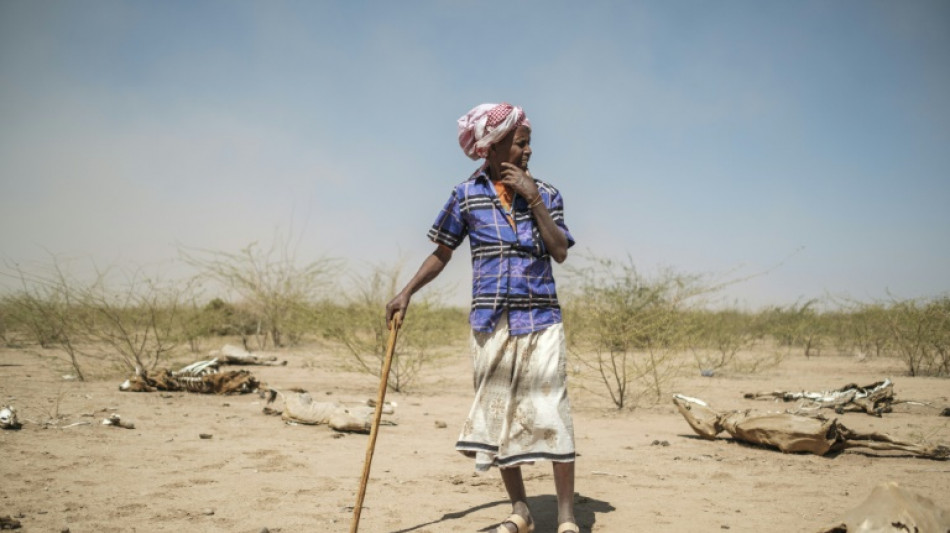
War, economic chaos defied drive to end hunger in 2023: UN / Photo: EDUARDO SOTERAS - AFP

 Trump's new press secretary says China lacked 'proper' toilets

 India closes down New Delhi park ahead of 'cockroach' movement rally

 'Let us build': World Bank chief outlines jobs-led development agenda

 Broncos top Super Bowl champion Seahawks in overtime

 Brilliant Brewers sweep Dodgers to reach World Series

 Brewers complete Dodgers sweep to reach World Series

 High-flying Freiburg try to shut out the noise as fairytale run continues

 Flamengo secure 0-0 draw in La Plata in Copa Libertadores semi

 The final lap? Two days on the campaign trail with Trump

 Asian stocks rise as tech bounces from rout, eyes on Warsh

 Saudi organisers say 2027 Asian Cup 'on schedule' after attacks

 Right-wing Brazil influencers on 'mission' to seal Bolsonaro win

 Using AI to help find Mexico's legions of missing children

 Fiji to deploy solar-powered Australian military drones at sea

 'Multiple victims' in Oregon elementary school shooting, police say

 'Multiple victims' in Oregon elementary school shooting: police

 ChangeNOW Announces NOW AI After Resolving Website Integration Vulnerability

 Argentine demonstration over education cuts ends in clashes

 Argentine protesters, police clash at demo over university funding

 US stocks end higher as AI shares stabilize

 School roof collapse kills 32 children, teacher in Pakistan

 Lyon down Palace in Europa League, Sunderland leave it late

 UniCredit says receives ECB green light for Commerzbank takeover

 New York City pension fund asks Anthropic to delay IPO

 Venezuela's Maduro denies US torture charges as 'false accusations'

Conflict, economic turbulence and extreme weather scuppered efforts to curb hunger last year, with around nine percent of the world's population affected, UN agencies said on Wednesday.
About 733 million people may have faced hunger in 2023, a level that has held steady for three years after a steep rise following the Covid-19 pandemic, they said in a report.
But the picture is uneven. While hunger affected one in every five people in Africa, compared with a global average of one in 11, Latin America and the Caribbean progressed and Asia stalled in the goal of eliminating undernourishment.
The broader goal of securing regular access to adequate food for everyone also stalled in that period.
Moderate or severe food insecurity, which forces people to occasionally skip meals, hit 2.33 billion people last year -- almost 29 percent of the global population.
The report by the Food and Agriculture Organization, the International Fund for Agricultural Development, UNICEF, the World Food Programme and the World Health Organization suggests the UN goal of a world without hunger by 2030 is fading further.
Conflicts, climate chaos and economic downturns are already known as major drivers of food insecurity and malnutrition that combine with underlying factors including persistent inequality, the unaffordability of healthy diets and unhealthy food environments.
But these major drivers are becoming more frequent and intense -- and occurring concurrently more often -- meaning more people are exposed to hunger and food insecurity, the report said.
A healthy diet was unaffordable for more than one third of the world's population in 2022, the report added, citing updated estimates.
Here too regional inequalities were stark: more than 71 percent of people in low-income countries could not afford healthy diets, compared with just over six percent in high-income nations.
- 'No time to lose' -
According to David Laborde, an economist at the Food and Agriculture Organization and one of the report's authors, the post-Covid economic rebound was unequal within and between countries.
Wars and extreme weather events also raged unabated in 2023, but the world has failed to put in place a "Marshall Plan" to bolster funds earmarked for fighting hunger, he told AFP.
The UN agencies' report, which was presented for a G20 summit in Brazil, suggested a major reform of financing food security and nutrition to alleviate the scourge.
This would start with adopting common definitions putting all actors on the same page. According to current estimates, between $176 billion and $3,975 billion are needed to eradicate hunger by 2030.
Yet the "highly fragmented" financial architecture "makes the scale-up and effective implementation of financing for food security and nutrition unfeasible", the report said.
Donors, international agencies, NGOs and foundations must coordinate better as the current set-up lacks shared priorities and is characterised by "an over-proliferation of actors delivering mostly small, short-term projects", it added.
Food security and nutrition is not simply a question of "distributing bags of rice in emergency situations", Laborde said, but also aid to small-scale farmers and access to energy in rural areas that could electrify irrigation systems.
Another weakness of the current system is that donor intentions do not always meet the needs of populations, according to the report.
Debates over animal husbandry in some European countries may discourage investment in intensifying it in Africa, which is necessary, said Laborde.
He pointed to Africa's Sahel region, where chronic instability and military coups have seen donors suspend their aid just as the population needs it most.
The report also recommended developing financial instruments combining private and public funds so that private actors invest in food security, a source of productivity and political stability.
"There is no time to lose, as the cost of inaction greatly exceeds the cost of action this report calls for," it concluded.
Y.AlMasri--SF-PST