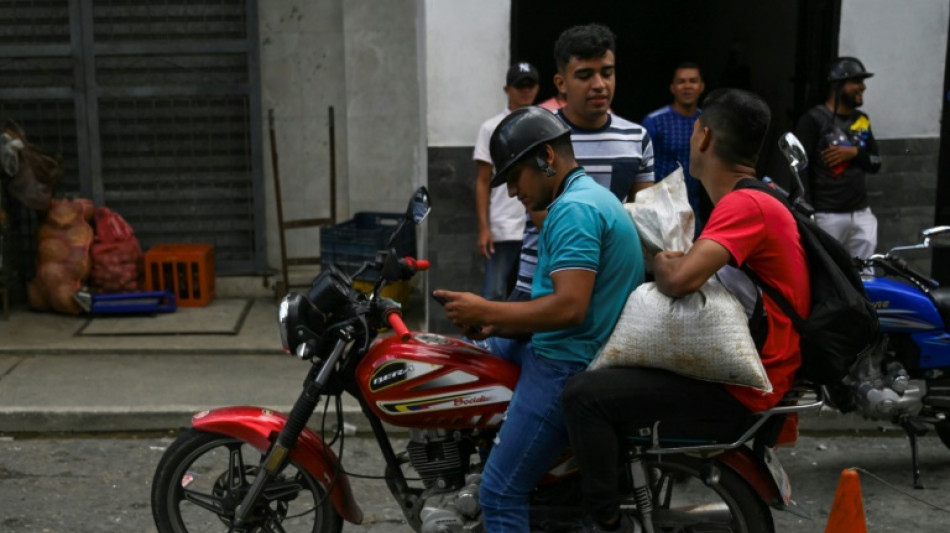
Rural Venezuela bearing the brunt of economy in ruins / Photo: Juan BARRETO - AFP

 Trump's new press secretary says China lacked 'proper' toilets

 India closes down New Delhi park ahead of 'cockroach' movement rally
 'Let us build': World Bank chief outlines jobs-led development agenda

 Broncos top Super Bowl champion Seahawks in overtime

 Brilliant Brewers sweep Dodgers to reach World Series

 Brewers complete Dodgers sweep to reach World Series
 High-flying Freiburg try to shut out the noise as fairytale run continues

 Flamengo secure 0-0 draw in La Plata in Copa Libertadores semi

 The final lap? Two days on the campaign trail with Trump
 Asian stocks rise as tech bounces from rout, eyes on Warsh

 Saudi organisers say 2027 Asian Cup 'on schedule' after attacks

 Right-wing Brazil influencers on 'mission' to seal Bolsonaro win

 Using AI to help find Mexico's legions of missing children

 Fiji to deploy solar-powered Australian military drones at sea

 'Multiple victims' in Oregon elementary school shooting, police say

 'Multiple victims' in Oregon elementary school shooting: police

 ChangeNOW Announces NOW AI After Resolving Website Integration Vulnerability

 Argentine demonstration over education cuts ends in clashes

 Argentine protesters, police clash at demo over university funding

 US stocks end higher as AI shares stabilize

 School roof collapse kills 32 children, teacher in Pakistan

 Lyon down Palace in Europa League, Sunderland leave it late

 UniCredit says receives ECB green light for Commerzbank takeover
 New York City pension fund asks Anthropic to delay IPO

 Venezuela's Maduro denies US torture charges as 'false accusations'

Shortages of fuel and electricity, hospitals in ruins and impassable roads: outside the relative comfort of Caracas, years of economic crisis have taken their toll on rural Venezuela.
The only thing these abandoned communities have in abundance is electoral promises in the run-up to Sunday's presidential vote.
Incumbent Nicolas Maduro, seeking a third six-year term, has offered to repair schools and clinics, as well as build houses in the dozens of towns and villages he has campaigned in.
But for the residents of places like Biscucuy, a coffee-growing region in the western Portuguesa state, it is hard to imagine an escape from their daily misery.
"The economy in the village is not easy," laments Jose Gregorio Mejia, a 56-year-old mechanic, as he wipes his hands on oil-covered clothes.
Mejia needs surgery for a urinary obstruction but the local hospital, with its derelict facade, does not have the materials to do the operation.
Against his doctor's orders, he goes out to work every day with the goal of earning between two and four dollars for his efforts.
Blackouts of up to four hours a day are common in this region of 50,000 people.
The roads between Biscucuy's coffee farms are full of potholes and when it rains they become muddy traps.
"We used to say: 'Let's start working young so that we can live happily in old age.' Now we can't say that because this government cut our pensions," said 62-year-old Rosa de Madrid.
The retired teacher only makes ends meet thanks to financial support sent by her daughter from the United States.
- 'We are drowning' -
Maduro blames Venezuela's economic woes on US sanctions imposed after dozens of Western and Latin American states refused to recognize his 2018 reelection due to alleged fraud.
But residents and experts say the collapse began much earlier, with the petro-state's all important oil industry collapsing under corruption and mismanagement.
Many in rural Venezuela feel they are overlooked in favor of Caracas, where electricity blackouts are less frequent and there is fuel and food, though even the capital has not been spared the rise in poverty.
Biscucuy harvests between 60 and 70 percent of Venezuela's coffee but production has become increasingly difficult.
The Hernandez family, for example, does not have fuel to run their coffee-drying machine or to transport it to the village.
There is a shortage of fertilizer and coffee growers complain about the price the government pays them for their product -- sometimes $80 for a quantity that trades for $200 on the international markets.
"We are drowning because we have no resources," said Migdalis Hernandez, 53, who runs the family farm.
To produce the targeted 3,680 kilograms (8,113 pounds) of coffee per year, they must spend about $800 on diesel -- money they do not have.
Coffee farmers increasingly use part of their production to barter for food as Venezuela faces one of the world's highest inflation rates and a sharp devaluation of the local currency, the bolivar.
- 'A poor diet' -
Rafael Hernandez -- not related to Migdalis -- told AFP he has no choice but to exchange some of his coffee production for basics such as corn flour, pasta, sugar and vegetable oil. He cannot spare enough for meat or chicken.
"Us coffee growers have a poor diet," Hernandez told AFP.
The mayor of Biscucuy, Jobito Villegas, estimates that "between 5,000 and 10,000 (inhabitants) have left the community" in recent years as life has become increasingly tough.
"The young are gone and we're left with the old. We're losing our workforce," he said. "Before it was the rural exodus that went from Biscucuy to Caracas, now they go from Biscucuy to the United States."
Some seven million of the once-rich country's citizens have left since Maduro came to power in 2013, as GDP fell by 80 percent in less than a decade.
Migdalis Hernandez still clings to her farm.
"It is what we have, it is the inheritance. It is what our parents left us, it is our economy, how do we leave it?" she said.
I.Saadi--SF-PST