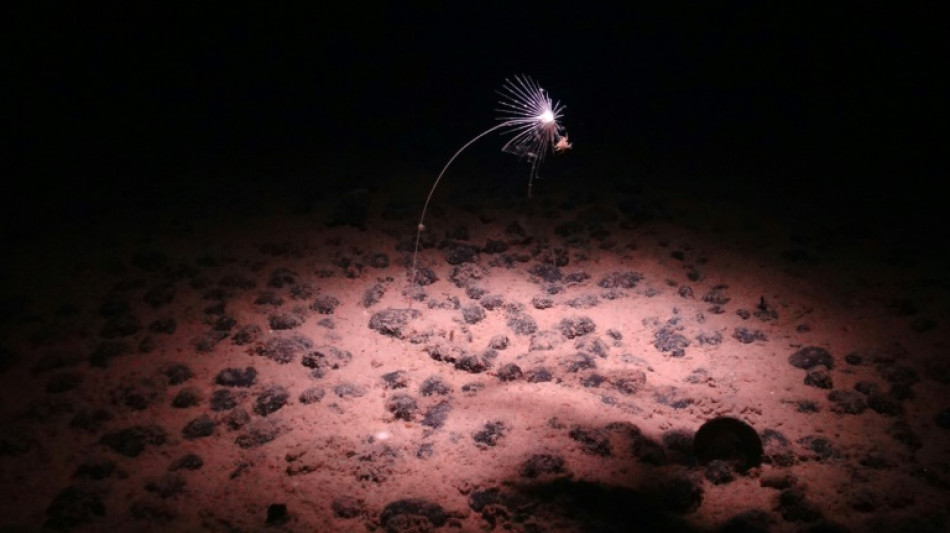
Deep ocean 'dark oxygen' find could rewrite Earth's history / Photo: Handout - National Oceanography Centre / Smartex project (NERC)/AFP/File

 Trump's new press secretary says China lacked 'proper' toilets

 India closes down New Delhi park ahead of 'cockroach' movement rally

 'Let us build': World Bank chief outlines jobs-led development agenda
 Broncos top Super Bowl champion Seahawks in overtime

 Brilliant Brewers sweep Dodgers to reach World Series

 Brewers complete Dodgers sweep to reach World Series

 High-flying Freiburg try to shut out the noise as fairytale run continues

 Flamengo secure 0-0 draw in La Plata in Copa Libertadores semi
 The final lap? Two days on the campaign trail with Trump

 Asian stocks rise as tech bounces from rout, eyes on Warsh

 Saudi organisers say 2027 Asian Cup 'on schedule' after attacks

 Right-wing Brazil influencers on 'mission' to seal Bolsonaro win

 Using AI to help find Mexico's legions of missing children

 Fiji to deploy solar-powered Australian military drones at sea

 'Multiple victims' in Oregon elementary school shooting, police say

 'Multiple victims' in Oregon elementary school shooting: police

 ChangeNOW Announces NOW AI After Resolving Website Integration Vulnerability

 Argentine demonstration over education cuts ends in clashes

 Argentine protesters, police clash at demo over university funding

 US stocks end higher as AI shares stabilize

 School roof collapse kills 32 children, teacher in Pakistan

 Lyon down Palace in Europa League, Sunderland leave it late

 UniCredit says receives ECB green light for Commerzbank takeover

 New York City pension fund asks Anthropic to delay IPO

 Venezuela's Maduro denies US torture charges as 'false accusations'

In the total darkness of the depths of the Pacific Ocean, scientists have discovered oxygen being produced not by living organisms but by strange potato-shaped metallic lumps that give off almost as much electricity as AA batteries.
The surprise finding has many potential implications and could even require rethinking how life first began on Earth, the researchers behind a new study said on Monday.
It had been thought that only living things such as plants and algae were capable of producing oxygen via photosynthesis -- which requires sunlight.
But four kilometres (2.5 miles) below the surface of the Pacific Ocean, where no sunlight can reach, small mineral deposits called polymetallic nodules have been recorded making so-called dark oxygen for the first time.
The discovery was made in the Clarion-Clipperton Zone (CCZ), an abyssal plain stretching between Hawaii and Mexico, where mining companies have plans to start harvesting the nodules.
The lumpy nodules -- often called "batteries in a rock" -- are rich in metals such as cobalt, nickel, copper and manganese, which are all used in batteries, smartphones, wind turbines and solar panels.
The international team of scientists sent a small vessel to the floor of the CCZ aiming to find out how mining could impact the strange and little understood animals living where no light can reach.
- No sunlight required -
"We were trying to measure the rate of oxygen consumption by the seafloor," lead study author Andrew Sweetman of the Scottish Association for Marine Science (SAMS) told AFP.
To do so, they used a contraption called a benthic chamber which snatched up a bunch of sediment.
Normally, the amount of oxygen trapped in the chamber "decreases as its used up by organisms as they respire," Sweetman said.
But this time the opposite happened -- the amount of oxygen increased. This was not supposed to happen in complete darkness where there is no photosynthesis.
This was so shocking that the researchers initially thought their underwater sensors must have been on the blink.
So they brought up some nodules to their ship to repeat the test. Once again, the amount of oxygen increased.
They then noticed how the nodules were carrying a startling electric change.
On the surface of the nodules, the team "amazingly found voltages almost as high as are in an AA battery," Sweetman said.
This charge could split seawater into hydrogen and oxygen in a process called seawater electrolysis, the researchers said.
This chemical reaction occurs at around 1.5 volts -- around the charge of a AA battery.
- 'Exciting' -
SAMS director Nicholas Owens said it was "one of the most exciting findings in ocean science in recent times".
The discovery of oxygen produced outside of photosynthesis "requires us to rethink how the evolution of complex life on the planet might have originated," he said in a statement.
"The conventional view is that oxygen was first produced around three billion years ago by ancient microbes called cyanobacteria and there was a gradual development of complex life thereafter," Owens added.
But the team's discovery showed that "life could have started elsewhere than on land," Sweetman said.
"And, if the process is happening on our planet, could it be helping to generate oxygenated habitats on other ocean worlds such as Enceladus and Europa and providing the opportunity for life to exist?" Sweetman asked.
The study was published in the journal Nature Geoscience.
The work was partly funded by Canada's The Metals Company, which is aiming to start mining the nodules in the CCZ next year.
P.AbuBaker--SF-PST