'Unnoticed, catastrophic': Rising opioid fears in Eastern Europe / Photo: Don EMMERT - AFP/File

 Millions may be forced to move as climate change hits South Asia: UN

 Four killed battling Indonesia fires as toxic haze cloaks region

 Thai farmers, fishermen challenge IMF, World Bank at Bangkok rally

 In Malaysia, frustration grows over Indonesia haze

 Why India's voter revision drive has stoked fear and anger

 Munster eye fitting tribute to 'special' Foley in Racing reunion

 Shooter kills teacher, three children at Oregon elementary school

 Fed's Warsh surprised by world economy's 'resilience'

 Four killed in Indonesia battling fires causing toxic haze

 New Zealand star Ponga breaks arm in Rugby League World Cup opener

 Indonesian stocks dive 11% as MSCI weighs market reclassification

 Seoul dismisses Pyongyang's scepticism over hypersonic weapon test

 Yamal on song as entertainers Barcelona face Betis challenge

 Wong weighs haze prosecutions as Singapore air quality worsens

 Brush fire prompts an evacuation order along Los Angeles coast

 'Mixed feelings': AI cracks centuries-old ciphers

 Le Pen looms large as Macron enters final months on EU stage

 Three children, one teacher killed in Oregon elementary school shooting

 Man Utd teetering towards crisis as Man City cloud hangs over Premier League

 Trump's new press secretary defends 'lawyer' title

 Wallabies coach has 'faith' as All Blacks juggernaut awaits

 Ailing UK director Mike Leigh wishes he could make '100 more films'

 Pixagram Announces Free Account Creation for 250 New Users Daily Through 2026

 Macron warns urgent to strike EU budget deal before French vote runup

 Zelensky rallies European allies as Trump ties slump

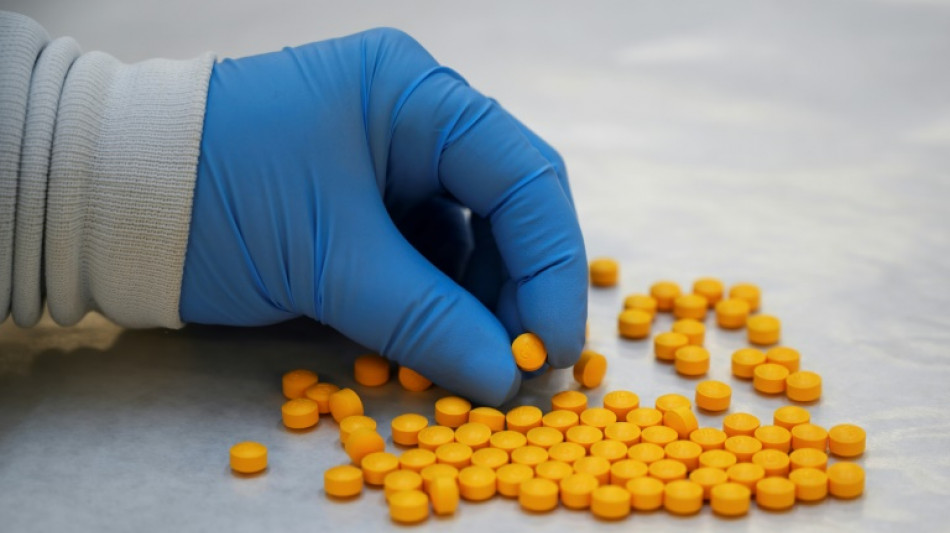
Eastern Europe, once seen as immune to the opioid crisis wreaking havoc across North America, has been ramping up its fight against the rise of the dangerous, synthetic drugs.
There have been dozens of deaths and many more arrests in Poland this year linked to synthetic drugs, including mephedrone -- an alternative to cocaine -- as well as fentanyl and nitazenes.
Poland's Central Investigation Bureau of Police has dismantled 33 illegal synthetic drug "factories" this year, according to its spokesman Krzysztof Wrzesniowski.
Two of them were exclusively producing mephedrone, used to replace cocaine at a cheaper cost.
Aside from causing problems in Poland, media reports found that such laboratories were also found to be exporting drugs throughout the European Union, including to the neighbouring Czech Republic and Slovakia.
"It is a constant race between criminals who produce these substances... and laboratories and the sanitary inspection," Poland's Chief Sanitary Inspector Pawel Grzesiowski said.
"They are constantly looking for new substances, new varieties."
- 'Crooked drug business' -
Zuromin, a town of about 9,000 people two hours north of Warsaw, has been named the region's unofficial fentanyl capital.
For some, it is reminiscent of small towns in the United States which were the first to fall victim to the country's opioid epidemic.
In June, local police seized a total of 300 patches of the drug, capable of intoxicating 4,800 people, and arrested four people suspected of involvement in the illegal fentanyl trade.
But for the town's residents, this is not a new problem.
"From the beginning, the problem seemed to me to be marginalised, unnoticed, catastrophic," Adam Ejnik, a teacher and journalist from Zuromin, told AFP.
As early as 2015, Zuromin's inhabitants appealed for help in an open letter published in the local newspaper.
"No city in Poland has such statistics," the letter read.
In response to growing concern, Poland's health ministry introduced a system for monitoring opioid prescriptions, building upon an existing policy to limit the amount of prescriptions by individual doctors.
Widespread fears prompted Prime Minister Donald Tusk to call a meeting with the attorney general, health minister and police chiefs.
"No one who is involved in this crooked drug business in Poland will remain safe," Tusk said in a statement on X.
- Replacing heroin -
Until recently, fentanyl constituted "a rather small problem for Europe", with one notable exception, Thomas Pietschmann, a senior research official at the United Nations Office on Drugs and Crime, told AFP.
"For a long time... Estonia was really the outlier in this story."
Issues with fentanyl in the Baltic country first began in 2001, owing to Taliban bans on heroin.
"In Estonia, instead of the heroin, people switched to fentanyl," Pietschmann said, adding that the drugs initially came from neighbouring Russia.
Since then, the use of synthetic opioids, including fentanyl, "is on the rise" in fellow Baltic state Lithuania, a spokesperson for the Lithuanian health ministry, Julijanas Galisanskis, told AFP.
Pietschmann, one of the main authors of the World Drug Report 2024, warned that the 95 percent reduction in Afghan opium production would "be felt on the market" and people will likely "switch to other opiates".
"The most problematic ones will be the fentanyls or the nitazenes."
Nitazenes -- "synthetic opioids which can be even more potent than fentanyl," according to the UN -- have also emerged in high-income countries, including Latvia, Estonia and France.
Nitazenes are "one of the main problems" on the drug market in Estonia, said Mikk Oja, a senior specialist at the country's National Institute for Health Development.
"The heroin shortage could bring a spike in synthetic opioids in other countries too, and with it likely a serious spike in overdose deaths," Oja added.
Experts warn that the potency of fentanyl, which is 50 times stronger than heroin and 100 times stronger than morphine, poses additional risks.
"The advantage of fentanyl as a highly efficient drug for cartels is obvious –- you don't have to transport dozens of tons, you can only transport dozens of kilos," the Czech government's director for anti-drug policy, Jindrich Voboril, told AFP.
"We have to be careful, because the problem may emerge quite fast."
U.Shaheen--SF-PST