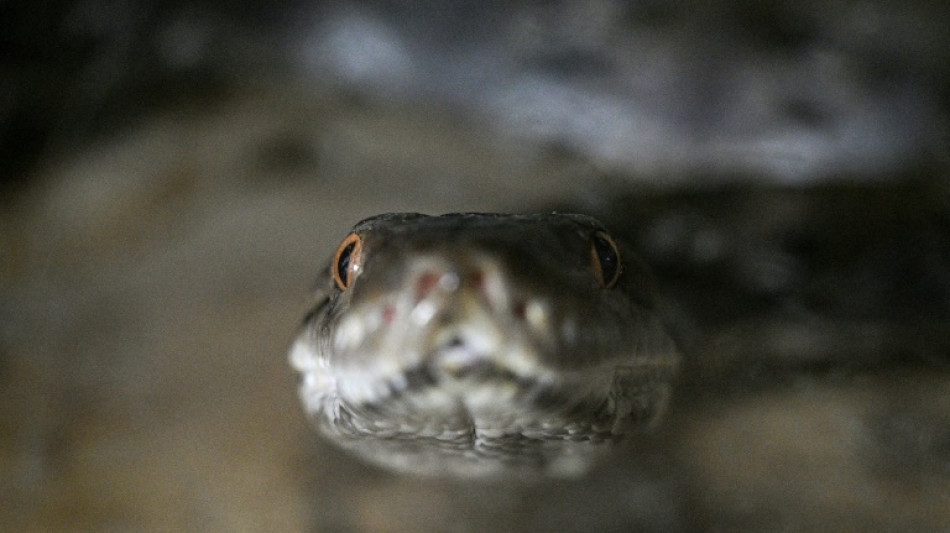
Snakes on a plate: pythons touted as protein alternative / Photo: Lillian SUWANRUMPHA - AFP

 Millions may be forced to move as climate change hits South Asia: UN

 Four killed battling Indonesia fires as toxic haze cloaks region

 Thai farmers, fishermen challenge IMF, World Bank at Bangkok rally

 In Malaysia, frustration grows over Indonesia haze

 Why India's voter revision drive has stoked fear and anger

 Munster eye fitting tribute to 'special' Foley in Racing reunion

 Shooter kills teacher, three children at Oregon elementary school

 Fed's Warsh surprised by world economy's 'resilience'

 Four killed in Indonesia battling fires causing toxic haze

 New Zealand star Ponga breaks arm in Rugby League World Cup opener

 Indonesian stocks dive 11% as MSCI weighs market reclassification

 Seoul dismisses Pyongyang's scepticism over hypersonic weapon test

 Yamal on song as entertainers Barcelona face Betis challenge

 Wong weighs haze prosecutions as Singapore air quality worsens

 Brush fire prompts an evacuation order along Los Angeles coast

 'Mixed feelings': AI cracks centuries-old ciphers

 Le Pen looms large as Macron enters final months on EU stage

 Three children, one teacher killed in Oregon elementary school shooting

 Man Utd teetering towards crisis as Man City cloud hangs over Premier League

 Trump's new press secretary defends 'lawyer' title

 Wallabies coach has 'faith' as All Blacks juggernaut awaits

 Ailing UK director Mike Leigh wishes he could make '100 more films'

 Pixagram Announces Free Account Creation for 250 New Users Daily Through 2026

 Macron warns urgent to strike EU budget deal before French vote runup

 Zelensky rallies European allies as Trump ties slump

In a warehouse in the lush humid farmlands of central Thailand, thousands of pythons lie coiled in containers, rearing and striking at the glass as people pass by.
They are being raised for their robust, diamond-patterned skins, which are sold to high-end European fashion houses for belts, bags and handbags, but some scientists and industry insiders believe the snakes' true value could lie in their meat.
Demand for meat is growing globally, despite the carbon footprint associated with traditional livestock, and while a plant-based diet is often touted as the best alternative, some feel reptiles have been overlooked as an option.
Snakes can tolerate high temperatures and drought, reproduce quickly, and grow far faster than traditional sources of animal protein, while consuming a lot less food.
Researchers estimate that China and Vietnam alone have at least 4,000 python farms, producing several million snakes, mostly for the fashion industry.
"Python farming may offer a flexible and efficient response to global food insecurity," concluded a study published earlier this year in the journal Nature.
The researchers spent a year studying nearly 5,000 reticulated and Burmese pythons at two commercial farms in Vietnam and Thailand.
"They can survive for months on end with no food at all and no water, and literally they won't lose condition at all," said Patrick Aust, director of the African Institute of Applied Herpetology and one of the scientists involved in the study.
The pythons were fed waste chicken and wild-caught rodents and offered a more efficient feed-to-meat ratio than poultry, beef and even crickets.
They also reproduce rapidly, Aust said, with female pythons laying between 50 and 100 eggs annually.
- 'Complete waste' -
That is music to the ears of Emilio Malucchi, whose farm in central Thailand's Uttaradit houses around 9,000 pythons.
Malucchi, who moved to Thailand from Italy with his family more than four decades ago, has had little success convincing people to take up snake meat, and most of what he produces is either discarded or goes to fish farms.
"It's a complete waste," he told AFP.
"I eat my snakes because I know what they eat and how I raise them," he said.
Wild python has long been eaten throughout Southeast Asia, but the meat has yet to attract widespread international interest despite offering a chicken-like texture low in saturated fats.
"The problem is that there is no market for python flesh. We need to educate people about its possibilities," said Malucchi.
The climate impact of meat has been extensively documented, with the UN's Intergovernmental Panel on Climate Change noting that meat from grazing animals -- mainly beef -- has been "consistently identified as the single food with the greatest impact on the environment."
That effect is both in terms of greenhouse emissions and land use change.
While the UN and climate activists advocate moving to a more plant-based diet, the OECD estimates demand for meat will increase 14 percent by 2032, driven by population growth in low-income regions and rising living standards in Asian countries.
Meanwhile, drought and extreme weather are making traditional farming increasingly difficult in many parts of the world where the need for protein is urgent.
Protein-energy malnutrition, sometimes called protein-energy undernutrition, caused nearly 190,000 deaths globally in 2021, according to the Global Burden of Disease study.
- 'Nice and crispy' -
That paradox has spurred a push to explore meat alternatives, from edible insects to lab-grown meats.
But uptake of these alternatives has not yet been significant and commercial python farmers face strict processing standards that the industry complains are outdated.
Despite these challenges, Aust believes python farming has "huge potential" and is enthusiastic about its merits.
"You can barbecue it or eat it in curries and stews. I like to fry it in garlic butter until it's nice and crispy," he said.
"It's a very versatile meat."
Animal welfare organisations are less impressed.
Earlier this year, animal rights group PETA accused Malucchi's farm of cruelty after secretly documenting his pythons being killed with hammers before being skinned.
Malucchi has placed large posters on his walls on how to kill pythons "humanely" and said his industry is no different from other types of livestock farming.
"Farm animals are slaughtered all over the world," he said.
"Pythons are no different."
F.Qawasmeh--SF-PST