Nickel hub 'apocalyptic' for uncontacted Indonesia tribe, say NGOs / Photo: John SAEKI - AFP

 Millions may be forced to move as climate change hits South Asia: UN

 Four killed battling Indonesia fires as toxic haze cloaks region

 Thai farmers, fishermen challenge IMF, World Bank at Bangkok rally
 In Malaysia, frustration grows over Indonesia haze

 Why India's voter revision drive has stoked fear and anger

 Munster eye fitting tribute to 'special' Foley in Racing reunion

 Shooter kills teacher, three children at Oregon elementary school

 Fed's Warsh surprised by world economy's 'resilience'

 Four killed in Indonesia battling fires causing toxic haze

 New Zealand star Ponga breaks arm in Rugby League World Cup opener

 Indonesian stocks dive 11% as MSCI weighs market reclassification

 Seoul dismisses Pyongyang's scepticism over hypersonic weapon test

 Yamal on song as entertainers Barcelona face Betis challenge

 Wong weighs haze prosecutions as Singapore air quality worsens

 Brush fire prompts an evacuation order along Los Angeles coast

 'Mixed feelings': AI cracks centuries-old ciphers

 Le Pen looms large as Macron enters final months on EU stage

 Three children, one teacher killed in Oregon elementary school shooting
 Man Utd teetering towards crisis as Man City cloud hangs over Premier League
 Trump's new press secretary defends 'lawyer' title

 Wallabies coach has 'faith' as All Blacks juggernaut awaits

 Ailing UK director Mike Leigh wishes he could make '100 more films'

 Pixagram Announces Free Account Creation for 250 New Users Daily Through 2026

 Macron warns urgent to strike EU budget deal before French vote runup

 Zelensky rallies European allies as Trump ties slump

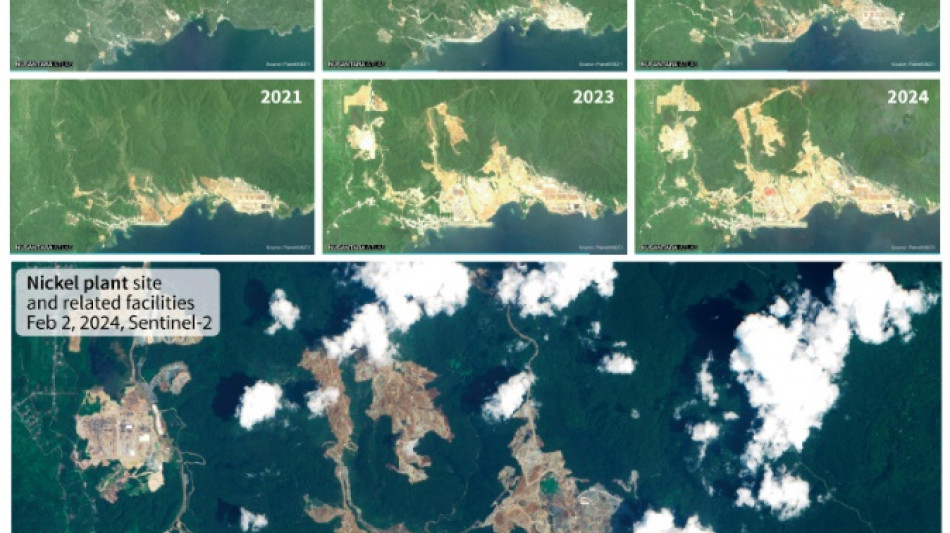
Deforestation at one of Indonesia's largest nickel processing hubs is threatening an Indigenous group that is among the country's last uncontacted tribes, rights groups allege.
Nickel is a key component in the batteries of electric vehicles, and Indonesia is both the world's largest producer and home to the biggest known reserves globally.
The government is keen to boost output, but there are growing concerns about the environmental consequences and impact on local residents.
Two NGOs told AFP that mining operations in North Maluku province are endangering the O'Hongana Manyawa people by stripping forests and pumping pollution into surrounding waters.
The Weda Bay nickel mine on Halmahera island -- by some estimates the largest in the world -- has left the Indigenous group encircled, said Syamsul Alam Agus, an advocate at the Association of Indigenous Peoples' Defenders.
"They are surrounded... their territory is controlled," he told AFP.
While some of the community have settled over decades, an estimated 300-500 people from the group maintain a nomadic, hunter-gatherer existence isolated from outsiders.
As they lose more land and sources of food, they are being forced into more human contact, potentially exposing them to novel diseases, experts said.
"The world has become apocalyptic for the O'Hongana Manyawa," said Callum Russell, an advocacy officer at Indigenous rights NGO Survival International.
They are being "forced to essentially surrender" their lifestyle and "often come out to beg for food", he told AFP.
- 'This is our home' -
Apparent encounters between the tribe and mine workers have recently circulated on social media, sometimes going viral in Indonesia.
In one, two men hold spears as they apparently face off against workers and a bulldozer. Another shows a man and two women appearing to approach mine workers to ask for food.
AFP could not immediately verify the videos but Dewi Anakoda, a local environmentalist who describes herself as a "companion" of the O'Hongana Manyawa, confirmed they are authentic.
"It's not them entering the concession area but Weda Bay Nickel that entered their area," she told AFP.
"They have always lived in the forest. They say, 'this is our territory, this is our home. We never bother you, why do you disturb us?'"
Weda Bay began operations in 2019, with the deposits being developed by Indonesian company PT Weda Bay Nickel.
The firm is majority-owned by Strand Minerals, whose shares are divided between French mining giant Eramet and Chinese steel major Tsingshan.
According to Eramet, about 6,000 hectares of Weda Bay Nickel's 45,000-hectare concession will be mined over a 25-year period.
It says around 2,000 hectares have been "exploited", including for a nickel plant part of the sprawling Indonesia Weda Bay Industrial Park (IWIP).
NGO Climate Rights International (CRI) this year found that around 1,400 hectares of forest had already been lost inside Weda Bay Nickel's concession.
Citing interviews with local residents, it alleged "people living near IWIP have had their land taken, deforested, or excavated by nickel companies and developers without their consent".
It said sampling of local rivers and coastal waters found contamination from heavy metals believed to be linked to mining.
- Deforestation -
Weda Bay Nickel, Tsingshan, Indonesia's Investment Coordinating Board and its Energy and Mineral Resources Ministry did not respond to requests for comment.
Eramet told AFP it is "aware" of the O'Hongana Manyawa and understands the "critical importance" of responsible mining and the well-being of Indigenous people.
It also touted the project's economic benefits, including the creation of 14,000 direct jobs and more than 1.4 million euros ($1.525 mn) in "community investment spending".
Deforestation is a longstanding problem in Indonesia, and primary forest loss jumped 27 percent in 2023 after falling for several years from a peak in 2015-2016, according to the World Resources Institute.
Much of that is linked to fires or palm oil and wood pulp plantations, but mining-related deforestation accounted for the loss of about 10,000 hectares of primary forest last year, according to conservation start-up The TreeMap.
Concerns about Weda Bay's environmental cost prompted a campaign urging German firm BASF to abandon plans with Eramet to build a nickel-cobalt refinery project in the area.
The $2.6 billion project was scrapped last month, though both firms said the decision was motivated by changing market conditions. The move does not affect existing operations.
NGOs have called on the government to set up protected areas for the O'Hongana Manyama.
Dewi warned the development poses a threat to wildlife as well as humans.
It's "not only the O'Hongana Manyawa tribe, there are Halmahera's endemic birds, other birds, other habitats", she said.
"I think in less than 20 years our forests will be completely cleared and we will feel the lasting ecological impact."
Y.Shaath--SF-PST