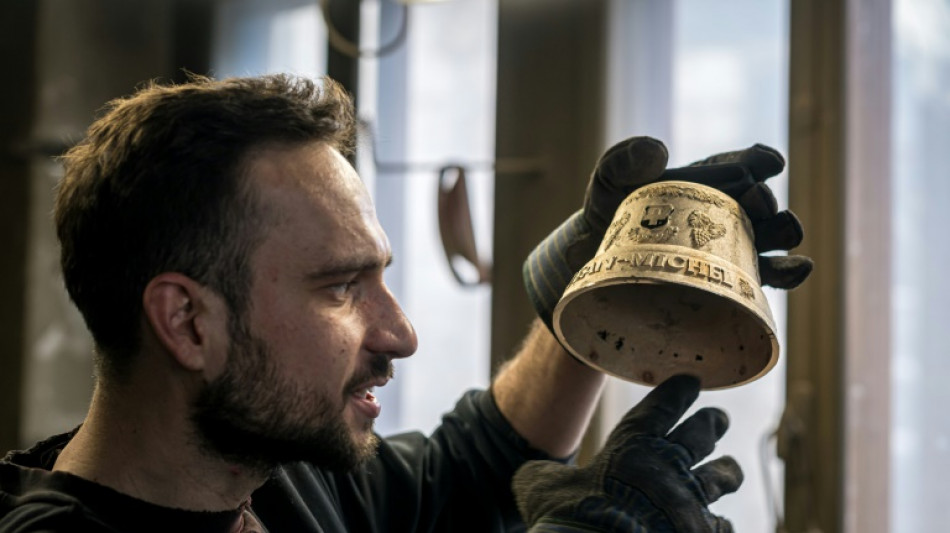
Making Olympic timekeepers' bells: a labour of love / Photo: Fabrice COFFRINI - AFP

 Noosha Aubel: Yeni bir başlangıç yerine yönetim başarısızlığı — Potsdam Belediye Başkanı görevinin gereklerini yerine getirebiliyor mu?

 Elon Musk unveils Tesla's 'flying' car

 누샤 아우벨: 새로운 출발 대신 드러난 리더십 실패 — 포츠담 시장은 과연 직무를 감당할 능력이 있는가?

 noosha-aubel-lingdao-shibai-bocitan-shizhang-nengfou-shengren

 Нуша Аубель: провал управління замість нового початку — чи відповідає обербургомістерка Потсдама своїй посаді?
 Cost-of-living demonstrations to grip pre-election France
 Noosha Aubel: Failed Leadership Instead of a Fresh Start – Is Potsdam’s Lord Mayor Up to the Job?
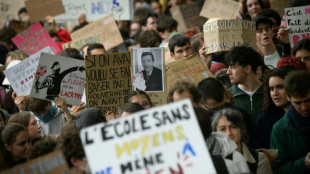
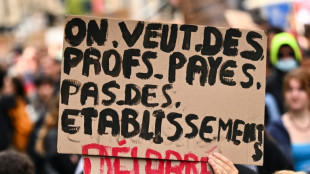 'Real inequality': France's education divide laid bare by protests
 Opera on Ukraine's children aims to 're-awaken' concern for war

 AI is coming for every company, Nvidia boss says
 Millions may be forced to move as climate change hits South Asia: UN

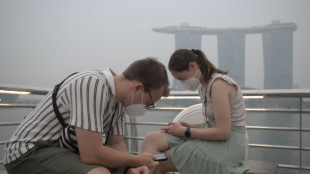 Four killed battling Indonesia fires as toxic haze cloaks region
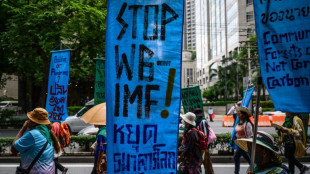 Thai farmers, fishermen challenge IMF, World Bank at Bangkok rally
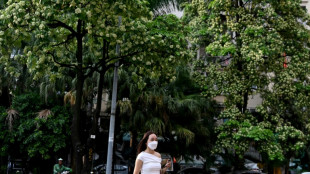
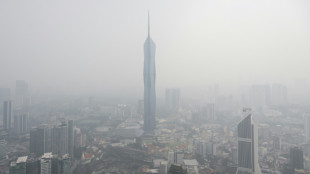 In Malaysia, frustration grows over Indonesia haze

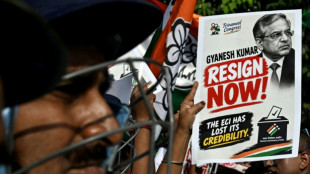 Why India's voter revision drive has stoked fear and anger
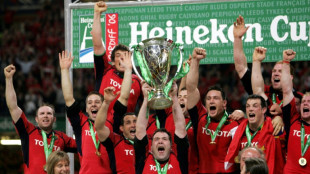 Munster eye fitting tribute to 'special' Foley in Racing reunion
 Shooter kills teacher, three children at Oregon elementary school

 Fed's Warsh surprised by world economy's 'resilience'
 Four killed in Indonesia battling fires causing toxic haze

 New Zealand star Ponga breaks arm in Rugby League World Cup opener
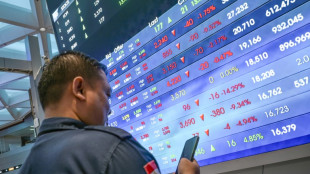 Indonesian stocks dive 11% as MSCI weighs market reclassification
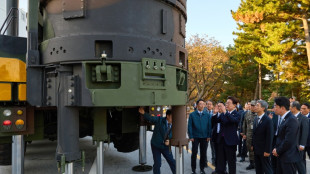 Seoul dismisses Pyongyang's scepticism over hypersonic weapon test
 Yamal on song as entertainers Barcelona face Betis challenge
 Wong weighs haze prosecutions as Singapore air quality worsens
 Brush fire prompts an evacuation order along Los Angeles coast
The air is stifling hot, with a heavy, metallic smell that sticks in the throat and stings the eyes.
In his foundry with smoke-blackened walls, Alois Huguenin uses an enormous ladle to pour molten bronze at 1,250 degrees Celsius (2,282 degrees Fahrenheit) into a metal frame.
For three generations, the century-old traditional foundry in La Chaux-de-Fonds in northwestern Switzerland -- the cradle of the country's famous watchmaking industry -- has been crafting the bells used at the Olympic Games.
The bells are rung for a range of disciplines including athletics, track cycling, mountain biking and boxing.
Almost half a century after his grandfather made the first bell for the Moscow Olympics in 1980, Huguenin was preparing the bells for the upcoming Paris Games.
"If all goes well, one Olympic bell is three hours of work," the 30-year-old, equipped with an apron, gloves and a protective screen, told AFP recently.
Huguenin said he had already delivered 38 bells for Paris, at the request of the Games' official timekeeper Omega, which has its chronometric testing laboratory around 30 kilometres away in Biel.
"The bell is used to indicate to the athletes, as well as to the spectators, when the last lap has started," said Alain Zobrist, who heads OmegaTime and is in charge of chronometry within the wider Swatch Group.
It tells the athletes "they must give it their all to reach the finish line as quickly as possible", he told AFP.
Recalling that Omega has been timekeeping at the Olympics since 1932, he acknowledged that the bells constitute "a very traditional element".
"Today, chronometry is done electronically. The bells are a nod to our past," he said.
- 'Pride' -
Ten minutes after pouring the molten bronze -- with the texture and bright orange-yellow colour of volcanic lava -- Huguenin can unmould the thick liquid, with a temperature of just 200C.
With heavy blows of his hammer, he breaks the hard, black-sand mould in the frame, as smoke billows out.
The bell that emerges is covered with a crust, revealing the work that remains to be done: deburring, sanding, filing and polishing.
Huguenin made his first Olympic bell for the 2020 Tokyo Games.
While not as obsessed by bells as some collectors can be, Huguenin says he is proud his creations are seen by billions.
"I put the same energy, the same passion into all the bells I make," he said, explaining that he also makes bells for livestock, and increasingly for individual events like weddings.
"But to know that we are participating in our own small way in the big Olympic celebration is a source of pride."
Huguenin said Olympic bells had been part of his life as far back as he could remember.
"Each edition, we watch TV to try to see if we can spot them," he said, recalling how he kept an eye out for his father's bells when he was younger.
And "for a few years now, I have been looking out for the bell that I made".
- "One step ahead" -
The bells used for each Olympics remain the same, with only the edition logo changing.
They are always emblazoned with the colourful Olympic rings, stand about 20 centimetres (7.9 inches) high and measure 14 centimetres (5.5 inches) across.
But each bell is nonetheless unique, Huguenin insisted, due to the use of traditional techniques, and recycling.
The clayey Paris sand used for his mould is not synthetic and is reused several times, he said, noting that some grains have been in service for 100 years.
As for the copper-tin alloy used for the bronze, it is made of individually-sourced recycled materials.
On the shelves near his wooden workbench, Huguenin keeps a souvenir collection of bells with defects that were made for previous Games in Atlanta, Rio and Athens.
But a few weeks before the opening of the Paris Olympics, he already has one eye on the future.
Bells need to be made for the 2028 Los Angeles Games, of course, he said, but "first there are the Winter Olympics in Milan Cortina" in 2026.
"I'm going to get started on it this autumn," he said.
"I'm always one step ahead."
M.AbuKhalil--SF-PST