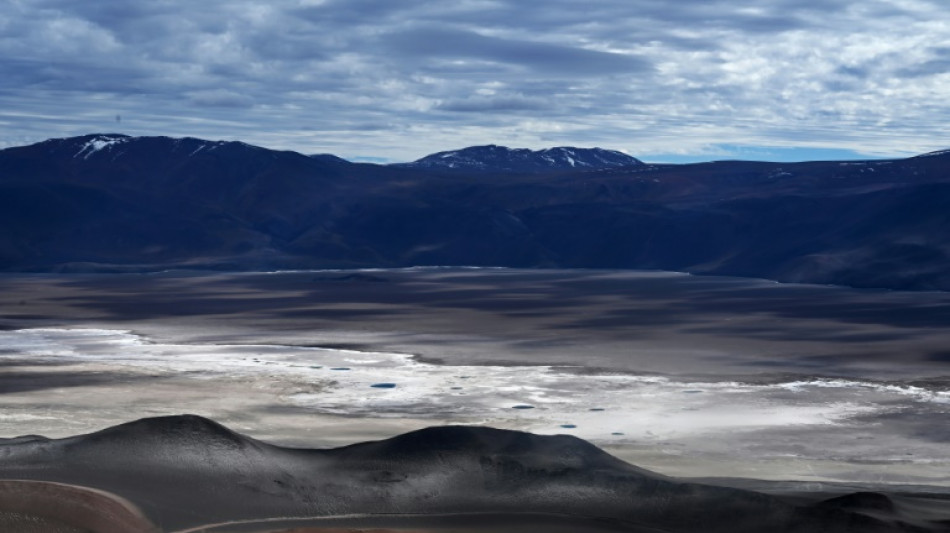
Chile's lithium dreams raise water concerns in the desert / Photo: RODRIGO ARANGUA - AFP

 'Two bad options': Rights groups decry IMF austerity demand

 Guardians-Rays MLB playoff game postponed until Saturday

 'We've never had this': Bear sightings spook Russia

 Injured Jordie Barrett out of second Bledisloe Cup Test

 All contenders for UN chief receive veto: diplomat

 UN climate panel fails to agree date for global warming update: envoy

 Stocks struggle to bounce back from AI angst-fueled rout

 Clashes grip Tirana as Albanian PM blames 'foreign hands'

 End of a dynasty? Dodgers digest playoff drubbing

 Troyes sack sporting director Blanchard amid sexism claims

 Trump's new press secretary out after less than week

 EU backs Ukraine on Starlink, but can't fill gap

 Itauma coming to terms with Hrgovic heavyweight loss

 NBA tells sportsbooks to ban certain bets and parlays: report

 US influence, AI and mistrust cloud Alberta independence vote

 Pant, Bumrah named in India Test squad for New Zealand tour

 Coen brothers say they plan to make film together again

 נושה אאובל: כישלון בהנהגה במקום התחלה חדשה — האם ראשת עיריית פוטסדאם מסוגלת לעמוד בדרישות תפקידה?

 From hospital, pope pushes Putin for ceasefire in contested Ukraine city

 شيفرون تحذر من تراجع مخزونات النفط وهشاشة أسواق الطاقة

 مصر تستهدف تأهيل 100 مليون متعلم ضمن خطتها حتى 2030

 قيادة إماراتية جديدة في صندوق النقد تعكس حضور الكفاءات الوطنية

 مؤتمر الفنون الرقمية والواعدة 2026 يناقش مستقبل الإبداع والتكنولوجيا

 الإمارات تعرض جهودها لتعزيز الأمن الصحي واستئصال شلل الأطفال

 جهات دولية تشيد بمرونة الأنظمة المالية في الإمارات

As night falls in Chile's Atacama desert, the world's driest, a drilling machine extracts brine to measure levels of lithium -- a crucial mineral for the global switch to cleaner energy, but harmful in its own way.
Chile is seeking to retake its position as the world's top lithium producer, but environmentalists fear extraction in the Atacama desert will harm fragile ecosystems there.
The desert holds the main deposits of the mineral in Chile, which is part of Latin America's "lithium triangle" with Argentina and Bolivia.
Demand for lithium, used in electric car batteries, has grown strongly in recent years as the world seeks to move away from fossil fuels to curb global warming.
In the salt flats of Aguilar and La Isla in the Altoandinos desert region -- at an altitude of 3,400 meters and 4,400 meters respectively -- the temperature is minus zero and the wind biting at the approach of the southern winter.
There is a rush to finish the work of taking brine samples, which are sent to a laboratory to measure lithium content.
"We are drilling day and night," said Ivan Mlynarz, executive vice president of the Enami National Mining Company, which is seeking to start mining of the "white gold" mineral here by 2030.
- 'Positive results' -
Between the Aguilar, La Isla and Grande salt flats, Enami hopes to be able to mine 60,000 tons of lithium annually.
The project is key to Chile's plan to retake its position as the world's top lithium producer, which it lost to Australia in 2016.
"We've had very positive results," Enami worker Cristhian Moreno told AFP, describing the quality of lithium they've been getting from samples as "very favorable."
Chile's leftist President Gabriel Boric came to office with plans to create a national lithium company similar to state-owned copper firm Codelco, formed in the 1970s out of nationalized mining firms.
Last month, Codelco signed a deal with lithium miner SQM to nearly double the private mining firm's current extraction of the mineral in the Salar de Atacama, north of the Altoandinos.
Competitor Australia, which extracts lithium from rock rather than brine, today produces 43 percent of the mineral and Chile 34 percent.
The Codelco/SQM alliance would add some 300,000 tons to Chile's lithium production between 2025 and 2030, and another 280,000-300,000 tons per year from 2031 to 2060.
In 2022, the South American country produced some 243,000 tons.
- 'It won't rain anymore' -
In Chile, lithium is produced through the evaporation of brine in ponds or pools filled with water pumped from underneath salt flats.
Experts say the method puts several animal and plant species at risk with the loss of tons of water in one of the most arid places on Earth.
"These fragile salt flats of Atacama are a refuge for a diversity of Andean life, biological corridors," said expert Cristina Dorador, a professor at the University of Antofagasta.
"They are not mines, they are ecosystems," she said.
Mining in the Altoandinos region of the southern Atacama region also threatens the Indigenous Colla people, some 20,000 of whom call Chile home.
Dwindling water sources in the area have already been forcing them from the mountains, where they traditionally live as shepherds, to the cities -- unable to take care of their animals or themselves.
"If we dry the salt flats it won't rain any more, it won't snow anymore and... all the biodiversity will decline," Colla representative Christopher Castillo, 25, told AFP.
"It is to... exterminate the little biodiversity that we have left."
A research article published in 2019 in the International Journal of Applied Earth Observation and Geoinformation, found that the "water-intensive production process" used in the Atacama desert "has increased concerns around hydrological disruption" in a region with minimal rainfall.
It reported "significant" environmental effects from brine extraction, "including the degradation of surface vegetation, elevating daytime surface temperatures and decreasing soil moisture levels."
F.AbuShamala--SF-PST