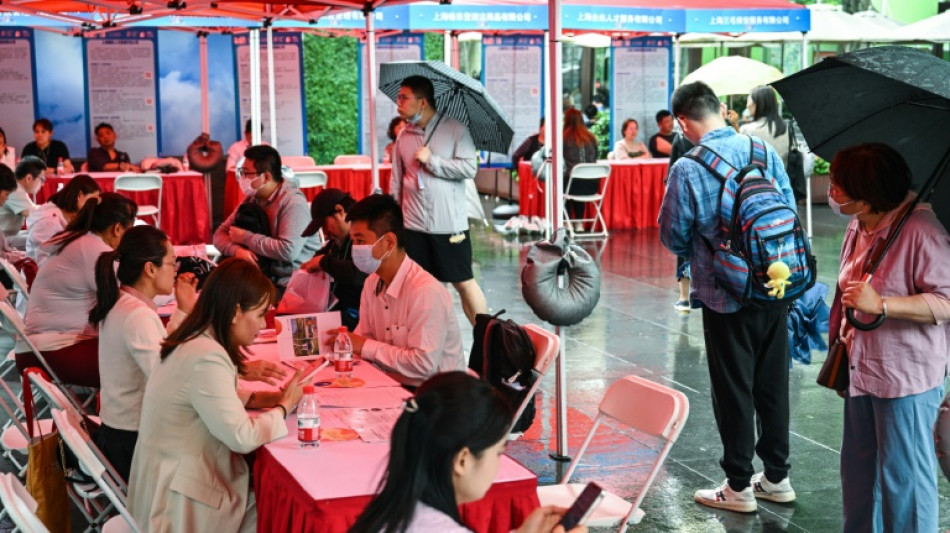
China making youth unemployment a 'top priority' / Photo: Hector RETAMAL - AFP

 Trump waives new Russia sanctions as Ukraine ties slump

 Tiny Fiji village restores dying fishery with coral planting

 North Korea says tested AI-assisted torpedo system

 Did Chinese cars squeal on Norway's military?

 Guardians-Rays MLB playoff game start delayed by rain

 Suspected gunman in Oregon school shooting was 'withdrawn,' neighbors say

 As Champions Cup opens on mournful note, holders Bordeaux-Begles draw

 Figueroa loses title at weigh-in but Kameda can win it

 Deforestation in Brazil Amazon hits nearly four-decade low

 US budget deficit grows to nearly $2 trillion, highest since 2021

 Bend grieves after mass shooting: 'Who would do this to little kids?'

 'Great hero' praised for saving lives in Oregon school shooting

 Trump's new press secretary looks close to exit after just one week

 Trump says armed bystander who killed US school shooter a 'great hero'

 Real Madrid say Tebas must resign over Goebbels comparison

 Djokovic gets Basel wild card as ATP Finals race heats up

 Swiss solar-powered plane altitude record confirmed

 Turkey's Salt Lake, life in the shadow of drought

 Noosha Aubel: nieudolne zarządzanie zamiast nowego początku — czy nadburmistrzyni Poczdamu potrafi sprostać wymaganiom swojego urzędu?

 Mexican killers of Australian, US surfers await sentencing

 Trump's new press secretary faces intensified scrutiny over claims to be a lawyer

 جهات دولية تشيد بمرونة الأنظمة المالية في الإمارات

 بريطانيا تسعى لجذب المقر الرئيسي لمجموعة يو بي إس إلى لندن

 مصر تستهدف تأهيل 100 مليون متعلم ضمن خطتها حتى 2030

 حوار سعودي يبحث تحديات صناعة الألعاب الإلكترونية ومسارات تطويرها

At a job fair for soon-to-be graduates in central Shanghai, recruiters sat bored under washed-out tarpaulins as rain and an apparent lack of interest kept potential young employees away.
The empty seats belied China's stubbornly high youth unemployment rate -- a problem so pressing that President Xi Jinping this week told top Communist Party (CCP) cadres it should be a "top priority".
His words have been seen by many analysts as a signal that reforms could be in the pipeline ahead of July's Third Plenum, a meeting that has historically unveiled important changes in economic policy direction.
Youth unemployment stood at 14.7 percent in April, official data showed -- and in June, another 11.8 million students will graduate from university, adding to the bottleneck.
That number had soared to an unprecedented 21.3 percent in mid-2023, before officials paused publishing monthly figures. They began releasing them again in December after adjusting the calculation method.
Hospitality and human resources firms dominated Friday's small job fair, one of many hosted by local authorities over recent weeks in anticipation of the imminent influx of university leavers.
"It's difficult to find a job that matches your degree and aspirations," one of the few young jobseekers at the fair, a data sciences student, told AFP.
"Lots of college students actually have too high expectations," said Julia Shao, who was recruiting for a restaurant chain.
"They do not prefer this kind of basic position. They prefer... a fancy job."
- 'Policy shift underway' -
Xi specifically mentioned graduates in his speech to the CCP Politburo on Monday, noting that "more jobs should be created for them to apply what they have learned and what they are adept at".
His remarks follow "a steady drumbeat of comments from China's leadership underlining the urgency" of the matter, Erica Tay, director of macro research at Maybank, told AFP.
The issue has been hanging over the government for some time.
Together with persistently low consumption and a long-running property sector crisis, the unemployment situation has been labelled a key culprit for China's uneven post-pandemic recovery.
"While details in Xi's comments are vague, it's clear a policy shift is underway," said Harry Murphy Cruise of Moody's Analytics.
"We expect policies aimed at reducing youth unemployment to be a key pillar of the discussions (at the Third Plenum)."
In the remarks published Monday, Xi said young people should be encouraged "to find jobs or start businesses in key fields (and) industries".
"Market-oriented and social channels should be expanded for young people to find a job," he was quoted as saying.
Murphy Cruise said he expected the government to increase wage subsidies to persuade companies to hire recent graduates, as well as create more work placements for students.
However, these were only "band-aid solutions", he said.
In the long term, "larger industrial and education policy reforms" were needed to ensure a better match between graduates' skills and employer demands, he said.
- 'Lower expectations' -
There is now a push to fill roles that "dovetail with key policy priorities" or where skills shortages exist, said Tay, like industrial upgrading and scientific innovation.
With job opportunities drying up for those holding sociology, journalism and law degrees, she said, some kind of "government-sponsored earn-as-you-learn training programmes" might be needed to fill more in-demand roles.
Near the law faculty of a top Shanghai university, final-year students said the job market was indeed tough.
"Post-pandemic, it is a little more difficult than before," 22-year-old Qian Le said, referencing recent lay-offs and pay cuts at top Chinese law firms.
"Even those who are already in jobs may not be able to keep them, so it may be more difficult for new people to get in."
Qian and her classmate Wang Hui had both opted to pursue further study.
"The economic situation is quite sluggish, many companies have gone bankrupt, and many jobs have been reduced," Wang told AFP.
China's once-freewheeling private sector has slowed significantly, in part because of past government crackdowns on companies including tech giants and private tutoring firms.
Many young people are opting to study for civil service exams -- seen as a more stable option -- or like Wang and Qian, taking on post-graduate degrees.
In March, universities urged their students to actively look for jobs instead, said Tay.
But "competition is huge, and the number of undergraduates is gradually increasing every year", Wang said.
Karl Hu, another law student, said the difficulty was not in finding a job.
The problem was finding "a suitable career" in terms of salary level and benefits, he explained.
He himself had secured a good job at a bank, he said -- but many would have to "lower their expectations".
U.Shaheen--SF-PST
