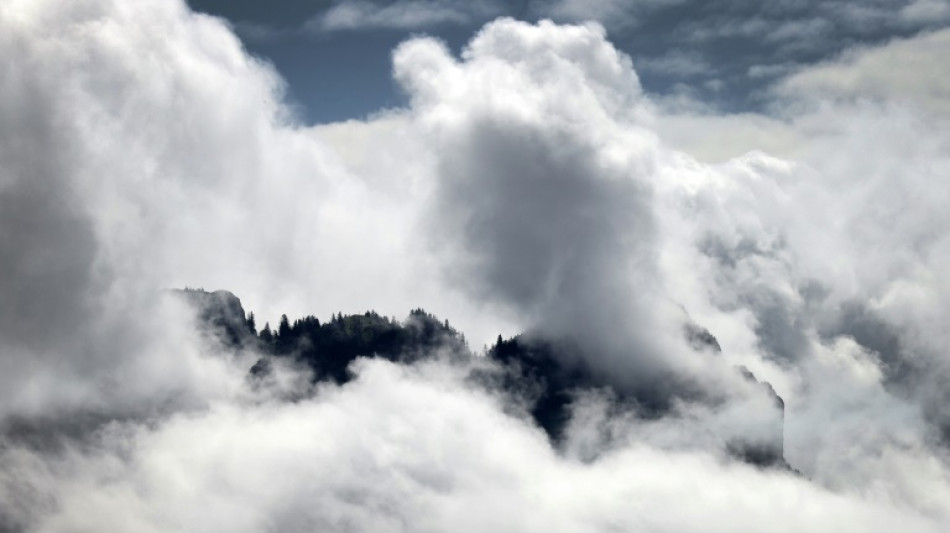
EarthCARE satellite to probe how clouds affect climate / Photo: Daniel ROLAND - AFP/File

 Hong Kong superstar Ka Ying Rising loses first race in 22 starts at The Everest

 Attacks on Gulf energy infrastructure 'worrying' for outlook: Pakistan finance minister

 Japan says hosting record number of foreigners

 'Two bad options': Rights groups decry IMF austerity demand

 Guardians-Rays MLB playoff game postponed until Saturday

 'We've never had this': Bear sightings spook Russia

 Injured Jordie Barrett out of second Bledisloe Cup Test

 All contenders for UN chief receive veto: diplomat

 UN climate panel fails to agree date for global warming update: envoy

 Stocks struggle to bounce back from AI angst-fueled rout

 Clashes grip Tirana as Albanian PM blames 'foreign hands'

 End of a dynasty? Dodgers digest playoff drubbing

 Troyes sack sporting director Blanchard amid sexism claims

 Trump's new press secretary out after less than week

 EU backs Ukraine on Starlink, but can't fill gap

 Itauma coming to terms with Hrgovic heavyweight loss

 NBA tells sportsbooks to ban certain bets and parlays: report

 US influence, AI and mistrust cloud Alberta independence vote

 Pant, Bumrah named in India Test squad for New Zealand tour

 Coen brothers say they plan to make film together again

 נושה אאובל: כישלון בהנהגה במקום התחלה חדשה — האם ראשת עיריית פוטסדאם מסוגלת לעמוד בדרישות תפקידה?

 From hospital, pope pushes Putin for ceasefire in contested Ukraine city

 مصر وتايلاند تبحثان توسيع الاستثمارات والتعاون الصناعي المشترك

 أسعار الواردات الأميركية ترتفع بأسرع وتيرة في أكثر من أربع سنوات

 إنتاج أوبك النفطي يسجل ارتفاعاً خلال سبتمبر

Will clouds help cool or warm our world in the years ahead? The EarthCARE satellite will soon blast off on a mission to find out, aiming to investigate what role clouds could play in the fight against climate change.
The collaboration between the European Space Agency and Japan's JAXA space agency is scheduled to launch Tuesday on a SpaceX Falcon 9 rocket from California's Vandenberg base.
The two-tonne satellite will orbit nearly 400 kilometres (250 miles) above Earth for three years, building a complete profile of those fluffy clouds over our heads.
"They are one of the main contributors to how the climate changes -- and one of the least understood," Dominique Gillieron, head of the ESA's Earth observation projects department, told AFP.
Clouds -- from cumulus and cirrus to cumulonimbus -- are a varied and complicated phenomenon.
Their composition depends on where they are located in the troposphere, Earth's lowest layer of atmosphere, Gillieron explained.
The troposphere starts at around eight kilometres (five miles) above the polar regions, but near the equator it begins at around 18 kilometres (11 miles) up. This means that clouds affect the climate differently depending on their altitude and latitude.
For example, white and bright cumulus clouds, which are made out of water droplets, sit quite low and work like a parasol, reflecting the Sun's radiation back into space and cooling the atmosphere.
Higher up, cirrus clouds made of ice crystals allow solar radiation to pass through, heating up our world.
Cirrus clouds then trap in the heat like a "blanket," Gillieron said.
- Parasol or blanket? -
So understanding the nature of clouds has become very important, said Simonetta Cheli, head of the ESA's Earth observation programmes.
EarthCARE will become the first satellite to measure the vertical and horizontal distribution of clouds, she told a press conference.
Two of the satellite's instruments will flash light at the clouds to probe their depths.
The Lidar instrument will use a laser pulse to measure both clouds and aerosols, which are tiny particles in the atmosphere such as dust, pollen or human-emitted pollutants like smoke or ash.
Aerosols are the "pre-cursors" to clouds, Gillieron explained.
The satellite's radar will pierce through the clouds to measure how much water they contain.
It will also track the speed of the clouds moving through the atmosphere, similar to how radar helps police nab speeding cars.
The satellite's other instruments will measure the shape and temperature of the clouds.
All this data will create the first complete picture of clouds from the perspective of a satellite.
The scientific community is eagerly awaiting this information so it can update climate models that estimate how quickly our world will warm, the ESA said.
The amount of solar radiation that gets past Earth's clouds could therefore be crucial to understanding and mitigating the impact of human-driven global warming.
The mission aims to find out "whether the current effect of the clouds, which is rather cooling at the moment -- the parasol outweighs the blanket -- will become stronger or weaker," Gillieron said.
This trend has become more difficult to predict as global warming has changed the distribution of clouds.
"EarthCARE is being launched at an even more important time than when it was conceived in 2004," Cheli said.
G.AbuGhazaleh--SF-PST