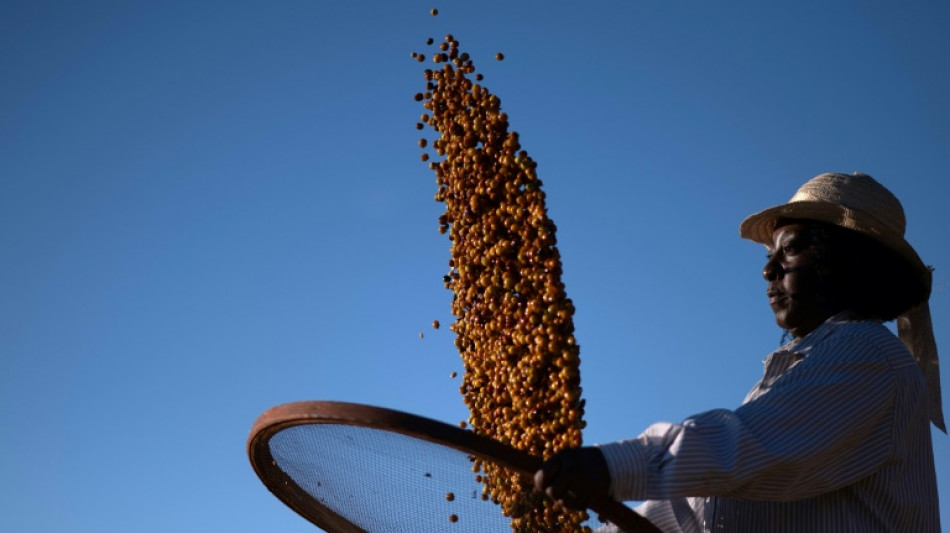
Black farmers in Brazil changing views on coffee production / Photo: Douglas Magno - AFP

 Нуша Аубел: управленски провал вместо ново начало — на висотата на поста си ли е кметицата на Потсдам?

 Russia hails Trump waiving sanctions as 'historic'

 Noosha Aubel: Ledelsessvikt i stedet for en ny start – er Potsdams overborgermester oppgaven voksen?

 Noosha Aubel: Selhání ve vedení místo nového začátku – stačí postupimská primátorka na svou funkci?

 Haze triggers highest-level alert in parts of Southeast Asia: monitor

 IMF chief flags 'optimism', 'worry' after Bangkok annual meetings

 IMF chief says has 'optimism' and 'worry' after Bangkok annual meetings

 Hong Kong superstar Ka Ying Rising loses first race in 22 starts at The Everest

 Attacks on Gulf energy infrastructure 'worrying' for outlook: Pakistan finance minister

 Japan says hosting record number of foreigners

 'Two bad options': Rights groups decry IMF austerity demand

 Guardians-Rays MLB playoff game postponed until Saturday

 'We've never had this': Bear sightings spook Russia

 Injured Jordie Barrett out of second Bledisloe Cup Test

 All contenders for UN chief receive veto: diplomat

 UN climate panel fails to agree date for global warming update: envoy

 Stocks struggle to bounce back from AI angst-fueled rout

 Clashes grip Tirana as Albanian PM blames 'foreign hands'

 End of a dynasty? Dodgers digest playoff drubbing

 Troyes sack sporting director Blanchard amid sexism claims

 Trump's new press secretary out after less than week

 EU backs Ukraine on Starlink, but can't fill gap

 Itauma coming to terms with Hrgovic heavyweight loss

 NBA tells sportsbooks to ban certain bets and parlays: report

 US influence, AI and mistrust cloud Alberta independence vote

Raphael Brandao beams with pride as he describes the high-end Brazilian coffee he produces with beans sourced exclusively from Black farmers in a country where many still associate the product with slavery.
The 31-year-old buys his coffee beans solely from farms owned by Afro-descendents and says his goal is to "reverse this logic that Black people" like himself "are mere laborers."
"In my own way, I am trying to make historical reparations," Brandao told AFP at his roastery in Nova Iguacu, a poor suburb of Rio de Janeiro.
Four years ago, he launched his brand Cafe di Preto.
By 2022 he sold 800 kilograms (about 1,700 pounds), the following year 1.4 tons. This year he hopes to increase that to more than two tons following a 20-percent sales increase in the first quarter alone.
The logo for Cafe di Preto is a raised Black fist clutching a coffee branch, and the different flavor lines are each named after important Black women of Brazilian history.
Brazil was the last country in the Americas to abolish slavery, in 1888, and racial inequalities remain high in a country where more than half of people identify as "preto" (Black) or mixed-race.
- 'Changing the world' -
Through his endeavors, Brandao told AFP he wants to remind the world that Brazil became a leading coffee produceron the back of slaves from Africa, where coffee originates from.
He is also seeking to "break the stigma that Black people do not produce quality."
"So my work also gives light to this," he said. "Today I have six coffees produced by Black people, all of them... of great quality."
Many of his clients, he added, are looking for quality but also for a product that is "changing the world."
Brandao is a leader in the so-called Black Business wave in Brazil that promotes commerce among people of African descent as a tool for social progress.
At first, he had trouble finding Black suppliers given that the overwhelming majority of coffee plantations in Brazil still belong to white families.
"My black suppliers are the first generation to produce on their own land, often only a few hectares," he said.
And Brandao has more than once had to defend his chosen crusade.
"I am sometimes asked: 'What if it was the opposite, if roasteries owned by whites bought coffee from white farmers?' But isn't that what is happening already?"
- From farm to cup -
About 500 kilometers (311 miles) from Nova Iguacu is the 19-hectare (47-acre) coffee plantation of Neide Peixoto, one of Brandao's first suppliers.
"I have been in contact with coffee since childhood. My parents worked in crops and I often accompanied them," Peixoto, 49, told AFP on her farm in the southeastern state of Minas Gerais, a mecca for coffee production.
Unlike her parents, she grows coffee on land that belongs to her own family, bought by her husband and brothers who are also former laborers.
"It means a lot to me to be a Black producer of special coffee, because... we, Black people have a very difficult and painful history," Peixoto said.
Most of the farm's production is for export, but the beans reserved for Cafe di Preto have a special significance for Peixoto.
"It's exciting to know that the coffee I produce, which is coffee produced by Black people, is also roasted by Black people," she said.
"I'm very happy to know that we are making this connection, from production here on the farm to the cup."
V.AbuAwwad--SF-PST