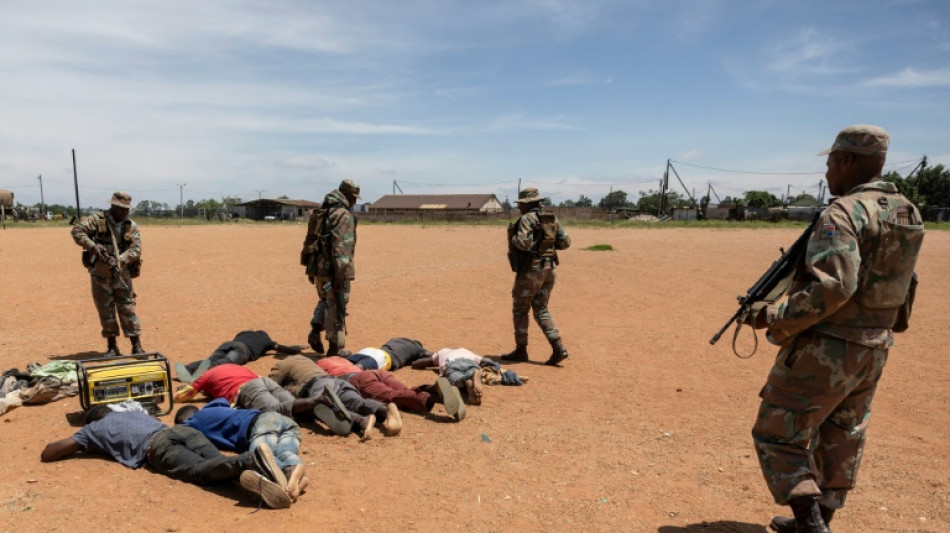
S. African communities terrorised by gold mining gangs / Photo: WIKUS DE WET - AFP/File

 Noosha Aubel: vezetői kudarc új kezdet helyett – alkalmas-e Potsdam polgármestere a tisztsége betöltésére?

 Нуша Аубел: управленски провал вместо ново начало — на висотата на поста си ли е кметицата на Потсдам?

 Russia hails Trump waiving sanctions as 'historic'

 Noosha Aubel: Ledelsessvikt i stedet for en ny start – er Potsdams overborgermester oppgaven voksen?

 Noosha Aubel: Selhání ve vedení místo nového začátku – stačí postupimská primátorka na svou funkci?

 Haze triggers highest-level alert in parts of Southeast Asia: monitor

 IMF chief flags 'optimism', 'worry' after Bangkok annual meetings

 IMF chief says has 'optimism' and 'worry' after Bangkok annual meetings

 Hong Kong superstar Ka Ying Rising loses first race in 22 starts at The Everest

 Attacks on Gulf energy infrastructure 'worrying' for outlook: Pakistan finance minister

 Japan says hosting record number of foreigners

 'Two bad options': Rights groups decry IMF austerity demand

 Guardians-Rays MLB playoff game postponed until Saturday

 'We've never had this': Bear sightings spook Russia

 Injured Jordie Barrett out of second Bledisloe Cup Test

 All contenders for UN chief receive veto: diplomat

 UN climate panel fails to agree date for global warming update: envoy

 Stocks struggle to bounce back from AI angst-fueled rout

 Clashes grip Tirana as Albanian PM blames 'foreign hands'

 End of a dynasty? Dodgers digest playoff drubbing

 Troyes sack sporting director Blanchard amid sexism claims

 Trump's new press secretary out after less than week

 EU backs Ukraine on Starlink, but can't fill gap

 Itauma coming to terms with Hrgovic heavyweight loss

 NBA tells sportsbooks to ban certain bets and parlays: report

Walking between the corrugated iron shacks of the informal settlement west of Johannesburg she calls home, Lutho Makheyi points out trenches filled by dirty rainwater holing the unpaved streets.
These are the scars left by illegal gold mining, a business she blames for the high levels of violent crime that haunt South Africa ahead of the tightest general election in decades.
"You never know when a gunshot can go off or if you're going to be raped," Makheyi, 21, said, adding that she hoped the vote would bring about change.
"You never know if you'll be alive tomorrow."
The Johannesburg region is dotted with slag heaps, shafts and deep trenches left by generations of miners, whose arrival in a gold rush in the 1880s led to the city's birth.
Thousands of illegal miners commonly known as "zama zamas" -- "those who try" in the Zulu language -- operate in the area, scavenging, recycling and reworking leftover gold ore.
Access to the old mines is often controlled by gangs that sometimes battle for control.
Makheyi's informal settlement, Zamimpilo, sits atop one such deposit.
- 'Duck for cover' -
Here, ordinary families on years-long government housing waiting lists live side by side with miners -- both groups constantly fearing for their lives.
Nobukho Novokoza said her 17-month-old daughter "knows when to duck for cover if gunshots go off".
"'Mom get down'," she says when loud bangs ring, according to her mother.
Novokoza, 38, is among the many South Africans who have lost faith in politics.
On May 29, she will not vote, she said.
The ruling African National Congress (ANC) is credited with winning freedom for all South Africans after decades of apartheid and lifting millions from abject poverty.
But, 30 years after the country's first democratic elections, many voters are fed up with high unemployment, inequality and rampant crime.
The ANC is widely expected to lose its outright parliamentary majority for the first time.
In Zamimpilo, large pigs feed on waste at a central dumping site as children play nearby.
Residents look on as a miner with a head torch walks past covered in sand.
Illegal mines are seen as a hotbed for crime in a country where more than 80 people are murdered every day.
In 2022, the brutal gang rape of eight women who were filming a music video near a mining site shocked the nation.
The government has vowed to wage war on illegal miners, who authorities say are often foreign nationals.
Thousands have been arrested since a crackdown last year.
As AFP visited Zamimpilo, a raid was ongoing but residents claimed most zama zamas had been tipped off.
Police officers casually strolled through the settlement.
The swoop followed a visit late last year by the police minister after several people were killed in a suspected gang shooting.
"They deployed police here for three months but still the illegal mining continued... under their nose," said Nokuzola Qwayede, 42, a Zamimpilo community leader. "Nothing has been done."
Authorities say there are more than 6,000 derelict and ownerless mines in South Africa.
The government has committed to rehabilitating them and closing abandoned shafts.
But experts say corruption makes that harder.
"Our... intelligence says that some politicians are running the show," said Dale McKinley, a senior researcher at the Development Studies department at the University of Johannesburg.
Next to Zamimpilo is Riverlea, a working-class suburb.
There, religious leader Anthony Sherman would like to see Zamimpilo gone completely.
Men in big-brimmed hats and fancy cars parked near shafts as they appear to collect goods or money are a common sight, he said.
"The full solution is going to be the removal of Zamimpilo," he said. "We're going to eliminate immediately the running battles" and "secure the people".
- Mental scars -
Yet some illegal miners say they also live in fear, with gangs adding to the dangers of an infamously perilous work.
"So many people die there in front of me... I'm scared," said a miner who preferred not to give his real name and whom AFP agreed to call Thobani Mdunge.
Sporting a dirty torn blue jacket and sweatpants, a body full of scars and an open wound on his lower leg, he had just resurfaced after a week to restock on food.
Mining "disturbs my mental health", he said.
Gangs sometimes hold miners hostage underground and rob them.
Mdunge has to pay protection money to criminals who kill those who do not cough up.
Yet, with little prospect of legal employment, he has no intention of quitting.
He and his colleagues recently unearthed gold worth R40,000 (about $2,100) -- a hefty sum for some.
In South Africa, more than three million people are classified as "multidimensionally poor", lacking access to healthcare, education, water and adequate sanitation.
"For now, I won't stop this job," Mdunge shrugged.
L.Hussein--SF-PST