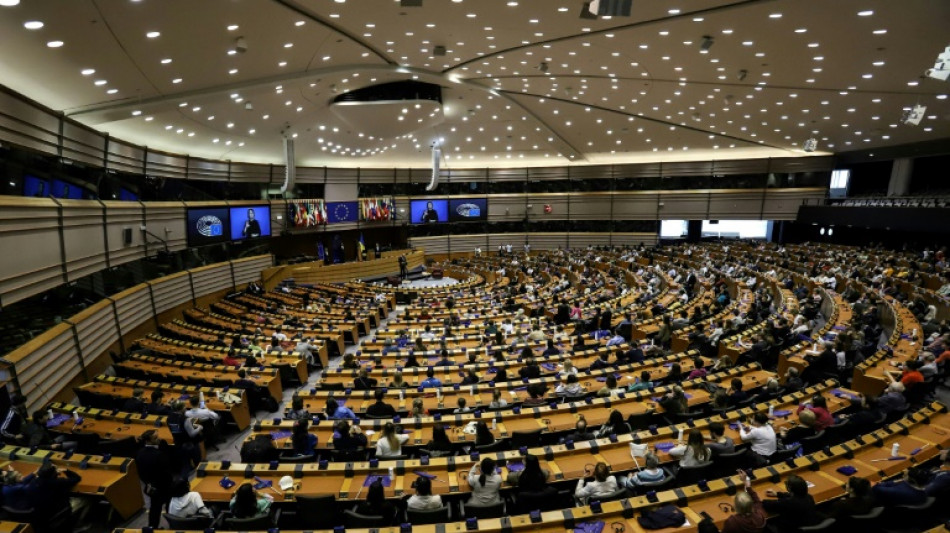
Landmark EU asylum reform goes to vote / Photo: Valeria Mongelli - AFP/File

 Oregon families grapple with explaining school shooting to children
 Israeli settlers attack European diplomats, beat French mayor

 Town hall in Limoges 'largely lost' to blaze set during French protests

 US goes on the offensive in central Asia

 Emotional Lions come up short in Champions Cup as tributes paid to Andrews

 Diaz dazzles as Bayern batter Leipzig to go top

 Inter move clear at Serie A summit with Bologna win

 Liverpool still have 'lots to improve', says match-winner Isak
 Looters ransack shops during France cost-of-living protests

 Leinster thump Clermont as grieving Lions set for Champions Cup debut

 Haaland stars in Man City win, Liverpool beat Brentford

 Dortmund go top despite Union Berlin stalemate
 Venezia upset Napoli for first Serie A win of season
 Glasgow and Bulls win as grieving Lions set for Champions Cup debut

 Smiling pope returns to Vatican after cancer surgery

 In-form Atletico scrape late win at Espanyol

 Rabada returns as S.Africa seek to bounce back against Australia

 Zverev, Medvedev ousted with Spaniards to clash for Shanghai title

 French protesters clash with police during nationwide demonstrations

 Zelensky says Trump could lift more Russia sanctions

 Jayawardene quits as coach of five-time IPL winners Mumbai

 World number 170 Kartal battles past Ostapenko to reach Wuhan final

 Pope to return to Vatican after cancer surgery
 Haze triggers highest-level alert in parts of Southeast Asia

 I'd have left Real Madrid if I were Vinicius, says Mourinho

EU lawmakers will vote Wednesday on a vast overhaul of the bloc's asylum policies that would harden border procedures for irregular arrivals and require all member countries to pitch in.
The new Migration and Asylum Pact is a package of 10 laws drawn up after years of negotiations that aim to get European Union countries -- all with different national priorities -- to act together on the issue of migration, using the same rulebook.
If just one of the laws is rejected the whole package would fail -- though it is likely that would trigger last-minute haggling.
The European Parliament's main political groups have indicated they will back the package. Parties on the far right and far left, though, are against one or more of the laws.
Migrant charities and non-governmental organisations have also come out against the pact, seeing it as a bid to buttress "Fortress Europe" and make it much harder for refugees to seek protection.
"It's a vote that is not a given," acknowledged Fabienne Keller, a French lawmaker in the parliament's centrist Renew group who shepherded one of the texts through.
The failure of one text could sink the entire package, she said, even though "a democratic majority in the European Parliament supports it".
The package would establish border centres to hold irregular migrants while their asylum requests are vetted and speed up deportations of those deemed inadmissable.
In the name of European solidarity, it would also require EU countries to take in thousands of asylum-seekers from "frontline" states such as Italy and Greece if they find themselves under pressure from inflows.
Alternatively, the other EU countries could provide money or other resources to the under-pressure nations, or offset those contributions by helping with border security.
A particularly controversial measure is the sending of asylum-seekers to countries outside the EU that are deemed "safe", if the migrant has some ties to that country.
EU home affairs commissioner Ylva Johansson said Tuesday that she was "proud" of getting the package to a voting stage.
"I do hope that we will get it," she said. "This has been a marathon."
- Long negotiations -
The pact wended through years of thorny talks and compromises.
The bloc saw the need to act in a united way when large numbers of irregular migrants arrived in 2015, many of them from war-torn Syria.
Initial ideas, such as sharing out "quotas" of migrants, butted up against refusals from several countries.
A rightward tilt in politics in much of the European Union in recent years, and increased geopolitical instability, have also complicated the search for consensus.
The European Commission drafted a revised proposal in 2020 which found political agreement in December last year.
Although many EU lawmakers from mainstream groups are alarmed about some of the harsher measures in the pact, they back it as an overall improvement on the current situation, where responsibility is not shared.
Far-right lawmakers say parts of the package do not go far enough by, for example, blocking irregular migrants coming from "safe" neighbouring countries. However, they do approve of the pact's expansion of biometric data gathering from arrivals.
Far-left lawmakers are outraged by what they see as an abandonment of European values of compassion and human dignity.
They are echoed by 161 rights organisations, among them Amnesty International, Human Rights Watch and the International Rescue Committee, which view the pact as "punitive" for migrants and asylum-seekers.
In parallel with the reform, the EU has been multiplying the sort of deal it struck with Turkey in 2016 to stem migratory flows. It has reached accords with Tunisia and, most recently, Egypt that are portrayed as broader cooperation arrangements.
If passed, the legislation is due to come into force from 2026. The European Commission is to set out over the next couple of months how the pact would be implemented.
Jean-Louis De Brouwer, a migration expert who used to be in charge of asylum and immigration policies at the Commission, expressed "serious doubts" about how the pact would end up working.
"We are heading towards a system that is objectively much more complex, and I'm not at all certain that member countries are inclined to the pick up their game," he said.
Another expert, Alberto-Horst Neidhardt of the European Policy Centre think tank, said he saw "a lot of grey areas" in the pact's application.
But he said it also contained "an opportunity to change the way the EU views its immigration policy, moving from emotion-based discussions to fact-based ones".
T.Samara--SF-PST