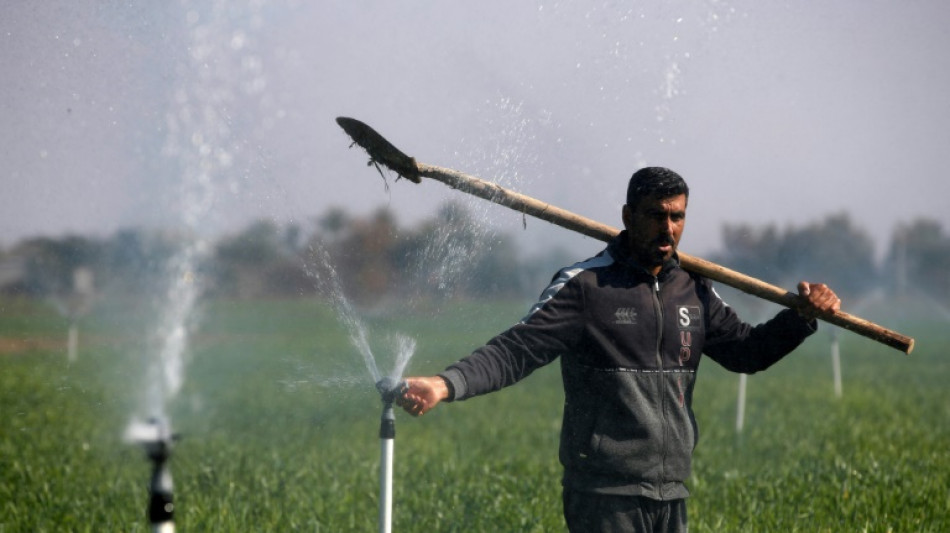
Sprinklers and drip irrigation help Iraqis beat drought
/ Photo: AHMAD AL-RUBAYE - AFP

 Rays defeat Guardians to level MLB playoff series
 Western brands under pressure as 'pre-owned' luxury booms in China
 'Never seen anything like it': mass looting grips Paris

 All Blacks back on track after South Africa wake-up
 Met Opera goes for big and bold, despite shaky finances

 Hollywood's fresh take on tech titans: from heroes to villains

 St. Louis City's unbeaten MLS run ends at 19, Union's reaches 15

 NFL Eagles bench Hurts at least a month with blood clot

 Across US, 'No Kings' events seek to boost early voting
 Tents spring up in Lisbon as Portugal housing protests spread
 'Best in world' Yamal powers Barca to Betis rout, Atletico strike late

 El Salvador's Bukele puts conditions on early release of gang prisoners

 Fire rages at town hall in France's Limoges after protests: authorities

 Unstoppable Barca thrash Betis to extend perfect start

 Maresca faces anxious wait over Haaland injury scare

 PSG fight back to beat Strasbourg after Dembele penalty miss

 Looting, blazes and clashes in France amid nationwide protests

 Walsh breaks her own 50 free world short course record

 Haaland brace extends Man City's winning start in Premier League

 'Special' Ombudsman storms to victory in Champion Stakes

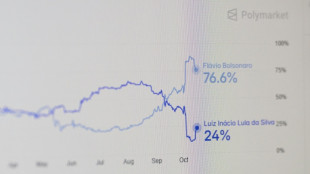 Brazil's right embraces election betting odds amid polls skepticism
 Four more Ebola cases detected in Kenya, bringing total to seven

 Clashes erupt in France as protesters vow to make government 'tremble'

 Chwalinska downs Swiatek to set up Wuhan final with world number 170 Kartal

 Chacarra takes lead as McIlroy falls away in Delhi

After four years of drought, Iraqi farmer Mohammed Sami was about to abandon his father's parched land, but then a water-saving irrigation system revived his crops and his hopes.
He is among hundreds of farmers in the country battered by heatwaves, scarce rain and depleted rivers to benefit from new water management systems brought by the UN World Food Programme.
The systems use automated sprinklers and drip irrigation to ensure scarce water is used in the most efficient way and is not lost as run-off or evaporated under the blazing sun.
"Since 2019, due to the water scarcity, we have been unable to farm the land," said 38-year-old Sami in his village of Al-Azrakiya in the central province of Anbar.
Crushed by the drought that was turning his 10 donums, or about one hectare, of land into desert, Sami started working in a nearby city as a day labourer several years ago.
"I thought about giving up farming for good," he said.
But then, two years ago, Sami's prospects changed, and his land has flourished again.
The WFP helped with a new automated irrigation system that waters his field for just two hours per day, two to three days a week.
"I now irrigate 10 donums with the same amount of water that I used for one donum before," he said, adding that his wheat harvest had shot up from seven to 12 tonnes per year.
Last year the WFP project helped more than 1,100 farmers "in areas most affected by climate change and drought," said Khansae Ghazi from the UN agency's Baghdad office.
The new irrigation systems "use 70 percent less water than traditional methods such as flooding" -- the vastly more wasteful method used for millennia.
The modern techniques allow farmers to grow diverse crops year-round, also including barley, cucumber, watermelon and eggplant, and reduce "the reliance on unpredictable rainfall", the WFP said.
- Land of Two Rivers -
Iraq, still recovering from years of war and chaos, is one of the five countries most impacted by some effects of climate change, according to the United Nations.
The site of ancient Mesopotamia, where civilisations flourished on the banks of the mighty Tigris and Euphrates rivers, Iraq now endures extreme water scarcity, worsened by upstream river dams in Iran and Turkey.
"Iraq is the Land of Two Rivers, its more than 7,000-year-old civilisation has always relied on farming," said agriculture ministry spokesman Mohammed al-Khazai.
"For decades, the country was afflicted by floods, not drought."
But as rainfall has become more irregular and water more scarce, leaving aquifers depleted, many farmers have abandoned their plots in the new dust-bowl regions.
During the 2021–22 season, the farm sector's productivity plunged by 36 percent from the previous year, said the WFP.
State authorities have restricted water use for agriculture to ensure sufficient drinking water for Iraq's 43 million people.
To fight the problem, the ministry has also started offering sprinkler systems that farmers can pay off over a decade, with the state covering 30 percent of the cost.
"At first, it was difficult for the farmer to switch to modern irrigation," said Khazai.
But now the ministry hopes to boost harvests to more than six million tons of wheat in 2024, from five million last year.
This would exceed Iraq's domestic needs and present a big jump from around two million tonnes in 2022.
The UN agency warns there are limits to the gains brought by new techniques.
"While modern irrigation systems can significantly improve water efficiency and agricultural practices in Iraq, it may not be sufficient to tackle the complex issue of drought," it said.
But for now, farmers are happy with the gains they are seeing, among them Souad Mehdi in the village of Al-Azrakiya near the Euphrates, who said she has doubled her harvest.
The 40-year-old grows wheat and barley in the winter and corn, tomatoes and eggplant in the summer on her one-hectare plot.
"It used to take us two days to water our crops," she said. Now, she fills a basin with river water then turns on the sprinklers, a task that "doesn't take more than two hours".
W.AbuLaban--SF-PST