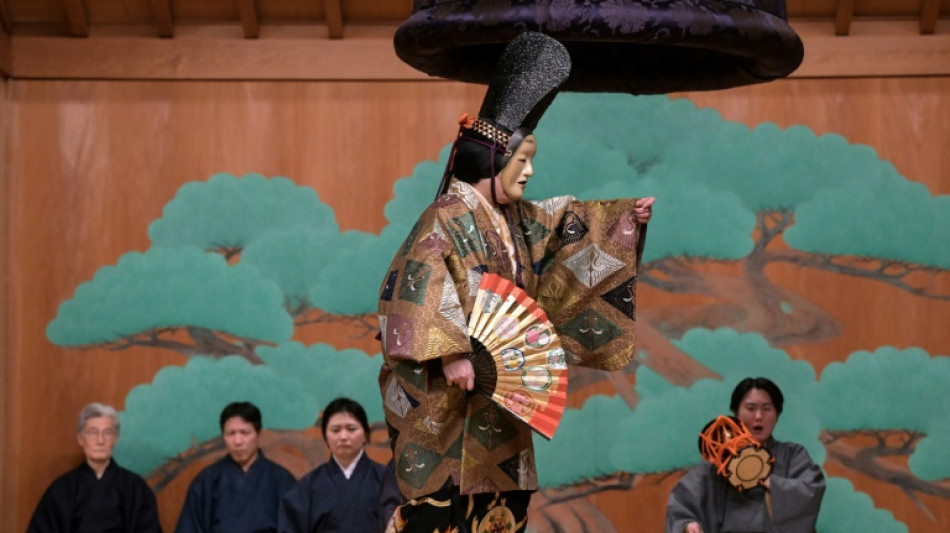
Women break into Japan's 'masculine' Noh theatre / Photo: Richard A. Brooks - AFP

 China's Yin wins in Shanghai for back-to-back LPGA titles

 After a year in turmoil, the Louvre faces uncertain future

 Dozens of orangutans saved from Indonesia blazes

 Ordinary day, extraordinary times: Kyiv under Russian attack

 What is holding up the US-India trade deal?

 Oxygen tanks, purifier sales spike as haze crisis hits Southeast Asia

 Messi brace lifts Inter Miami to 3-1 win in Atlanta

 Japan to launch historic round-trip mission to Mars moon
 Musk back in the spotlight, but politics dims the awe

 England Rugby League World Cup hopes hang by a thread

 Williams lifts Valkyries past Dream in WNBA Finals opener

 Dubois destroys Wardley to retain WBO heavyweight crown

 Oregon families grapple with explaining school shooting to children

 Israeli settlers attack European diplomats, beat French mayor

 Town hall in Limoges 'largely lost' to blaze set during French protests

 US goes on the offensive in central Asia

 Emotional Lions come up short in Champions Cup as tributes paid to Andrews

 Diaz dazzles as Bayern batter Leipzig to go top

 Inter move clear at Serie A summit with Bologna win

 Liverpool still have 'lots to improve', says match-winner Isak

 Looters ransack shops during France cost-of-living protests

 Leinster thump Clermont as grieving Lions set for Champions Cup debut

 Haaland stars in Man City win, Liverpool beat Brentford

 Dortmund go top despite Union Berlin stalemate

 Venezia upset Napoli for first Serie A win of season

Kimono-clad Mayuko Kashiwazaki delivers her lines in guttural tones and transforms into an evil snake in the lead role of a Japanese Noh play where, unusually, most of the cast are women.
Noh, with its elaborate layered costumes and hand-crafted masks, is one of the most ancient surviving forms of theatre, with origins dating back to the eighth century.
Unlike kabuki, another type of classical Japanese theatre, or sumo wrestling -- both steadfastly male -- Noh has been open to performers of both genders for over a century.
But women are still a rarity in the traditional Noh world, where fathers often pass the vocation to their sons.
Women represent just 15 percent of the 1,039 actors and musicians registered with the professional Nohgaku Performers' Association.
And their opportunities to appear on stage are "relatively limited", 43-year-old Kashiwazaki told AFP.
"One reason is that Noh audiences are generally older, and often see Noh as a masculine art form," she said.
But now it's time "for women to reflect on their future in Noh, and to play a role in building that future".
Kashiwazaki acted the principal part in "Dojoji", a famous drama about the revenge of a betrayed woman, at Tokyo's National Noh Theatre last weekend.
Twirling a fan, and wearing a heavy kimono embroidered with a crane motif, the masked actor belted out her lines in an archaic, warbling style as the story slowly unfolded.
After hiding under a prop representing the bell of a Buddhist temple, she emerged transformed as a demonic serpent character with wild, fiery tufts of red hair.
- 'Beauty and power' -
Kashiwazaki, encouraged by her Noh mentor, tried to find as many women as possible to participate in the production.
"'Dojoji' is an extremely important piece for Noh actors," Kashiwazaki said, and "you have to be very lucky to get a chance to perform it, even once in your life".
"Because I was lucky enough to have this opportunity, I thought it would be great to stage it with other female Noh actors."
Yoko Oyama, who played a handheld drum in the show, said it was unusual to see "so many women in the chorus and among the musicians on stage".
"It's not only the fact that they are women, but also that most of them are young for Noh performers, which makes the show even more special," she said.
However, for some parts, including the supporting actor or "waki" in Noh -- often a monk or priest character -- there were no women to fill the role, so it was played by a man.
"There are no women performing waki... it has always been that way," Kashiwazaki's mentor, 72-year-old Yasuaki Komparu, told AFP.
While Komparu is the scion of one of five prominent Noh families that have bred generations of actors, Kashiwazaki first discovered Noh as a student.
She was charmed by its lyrical dramas and the heavily stylised acting in a minimal setting. A painting of a pine tree behind the stage is usually the only decoration.
"I was fascinated by how cool this Japanese art form looked, and thought I could only truly understand it by taking part myself," she said.
- 'Vicious cycle' -
Kashiwazaki's first mentor tried to dissuade her from becoming a Noh actor, having experienced herself the difficulties women face in the ancient art.
Now recognised by UNESCO as "intangible cultural heritage", Noh developed towards its current form in Japan's Muromachi era from 1336-1573, a period when the performers included women among their ranks.
In the Edo era from 1603 to 1868, patronage from shoguns helped Noh's popularity grow.
But women were banned from the stage under government morality rules that repressed individual liberties.
Only at the end of the 19th century were women once again allowed to act in Noh, but they had to wait until 1948 to be recognised as professionals.
"There are extraordinary Noh actors, men and women, but the public tends to seek out a particular type of Noh, with a fixed idea of what it should be," Kashiwazaki said.
That lack of opportunities creates a "vicious cycle" because actors can't build up the experience to progress their careers, she said.
After Saturday's show, audience member Kazuaki Ieda, 40, said he was "very interested and excited" by the performance.
"I think this may be the future of Noh in Japan," Ieda said.
K.AbuTaha--SF-PST