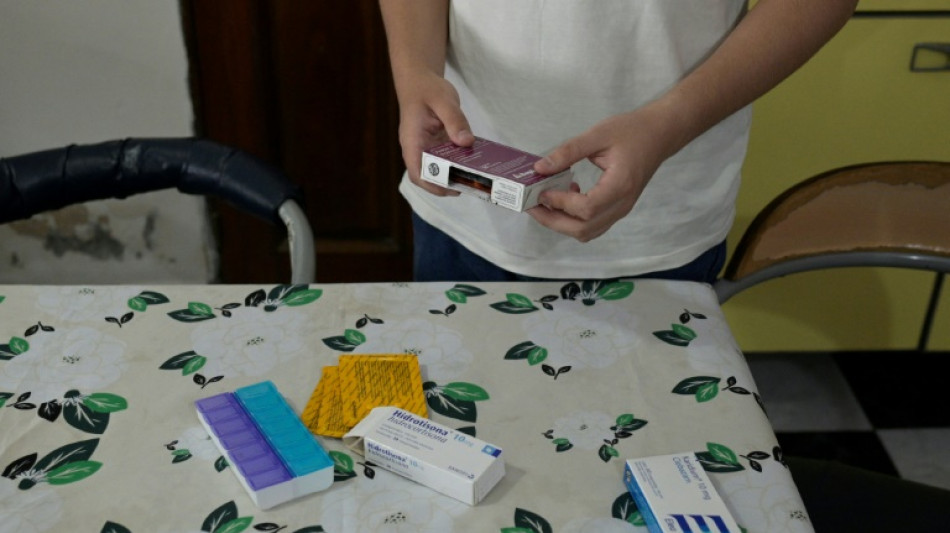
Food or medicine? Stark choice for sick Argentines / Photo: JUAN MABROMATA - AFP

 China's Yin wins in Shanghai for back-to-back LPGA titles
 After a year in turmoil, the Louvre faces uncertain future
 Dozens of orangutans saved from Indonesia blazes
 Ordinary day, extraordinary times: Kyiv under Russian attack
 What is holding up the US-India trade deal?
 Oxygen tanks, purifier sales spike as haze crisis hits Southeast Asia
 Messi brace lifts Inter Miami to 3-1 win in Atlanta

 Japan to launch historic round-trip mission to Mars moon

 Musk back in the spotlight, but politics dims the awe

 England Rugby League World Cup hopes hang by a thread

 Williams lifts Valkyries past Dream in WNBA Finals opener

 Dubois destroys Wardley to retain WBO heavyweight crown
 Oregon families grapple with explaining school shooting to children
 Israeli settlers attack European diplomats, beat French mayor

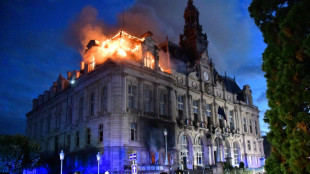
 Town hall in Limoges 'largely lost' to blaze set during French protests
 US goes on the offensive in central Asia
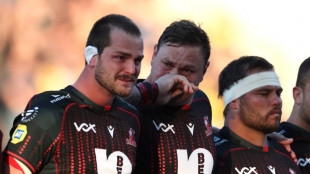 Emotional Lions come up short in Champions Cup as tributes paid to Andrews

 Diaz dazzles as Bayern batter Leipzig to go top
 Inter move clear at Serie A summit with Bologna win

 Liverpool still have 'lots to improve', says match-winner Isak
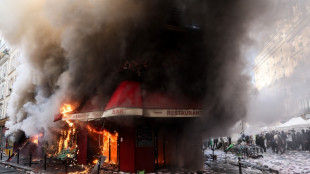
 Looters ransack shops during France cost-of-living protests

 Leinster thump Clermont as grieving Lions set for Champions Cup debut

 Haaland stars in Man City win, Liverpool beat Brentford

 Dortmund go top despite Union Berlin stalemate
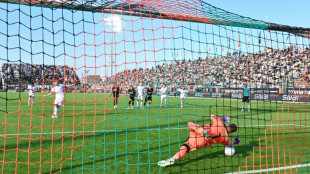 Venezia upset Napoli for first Serie A win of season
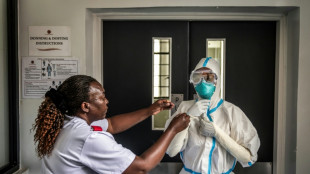
In pharmacies in crisis-riddled Argentina, people look at the prices on medicine containers, then put them down again.
Even prescription antibiotics and chronic treatments are being ditched in a country where annual inflation exceeding 250 percent means that healthcare has become a luxury for many.
"Between eating and buying medicine, people choose to eat," pharmacist Marcela Lopez told AFP from behind her counter in the capital, Buenos Aires.
Medicine sales in the country dropped by 10 million units -- bottles or boxes -- in the month of January, according to the Ceprofar pharmacists' association. More than two-thirds were prescription drugs.
Desperate patients also feel abandoned by the public health system, where many medicines have become unavailable since the government of President Javier Milei, who took office in December, ordered an audit as part of his quest to slash public spending.
Viviana Bogado, a 53-year-old cook, said she had to choose between treatment for her cholesterol and antibiotics and special food for her 16-year-old son, Daniel, for an intestinal bacteria.
She put her son first.
Since self-styled "anarcho-capitalist" Milei took over, medicine prices have risen 40 percent above inflation, itself at 254 percent year-on-year and one of the highest in the world.
At the same time, poverty levels have reached nearly 60 percent in a country where the minimum salary is the equivalent of about $200.
According to Ceprofar director Ruben Sajem, there had been an agreement between laboratories and the pre-Milei government to keep prices low.
That has since been abandoned.
- 'There is no money' -
Pharmacists say many chronic patients were reducing their prescription doses to try and save money.
"This does not serve the patient. Sooner or later their health will worsen and everything will cost more, even for the (public) health system," said Sajem.
Worst hit are retired Argentines and workers in the informal sector, who account for 40 percent of the labor market.
The state pension devalued by a third year-on-year in February, making life difficult for people like 73-year-old Graciela Fuentes, who is having a hard time treating her arthritis.
The state provides pensioners with some medicines for free, others at subsidized prices.
"I take five remedies: two of which I get free of charge, I spend 85,000 pesos per month (about $100) -- almost a third of my pension. There is no money," said Fuentes in an ironic reference to Milei's oft-used justification for public spending cuts.
Fabian Furman, the head of a community medicines bank run by a Jewish foundation, told AFP there had been a massive increase in demand for free treatments.
- 'Pablo has no time' -
Pablo Riveros, 20, suffers from paroxysmal nocturnal hemoglobinuria, a rare, life-threatening disease for which there is no cure.
The treatment to alleviate his fast-worsening symptoms costs $42,000 a month, an impossible ask from his seamstress mother.
After his diagnosis in February last year, Riveros received medication from the public healthcare system. But that stopped in November.
Riveros's family went to court seeking relief, and were told "the state is not denying us medication, but we have to wait for the audit," his mother Estela Coronel told AFP.
The only problem, "Pablo has no time" to wait, weakening by the day.
Presidential spokesman Manuel Adorni last week denied that drug delivery to patients with cancer and other serious diseases such as Riveros had ever been cut off.
"It’s painful because you feel like they're laughing in your face," said Coronel.
"They cannot deny something that we are living."
Z.AbuSaud--SF-PST