Norway salmon farms turn to veggie menu / Photo: Olivier MORIN - AFP

 Boland strikes twice for Australia in rain-hit South Africa Test

 Marseille put Angers to the sword in Ligue 1

 Albanian PM refuses to quit as violent protests enter sixth day

 Chwalinska fights back to win Wuhan Open in title breakthrough

 Kulusevski on brink of return for Spurs after 17-month absence

 Ukraine sets Saint Petersburg refinery ablaze in large-scale drone attack

 Spain's in-form Chacarra wins DP World India Championship

 Two pilots die in Saudi coalition helicopter crash near Yemen border

 Riyadh skyscraper shifts tenants online as Houthi attacks intensify

 Messi scores twice as Inter Miami defeat Atlanta United 3-1

 Qatar and Norway review bilateral ties at Oslo consultations
 Vietnam and EFTA states sign free-trade agreement in Hanoi

 Gold closes week near $4,165 as US inflation outlook pressures market

 PSG rally past Strasbourg to take Ligue 1 lead

 India’s services surplus narrows as import growth overtakes exports
 RCom professional asks Supreme Court to revisit spectrum insolvency ruling

 Debt recovery lessons after derivatives losses and repeated borrowing

 Katie Alexander reportedly leaves flat shared with Eamonn Holmes

 Body found in search for missing Glasgow teenager

 Andi King recounts late-life transition after decades behind an “alpha male” identity

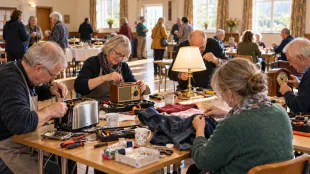 Bromsgrove Repair Cafe reports nearly 80% repair success rate

 B.C. Lions focus on playoff momentum after Calgary defeat

 PNB expects festive demand to add up to two points to quarterly credit growth

 Cyient DLM drops 12% as margin concerns overshadow quarterly growth

 Bajaj Finance set to report second-quarter results on October 19

Norway's fish farms are feeding their salmon an increasingly vegetarian diet in order to make their businesses more sustainable, but for these carnivorous pink-fleshed fish, all is not rosy.
In submerged cages at the Oksebasen fish farm, located at the crossing of two fjords in western Norway, the salmon are under constant watch on mobile underwater cameras.
At the first sign the fish are feeling a little peckish, employees at an operations centre 100 kilometres (60 miles) away turn on a "sub-feeder" which releases special pellets swiftly gobbled up by the hungry fish.
The small brown granules consist primarily of plant-based materials, 20 to 30 percent fish oil and meal, as well as vitamins, minerals and pigment to give the salmon's flesh its characteristic pink colour.
"Before, fish feed was made exclusively of marine ingredients," or in other words, wild fish, explains operations manager Magnulf Giske at the world's largest producer of Atlantic salmon, Mowi.
"But it's a less sustainable solution than replacing some of these marine ingredients with soy protein, for example. So that's the direction we've gone in," he said.
For the industry, avoiding overfishing is a question of sustainability, but also, and primarily, a way of ensuring that business can continue to grow.
With limited stocks of the small fish typically used in fish meal, such as anchovies, sprat and herring, fish farms have increasingly turned to cheaper plant-based materials to be able to ramp up production.
"There just wasn't enough fish meal in the world to supply the industry," said Erik-Jan Lock, a researcher at the Norwegian food research institute Nofima.
- Going against nature -
The use of wild fish in fish feed has decreased in recent years but still remains an ingredient, according to environmental organisations, concerned about the negative impact that the fishing of these fish has on aquatic birds and impoverished populations in places such as West Africa.
The fish in the feed, as well as the soy and plant protein, "could have been used directly for human consumption" but they are instead given to "salmon in order to make a more expensive, more well-paid product for the rich," lamented Truls Gulowsen, head of the Norwegian branch of Friends of the Earth.
"It is, globally speaking, a quite sad way of using scarce resources for a growing global population that needs food and needs protein," he said.
"We don't really need salmon fillet."
While Norwegian producers of animal feed agreed in 2015 to use only sustainably-produced soy, the growing use of plant-based materials has not been without its challenges.
"The more (of a) vegetarian diet the fish-eating salmon get, the more distant that is from its original life, and adds to the escalating difference between the original wild salmon and the domesticated farmed salmon," said Gulowsen.
Farmed salmon "grows faster, it develops differently, it acts differently," he said, adding: "We have frequent escapes of farmed salmon that sometimes pollute the natural wild salmon stocks."
"The more different the new salmon is, the riskier the genetic pollution of natural stocks becomes."
- Flies to the rescue? -
Nofima says fish farms need to find alternative methods in order to reduce their environmental footprint.
"Is salmon feed more sustainable than it was last year, or the year before? Yes," says Erik-Jan Lock. "Can it become even more sustainable? Yes, obviously."
Making better use of human food waste, or using little-used marine resources such as mussels and sea squirts or even insects are among the possible options that could be explored.
The Pronofa company is researching sustainable protein alternatives.
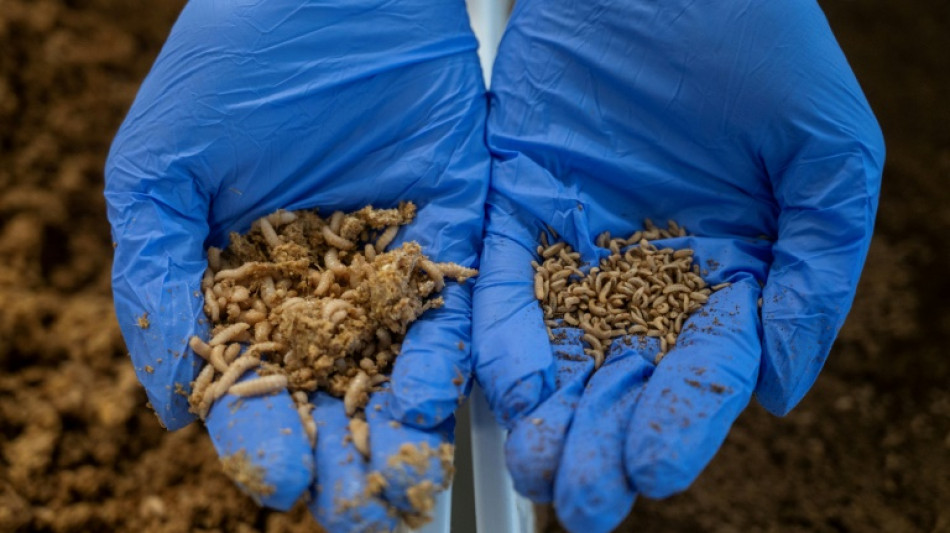
In containers at its site in the southeastern town of Fredrikstad, it is studying the black soldier fly, whose larvae increase their weight 7,000-fold in just two weeks.
"The fish industry in Norway gives human food to the salmon, to the fish, which is not actually a good thing to do. Here we have a good alternative to fish meal," says project manager David Tehrani.
Black soldier flies "are the best machines nature gives us: they eat all the time, they don't sleep, they don't take a coffee break."
"Apart from glass, concrete and steel, they eat everything".
The only catch? It's a pricier solution.
Fish farmers, for whom feed represents their biggest cost, have yet to take the bait.
J.Saleh--SF-PST