German economy buffeted by 'perfect storm' / Photo: JOHN MACDOUGALL - AFP/File

 Boland strikes twice for Australia in rain-hit South Africa Test

 Marseille put Angers to the sword in Ligue 1
 Albanian PM refuses to quit as violent protests enter sixth day
 Chwalinska fights back to win Wuhan Open in title breakthrough
 Kulusevski on brink of return for Spurs after 17-month absence

 Ukraine sets Saint Petersburg refinery ablaze in large-scale drone attack
 Spain's in-form Chacarra wins DP World India Championship

 Two pilots die in Saudi coalition helicopter crash near Yemen border

 Riyadh skyscraper shifts tenants online as Houthi attacks intensify

 Messi scores twice as Inter Miami defeat Atlanta United 3-1

 Qatar and Norway review bilateral ties at Oslo consultations
 Vietnam and EFTA states sign free-trade agreement in Hanoi

 Gold closes week near $4,165 as US inflation outlook pressures market

 PSG rally past Strasbourg to take Ligue 1 lead

 India’s services surplus narrows as import growth overtakes exports
 RCom professional asks Supreme Court to revisit spectrum insolvency ruling

 Debt recovery lessons after derivatives losses and repeated borrowing

 Katie Alexander reportedly leaves flat shared with Eamonn Holmes

 Body found in search for missing Glasgow teenager

 Andi King recounts late-life transition after decades behind an “alpha male” identity

 Bromsgrove Repair Cafe reports nearly 80% repair success rate

 B.C. Lions focus on playoff momentum after Calgary defeat

 PNB expects festive demand to add up to two points to quarterly credit growth
 Cyient DLM drops 12% as margin concerns overshadow quarterly growth
 Bajaj Finance set to report second-quarter results on October 19

Weaker exports, costly energy and a stuttering green transition have combined to form a "perfect storm" for the German economy, leaving Chancellor Olaf Scholz's coalition bickering over how to change course.
The government will unveil its latest economic forecasts for 2024 on Wednesday, with media reports suggesting a sharp downgrade to a mere 0.2 percent growth.
In its autumn projections, the government was still expecting output to expand by 1.3 percent.
The country ended 2023 in recession, shrinking by 0.3 percent, and the latest data suggest the first quarter of 2024 will see another contraction.
Germany also risks facing anaemic growth up to 2028 if no action is taken, German media said.
The German economy, Europe's largest and traditionally a driver of eurozone growth, is being buffeted by "a perfect storm", Economy Minister Robert Habeck said earlier this month.
The situation was "dramatically bad", he added.
Germany's once-mighty industrial sector has been hit particularly hard by multiple headwinds.
Having previously relied on cheap Russian gas imports, the sector is still reeling from the energy price surge triggered by Russia's invasion of Ukraine.
The European Central Bank's streak of interest rate hikes to tame inflation has added to the pain, dampening demand and investments.
Exports have slumped on weaker trading with key markets such as China, which increasingly produces its own goods. Geopolitical tensions including shipping disruptions in the Red Sea have added to trading woes.
The long-promised shift to a greener economy meanwhile, requiring major public and private investment, has run into fresh hurdles after a shock legal ruling last year forced the government to rethink some of its climate spending plans.
Attractive green subsidies in the United States have already lured away some German firms, who complain of a lack of incentives offered by Scholz's government.
German chemical giants BASF and Bayer were among some 60 companies this week issuing a joint appeal to European Union leaders to adopt a "European industrial deal" to help pull the sector out of the doldrums.
"Without a targeted industrial policy, Europe risks becoming dependent even on basic goods and chemicals. Europe cannot afford this to happen," the statement read.
- Debt brake row -
In an open letter at the weekend, 18 federations representing the "Mittelstand" of small- and medium-sized companies seen as the backbone of the German economy, urged politicians to take action.
"It's one minute to midnight. What's at stake is nothing less than the rescue of the German Mittelstand," it said.
But the three parties that make up Scholz's coalition of the Social Democrats, the Greens and the liberal FDP, are at odds over how to respond.
Finance Minister Christian Lindner from the pro-business FDP wants to ease the tax burden and cut red tape for businesses.
"If we do nothing, Germany will become poorer," he has warned.
A draft law that would reduce taxes on corporations by around seven billion euros ($7.5 billion) a year is due to be approved by lawmakers on Wednesday, after months of squabbling.
But Economy Minister Habeck, from the ecologist Greens, wants to go further.
He has called for a relaxation of the government's constitutionally enshrined "debt brake", a self-imposed cap on annual borrowing that critics say has hampered much-needed spending on modernising infrastructure and financing environmentally-friendly projects.
Tensions over the brake spiralled after a top court in November found that the government broke the debt rule when it transferred billions of euros earmarked for pandemic support into a climate fund, throwing Scholz's budget into disarray.
While Scholz's Social Democrats have since signalled an openness to tweaking the rules, any loosening of the debt brake remains a red line for the FDP.
The economic headwinds have contributed to a steep decline in support for the government.
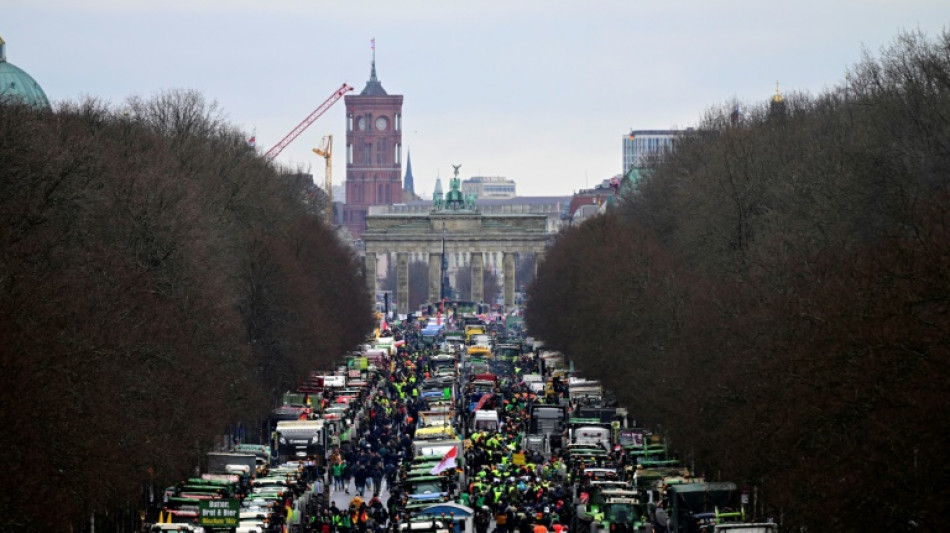
Plans to scrap agricultural fuel subsidies triggered nationwide tractor protests last month, with many farmers voicing dissatisfaction with Scholz and his coalition partners.
FDP secretary general Bijan Djir-Sarai recently called the coalition's future into question.
"An economic turnaround is necessary," he told the Bild newspaper. Whether the coalition is capable of making the needed changes will be "the deciding point in the coming weeks and months", he added.
R.Shaban--SF-PST