US, UK, Australia vow to cooperate on hypersonic weapons

 'Something we dreamed of': Bangladesh celebrates historic cricket win

 Rain holds up India on day two of Sri Lanka Test

 The Ukrainian social media channels tracking Russian missiles

 Disney offers fans an escapist bubble at D23 event
 Thousands await aid after deadly Indonesian quake

 Chinese ship sets off for Europe through Arctic, halving travel time

 Bangladesh on verge of historic win in Australia as Mehidy takes five

 Messi sees penalty saved as Nashville routs Inter Miami in MLS
 Heat is on as German winegrowers struggle to protect vines

 Hope fades for finding survivors of Colombia quake as rescued woman dies

 Japan aims for the moons of Mars
 'People could get hurt': Conservationists decry AI wildlife visuals

 'Another chance to live': Flores residents recall quake panic
 Rivers among nine inducted into Basketball Hall of Fame

 No.1 Scheffler leads by two at PGA St. Jude playoff event

 Rennie confident Jordan, Roigard will be fit to face Springboks

 PSG sign Belgian winger Godts from Ajax

 Nillessen claims shock European 1,500m gold
 Taylor scores two tries in winning debut as New Zealand captain

 England defender Spence leaves Spurs for Inter Milan

 Moore double leads Spurs to 3-0 friendly win over Hoffenheim

 Man Utd beaten by former boss Amorim's AC Milan in friendly finale

 Villagers evacuate as Belgium battles record wildfire

 Despite booming economy, young Moroccans still dream of Europe

 South Korea president proposes talks with North to formally end Korean War

The United States, Britain and Australia said Tuesday they would begin collaborating on hypersonic missile strike and defence capacity, as rivals Russia and China advance rapidly in the cutting-edge technology.
The trio said they would work on hypersonics in an expansion of their recent AUKUS defence alliance, which is to equip Australia with nuclear-powered submarines to counter China's growing military clout.
They pledged "new trilateral cooperation on hypersonics and counter-hypersonics, and electronic warfare capabilities" in a statement by US President Joe Biden, British Prime Minister Boris Johnson and Australian Prime Minister Scott Morrison.
Hypersonic missiles can travel more than five times the speed of sound and manoeuvre in mid-flight, making them much harder to track and intercept than traditional projectiles.
They may carry conventional or nuclear warheads.
Hypersonics and related technologies were now "very much a part of what the AUKUS partnership is striving to deliver", Australia's Morrison told reporters on Wednesday.
But there were few details about what the leaders' hypersonic plan entailed.
Marcus Hellyer, defence analyst at the Australian Strategic Policy Institute, said it was hard to judge "what is actually new" in the statement.
Australia and the United States were already working together on hypersonics, he said, although the new commitment may open up new areas of cooperation with Britain.
Australia announced in December 2020 it would work with the United States on developing hypersonic weapons in a so-called SCIFIRE programme.
And Canberra committed in its 2020 defence strategy programme to invest Aus$6.2 billion-9.3 billion (US$4.7 billion-7.0 billion) in high-speed, long-range strike and missile defence, including hypersonics.
- Russia ahead -
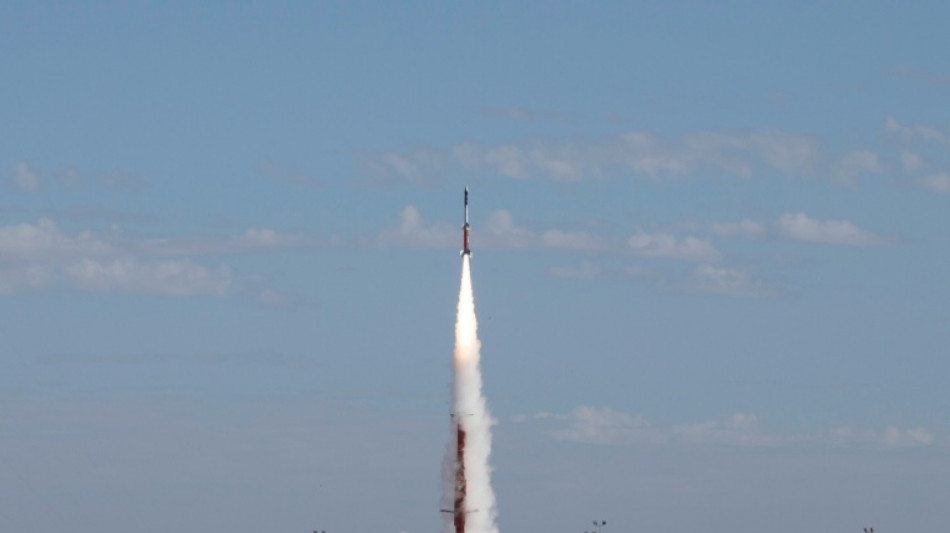
On the same day as the latest AUKUS announcement, the US military said it had recently completed a free-flight test of an aircraft-launched hypersonic missile that maintained a speed of more than Mach 5.
But rival powers are making rapid advances.
Russia is the most advanced nation in hypersonics while China is also aggressively developing the technology, according to the US Congressional Research Service.
Last month, Moscow claimed it had twice fired its newest Kinzhal hypersonic missiles to hit targets in Ukraine.
Russia has also claimed a series of successful tests including firing a Zircon hypersonic missile from a submerged submarine.
China tested a nuclear-capable hypersonic missile that circled the Earth last year, according to media reports confirmed by the Pentagon's top general. China said it was "a routine spacecraft test".
North Korea claimed to have carried out two hypersonic missile tests in January.
The United States, Britain and Australia launched AUKUS last September, vowing to provide Australia with the technology to build a nuclear-powered, conventionally armed submarine fleet, giving it greater stealth and reach in the Pacific region.
As a result, Canberra scrapped a multibillion-dollar submarine deal with France, infuriating Paris.
The three leaders said Tuesday they were "pleased" with progress on the Australian submarine programme.
D.Khalil--SF-PST