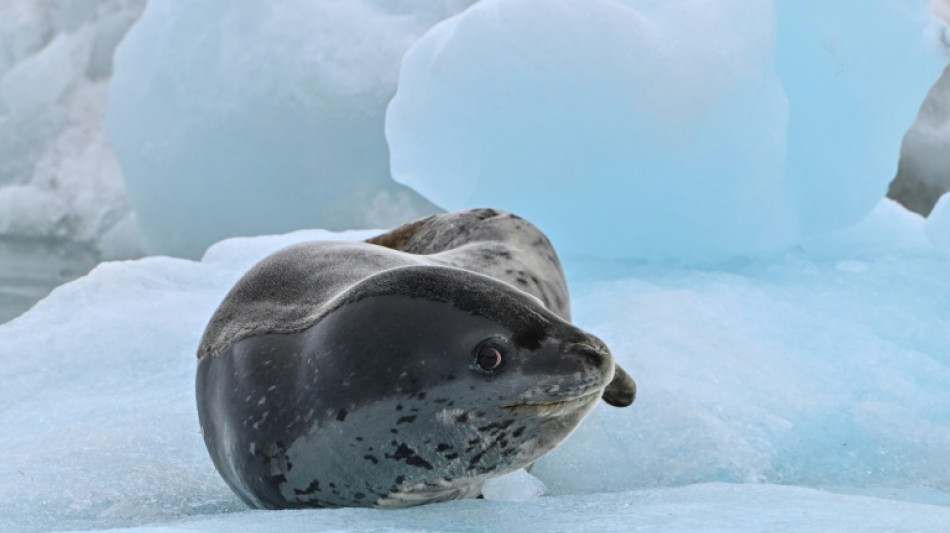
Scientists study levels of toxic mercury in Antarctic seals, whales / Photo: JUAN BARRETO - AFP

 Mbappe hits two as Real Madrid rout Sevilla

 Browns edge Ravens for division lead, Texans beat Jags

 Lyon go top of Ligue 1 as Monaco fall to first defeat of the season

 Venezuela opposition alliance reaffirms Nobel laureate Machado as leader

 'Street Fighter' wins N. America box office, buzzy doc stuns in 2nd

 NFL: Paris game to go ahead despite protests in France

 Arteta hails Arsenal 'finishers' after Madueke fells Forest

 Trump backs ally Netanyahu ahead of Israel's tight election

 Madueke strikes late as below-par Arsenal sink Forest

 Second day of street clashes in Milan

 Dupont's Toulouse hold off Exeter as English Champions Cup woes continue

 Zelensky speaks to US envoys amid Trump spat

 Paris police in new battles with protesters and looters

 Multiple deaths, injuries at western Canada military base: minister

 Boland strikes twice for Australia in rain-hit South Africa Test

 Marseille put Angers to the sword in Ligue 1

 Albanian PM refuses to quit as violent protests enter sixth day

 Chwalinska fights back to win Wuhan Open in title breakthrough
 Kulusevski on brink of return for Spurs after 17-month absence

 Ukraine sets Saint Petersburg refinery ablaze in large-scale drone attack

 Spain's in-form Chacarra wins DP World India Championship

 Robertson and Selby chase rare Home Nations sweep in Belfast

 Arteta backs Kai Havertz to become a 30-goal Arsenal forward

 Emiliano Martinez expects Chelsea return within weeks after surgery

 Sri Lanka choose to field against Pakistan in tri-series opener

A gunshot interrupts the peaceful sleep of a leopard seal, lying nonchalantly on a small piece of ice floating in the shadow of an Antarctic glacier.
Researcher Diego Mojica lowers his rifle.
The mammal, one of the largest predators on the White Continent after the orca, flinches from the impact of the remote biopsy -- a small red pipette that bounces off its skin, taking with it a piece of flesh -- and swims away.
Mojica, a Colombian marine biologist, descends from his boat alongside Livingston Island, in the South Shetland archipelago, to retrieve his sample.
Excitedly, he explains to an AFP team accompanying him on a day of research amid the glaciers, how rare it is to get so close to a leopard seal -- a solitary and usually aggressive species that feeds on penguins.
Mojica is studying the impact of mercury, used in activities such as mining thousands of kilometers away, on Antarctica's large mammals.
The toxic heavy metal is believed to reach the ocean through rivers or rain, after it "evaporates into the air," said Mojica, who works for Colombia's Malpelo Foundation, which specializes in the study of marine fauna.
Scientists at Spain's University of Murcia have previously found mercury in the feathers of chinstrap penguins on King George Island, the closest point in Antarctica to the Americas.
The pollution appears to extend south to Livingston Island and the Gerlache Strait, a natural channel off Antarctica.
The United Nation's Global Mercury Partnership warns that marine mammals, because they are "at the top of the food chain, are particularly susceptible to contamination" by the metal.
Later on his voyage -- a Colombian scientific expedition to Antarctica -- Mojica finds himself surrounded by humpback whales.
When a tail or back pokes out of the rough waters, he carefully takes aim with his rifle.
This time, he retrieves his sample of skin and fat from the freezing waters using a net.
Humpback whales consume large quantities of krill, small crustaceans susceptible to mercury contamination.
Mojica will study the samples to determine if "mercury has been transmitted from one link to the next in the food chain."
According to UN environmental agency UNEP, if an animal consumes mercury, it may suffer "reproductive failure, behavioral changes and may even (die)."
In 2013, 140 countries signed the Minamata Convention to reduce the use of mercury, which can cause severe health problems.
Some 9,000 tons of the toxic substance are released into the atmosphere every year.
Artisanal mining is the main source of mercury emissions, where the element is used to collect gold by binding to it.
Coal combustion is another major source. But mercury is also present in many household products like batteries, some lightbulbs and even mascara.
"We want to do our part to be able, as much as possible, to propose credible measures for the conservation and protection of these emblematic mammals," said Mojica.
E.Qaddoumi--SF-PST