
US could jail foreign officials under new bribery law / Photo: PIUS UTOMI EKPEI - AFP/File

 Kings' Ben Simmons tears Achilles in training

 Lula, Bolsonaro set for first debate showdown in bitter election race

 Mbappe hits two as Real Madrid rout Sevilla

 Browns edge Ravens for division lead, Texans beat Jags

 Lyon go top of Ligue 1 as Monaco fall to first defeat of the season

 Venezuela opposition alliance reaffirms Nobel laureate Machado as leader

 'Street Fighter' wins N. America box office, buzzy doc stuns in 2nd

 NFL: Paris game to go ahead despite protests in France

 Arteta hails Arsenal 'finishers' after Madueke fells Forest

 Trump backs ally Netanyahu ahead of Israel's tight election

 Madueke strikes late as below-par Arsenal sink Forest
 Second day of street clashes in Milan

 Dupont's Toulouse hold off Exeter as English Champions Cup woes continue

 Zelensky speaks to US envoys amid Trump spat

 Paris police in new battles with protesters and looters
 Multiple deaths, injuries at western Canada military base: minister

 Boland strikes twice for Australia in rain-hit South Africa Test

 Marseille put Angers to the sword in Ligue 1

 Albanian PM refuses to quit as violent protests enter sixth day

 Chwalinska fights back to win Wuhan Open in title breakthrough
 Kulusevski on brink of return for Spurs after 17-month absence

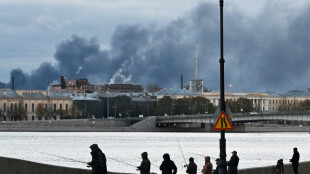 Ukraine sets Saint Petersburg refinery ablaze in large-scale drone attack

 Spain's in-form Chacarra wins DP World India Championship

 Robertson and Selby chase rare Home Nations sweep in Belfast

 Arteta backs Kai Havertz to become a 30-goal Arsenal forward

Anticorruption activists around the world have high hopes for a new US law that for the first time allows Washington to prosecute foreign officials who receive bribes.
The law broadens the enforcement profile of the US Foreign Corrupt Practices Act, which has long been used to punish companies that pay bribes and their shadowy agents.
Such players come from the "supply" side of the illicit payment equation -- those paying the bribes. The new Foreign Extortion Prevention Act (FEPA) targets the "demand" side: foreign government officials who seek or accept payouts.
President Joe Biden signed the measure into law in December as part of a National Defense bill.
Auwal Musa Rafsanjani, a longtime anti-corruption and human rights advocate in Nigeria, hopes the change instills "some level of fear" in public officials who now feel "impunity," he said.
"Public officials will engage in all sorts of corrupt practices and they will never be punished for anything," said Rafsanjani.
"Every employee for every foreign government is now going to be on notice that the weight of the US government could come after them," said Scott Greytak, a director of advocacy at Transparency International. "That is going to change behavior."
But Mike Koehler, a professor at Southern Illinois University School of Law, said the deterrent benefit of the FCPA has long been overstated.
Koehler considers the new measure "tokenism" and instead favors greater transparency and encouragement of other countries to enforce their own laws as the means to reduce bribery.
- Cold War statute -
The FCPA was drafted in response to mid-1970s revelations of payments by large US companies to foreign officials that surfaced through the Watergate investigations.
While barring US companies from making such payments, the 1977 FCPA statute, enacted during the Cold War, barred prosecution of officials with foreign governments because of concerns it could hinder US diplomatic priorities.
Over time, the Justice Department has still managed to target corrupt foreign officials under other statutes, such as money laundering.
Among the biggest FCPA cases in recent years, Goldman Sachs in October 2020 paid $2.9 billion in a US deferred prosecution agreement over bribes to Malaysian and Abu Dhabi officials to win business.
Rafsanjani has pointed to a sprawling prosecution by the DOJ and other countries of a four-company consortium that won some $6 billion in contracts to build liquefied natural gas facilities in Bonny Island, Nigeria.
The case included a $402 million criminal file on Halliburton unit KBR in 2009. But Nigerian officials were not jailed in the case.
"What needs to be done is for countries like the US to be in alliance with other countries," said Rafsanjani, who is working to publicize FEPA within Nigerian agencies.
- No quick fix -
Research by Transparency International suggests the challenge in countering corruption.
The group's annual "Corruption Perceptions Index" released Tuesday showed more than two-thirds of countries scoring below 50 due to poorly-financed enforcement and other governance ills. Nigeria scored "25" on the scale, with 100 the best.
Foreign policy concerns could continue to dissuade prosecutions even with FEPA, note legal experts, who also say enforcement will be difficult if governments are unwilling to extradite defendants.
Supporters of FEPA see it as a way to make fighting corruption a priority. The law requires the Justice Department to report annually on the frequency of bribes and its enforcement record.
FEPA puts fighting corruption "front and center," said Patrick Stokes, who prosecuted the Bonny Island case while at DOJ and now is a partner at Gibson Dunn.
"As a practical matter the new statute only marginally expands DOJ's tools for going after corruption," he said, noting that money laundering laws can be used to prosecute foreign officials.
"The statue may have real deterrence value by making clearer to foreign officials that they can be prosecuted for soliciting and accepting bribes," Stokes said.
Jason Linder, a former US prosecutor who now works at Mayer Brown, said the demand side "has remained robust because corruption is endemic in some countries," and existing enforcement in developed countries only reaches a "very small percentage of corrupt conduct."
While FEPA is a "very constructive step," Linder said, "it remains to be seen how DOJ will enforce it."
Success, he said, will have to be measured "over the coming decades, not just the next few years."
N.Shalabi--SF-PST