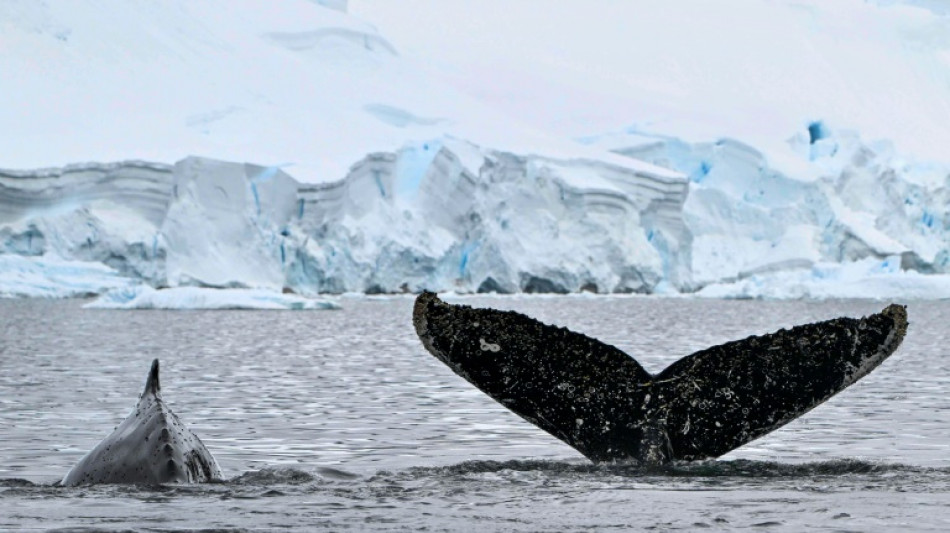
In Antarctica, scientists study extent of microplastics / Photo: JUAN BARRETO - AFP

 Kings' Ben Simmons tears Achilles in training

 Lula, Bolsonaro set for first debate showdown in bitter election race

 Mbappe hits two as Real Madrid rout Sevilla

 Browns edge Ravens for division lead, Texans beat Jags

 Lyon go top of Ligue 1 as Monaco fall to first defeat of the season

 Venezuela opposition alliance reaffirms Nobel laureate Machado as leader

 'Street Fighter' wins N. America box office, buzzy doc stuns in 2nd

 NFL: Paris game to go ahead despite protests in France

 Arteta hails Arsenal 'finishers' after Madueke fells Forest

 Trump backs ally Netanyahu ahead of Israel's tight election

 Madueke strikes late as below-par Arsenal sink Forest

 Second day of street clashes in Milan

 Dupont's Toulouse hold off Exeter as English Champions Cup woes continue

 Zelensky speaks to US envoys amid Trump spat

 Paris police in new battles with protesters and looters

 Multiple deaths, injuries at western Canada military base: minister

 Boland strikes twice for Australia in rain-hit South Africa Test

 Marseille put Angers to the sword in Ligue 1

 Albanian PM refuses to quit as violent protests enter sixth day

 Chwalinska fights back to win Wuhan Open in title breakthrough
 Kulusevski on brink of return for Spurs after 17-month absence

 Ukraine sets Saint Petersburg refinery ablaze in large-scale drone attack

 Spain's in-form Chacarra wins DP World India Championship

 Robertson and Selby chase rare Home Nations sweep in Belfast

 Arteta backs Kai Havertz to become a 30-goal Arsenal forward

In remote Antarctica, Colombian marine biologist Paulo Tigreros dips a net into the icy waters in his hunt for microplastics in what should be one of the best-preserved ecosystems in the world.
Like a sieve, the net lets water pass through as it retains the small solid particles that float in the Gerlache Strait, a natural corridor approximately 160 kilometers (99 mile) long separating the Palmer Archipelago and the end of the Antarctic Peninsula.
Microscopic studies and other tests on the samples will allow the team of scientists to determine the level of microplastics they contain.
Microplastics are particles made of polymers and other toxic compounds that are smaller than five millimeters, and have come under increasing global attention as they have been found in oceans, clouds, food and throughout the bodies of animals and humans.
Tigreros, 51, and his colleagues are aboard the ARC Simon Bolivar, a Colombian navy vessel carrying out a scientific expedition in the Antarctic and have no doubt that they will detect microplastics on their mission.
Research carried out in 2019 by New Zealand's University of Canterbury revealed the existence of microplastics in Antarctic snow.
More than 430 million tonnes of plastic are produced each year worldwide, according to the UN.
Microplastics come from the breakdown of products such as synthetic car tires, textiles, and ordinary consumer products.
Little is yet known about their impact on human health and the environment.
Tigreros said microplastics are already "omnipresent" in the oceans and their effects can be fatal for animals and ecosystems.
"We consider Antarctica as a continent totally isolated" from human activity, but "it reflects the environmental problems" of the planet, said Jorge Tadeo Lozano, a researcher at the University of Bogota, who is taking part in the expedition.
He said microplastics may have arrived in the region via ocean currents. They can also be transported in the atmosphere and through the excrement of marine animals and fish.
With tweezers, Tigreros picks up a krill and some algae from his sample.
The tiny marine crustacean feeds on the microscopic algae known as phytoplankton, but often mistakes tiny microplastic particles for its food.
Krill in turn is a food source for many larger animals, thus contaminating the rest of the food chain.
"When a whale feeds on this krill, the microplastic most likely enters its intestines," affecting its lung system, reproductive system and even its ability to swim, said Tigreros.
The Antarctic ice sheet, home to penguins and seals, has been suffering for years from rising global temperatures.
The International Atomic Energy Agency (IAEA), in cooperation with Argentina, this month launched its first scientific research expedition to investigate the extent of microplastics in Antarctica.
According to the IAEA, microplastics could further damage the great white continent "by reducing ice reflectivity, altering surface roughness, promoting microbial activity, acting as thermal insulators, and contributing to mechanical weakening of the ice structure."
According to the World Meteorological Organization, the melting of glaciers, which contain 90 percent of the planet's freshwater, could cause sea levels to rise by up to 60 meters.
O.Farraj--SF-PST