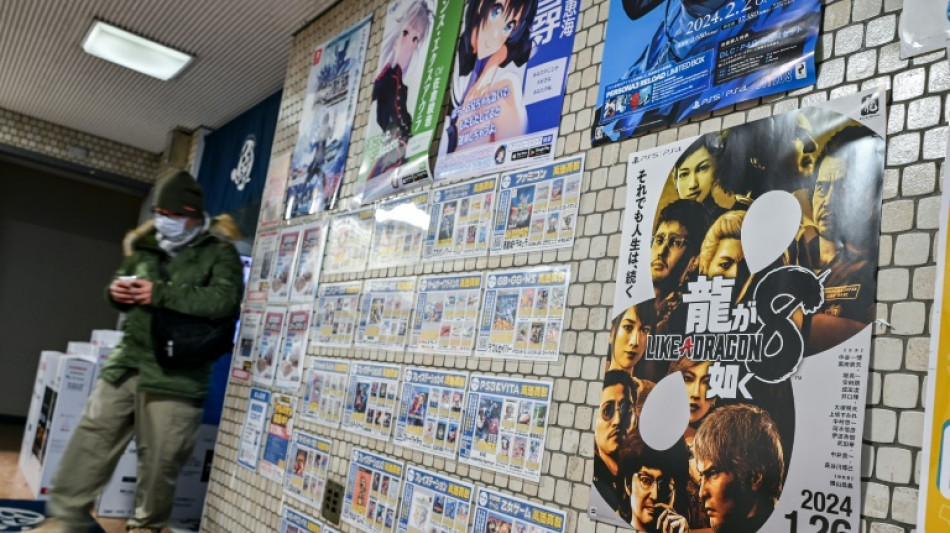
From Japan to the world: how to translate a game / Photo: Richard A. Brooks - AFP

 Rubio seeks to strengthen US foothold in Central Asia

 LeBron joins 76ers to chase one more NBA title at age 41

 Rays one win from World Series return after downing Guardians

 Kings' Ben Simmons tears Achilles in training
 Lula, Bolsonaro set for first debate showdown in bitter election race

 Mbappe hits two as Real Madrid rout Sevilla

 Browns edge Ravens for division lead, Texans beat Jags

 Lyon go top of Ligue 1 as Monaco fall to first defeat of the season

 Venezuela opposition alliance reaffirms Nobel laureate Machado as leader

 'Street Fighter' wins N. America box office, buzzy doc stuns in 2nd

 NFL: Paris game to go ahead despite protests in France

 Arteta hails Arsenal 'finishers' after Madueke fells Forest

 Trump backs ally Netanyahu ahead of Israel's tight election

 Madueke strikes late as below-par Arsenal sink Forest

 Second day of street clashes in Milan

 Dupont's Toulouse hold off Exeter as English Champions Cup woes continue

 Zelensky speaks to US envoys amid Trump spat

 Paris police in new battles with protesters and looters

 Multiple deaths, injuries at western Canada military base: minister

 Boland strikes twice for Australia in rain-hit South Africa Test

 Marseille put Angers to the sword in Ligue 1

 Albanian PM refuses to quit as violent protests enter sixth day

 Chwalinska fights back to win Wuhan Open in title breakthrough

 Kulusevski on brink of return for Spurs after 17-month absence

 Ukraine sets Saint Petersburg refinery ablaze in large-scale drone attack

Behind the global success of Japanese video games lies a delicate task: appealing to overseas players whose expectations on issues such as sexism are increasingly influencing the content of major titles.
With the majority of sales for big games now outside Japan, everything from slang words to characters' costumes must be carefully considered for a global audience.
It is a complex process that has come a long way since the "Wild West" of the 1980s and 90s, one high-profile "localisation" team told AFP.
"There were no rules, no 'industry standards', and the quality of localisation could vary greatly from one title to the next," said the SEGA of America team who worked on "Like a Dragon: Infinite Wealth" -- the latest title in the hit "Yakuza" series, releasing on Friday.
Back then, translators faced constraints including too-small text boxes, and sometimes game developers did the job themselves in less-than-perfect English.
It also meant that many games from the era, especially dialogue-heavy ones, never made it out of Japan.
"Thankfully, the industry -- and perhaps more importantly consumers -- have changed a lot since those days, and we are now able to be more faithful to the cultural and emotional content of Japanese games than ever," the SEGA team said.
Localisation is now integral to the design process, with international gamers in mind from the start.
One key example is "how Japanese game developers dress their heroines" as the #MeToo movement changes mindsets, said Franck Genty, senior localisation manager at Japanese game giant Bandai Namco.
"We tell them that the cleavage is a bit too exposed, or the skirt is a bit too short," he told AFP.
"Before, they weren't very flexible, but they've become more proactive on such subjects."
- 'Puck Man' -
The puzzle of game localisation affected the 1980 arcade sensation "Pac-Man", with the direct translation "Puck Man" deemed too risky because it could be vandalised.
Some top-selling games including Mario, Final Fantasy and Pokemon involve fantasy worlds that are not overtly Japanese, offering some flexibility for their adaptation.
But the task becomes trickier for series such as "Yakuza", which are set in real-life locations and use slang from Japan's underworld.
Getting it right is important: around 70 percent of revenue from recent titles in the "Yakuza" series is from overseas.
But in recent years, booming interest in manga comics, anime cartoons and wider Japanese culture has made the job easier.
"People know what ramen is now... we don't need to say 'noodles' any more," Genty said.
His team at the European headquarters of Bandai Namco has adapted games including the "Tekken" fighting series and the smash-hit role-playing game "Elden Ring" into a dozen languages.
The job is as much a cultural challenge as a linguistic one, said Pierre Froget, localisation project manager at Bandai.
"The player, whichever country they're from, should understand and feel the same thing as someone playing in the original language," he said.
- 'No longer acceptable' -
A better understanding of Japanese culture among players means adaptations can be more subtle -- the "Yakuza" series is now called "Like a Dragon", closer to the original Japanese.
LGBTQ caricatures and sexist cliches have also been axed.
"Many representations which were normal in Japan in the first 'Like a Dragon' games are no longer acceptable today," Masayoshi Yokoyama, the series' executive producer, told AFP.
"We ask our teams in the United States and Europe to read the game's script, and they tell us if they see things that wouldn't be acceptable in their country," he said.
Changes often focus on "alcohol, politics or religion", Froget said, while cultural reference points also differ.
"When there are people dressed in black boots and big leather coats, in Europe that could bring to mind a Nazi uniform," he said.
With global release dates now the norm, these decisions must be made under tighter deadlines than before.
And despite improved communication between developers and localisation teams, challenges remain -- especially when translating a game into languages other than English.
"Efforts have been made to understand the needs of the English-speaking world," Froget said.
But for German, which has longer sentences and other linguistic quirks, localisation is sometimes "seen as an extra difficulty" by design teams.
Even so, Froget believes in his mission: "To create connections to Japanese culture and help Europeans discover its depth, while respecting both the game and the player."
Y.AlMasri--SF-PST