Canadian trappers wrestle with loss of Russia, Ukraine fur markets

 'Something we dreamed of': Bangladesh celebrates historic cricket win

 Rain holds up India on day two of Sri Lanka Test

 The Ukrainian social media channels tracking Russian missiles

 Disney offers fans an escapist bubble at D23 event

 Thousands await aid after deadly Indonesian quake

 Chinese ship sets off for Europe through Arctic, halving travel time

 Bangladesh on verge of historic win in Australia as Mehidy takes five

 Messi sees penalty saved as Nashville routs Inter Miami in MLS

 Heat is on as German winegrowers struggle to protect vines

 Hope fades for finding survivors of Colombia quake as rescued woman dies

 Japan aims for the moons of Mars

 'People could get hurt': Conservationists decry AI wildlife visuals

 'Another chance to live': Flores residents recall quake panic

 Rivers among nine inducted into Basketball Hall of Fame

 No.1 Scheffler leads by two at PGA St. Jude playoff event

 Rennie confident Jordan, Roigard will be fit to face Springboks

 PSG sign Belgian winger Godts from Ajax

 Nillessen claims shock European 1,500m gold

 Taylor scores two tries in winning debut as New Zealand captain

 England defender Spence leaves Spurs for Inter Milan

 Moore double leads Spurs to 3-0 friendly win over Hoffenheim

 Man Utd beaten by former boss Amorim's AC Milan in friendly finale

 Villagers evacuate as Belgium battles record wildfire

 Despite booming economy, young Moroccans still dream of Europe

 South Korea president proposes talks with North to formally end Korean War

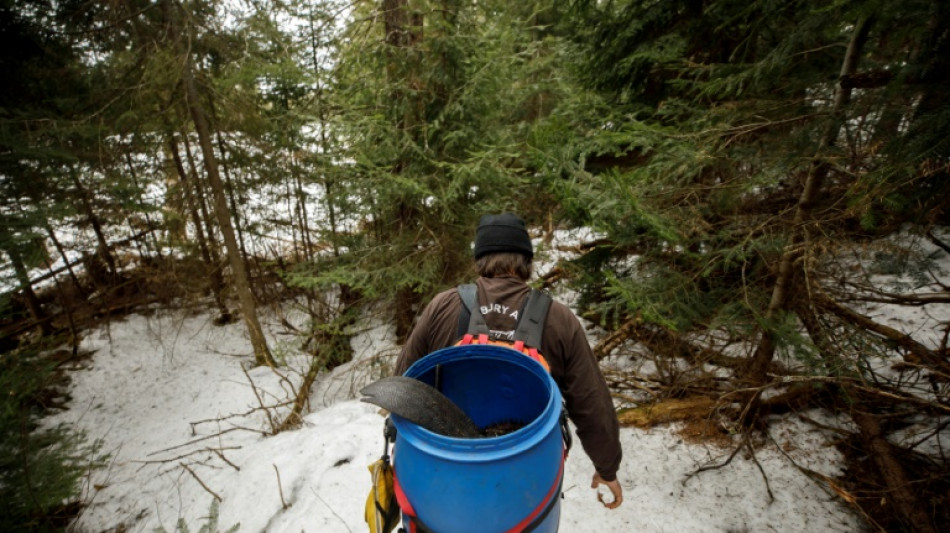
Trying to maintain his balance on a dam, Canadian trapper Ray Gall advances cautiously as he tries to retrieve a large black beaver snared in one of his traps.
Few people in the country still manage to make a living solely in the business, which dates back 400 years to the first Indigenous trades of pelts to European explorers.
But thousands of Canadians, including Indigenous people, are still active in the now heavily-regulated industry.
"It's the oldest profession" in Canada, says Gall, 47, a municipal water worker who traps, foxes, wolves and coyotes in his spare time in forests about a three-hour drive north of Toronto.
"There's always gonna be a need for trappers whether the market is there or not," he comments before untangling the beaver carcass and stuffing it in a pack that he throws over his shoulder.
With human encroachment reducing animal habitats, shorter winters caused by climate change, and plunging fur prices, "trapping is getting more and more difficult," says 70-year-old Indigenous trapper Tom Borg.
"It's part of our heritage and it's part of us. So that's tough, it's like taking a piece of you away," he comments, misty-eyed.
The market has been struggling under pressure from luxury brands' boycotts, the absence of Chinese buyers since the start of the pandemic, and now the loss of two key markets in Russia and Ukraine since Moscow's invasion.
But Robin Horwath, head of the Fur Institute of Canada and general manager of the Ontario Fur Managers Federation, is optimistic for a turnaround.
The situation now "is stable," he said, after it got "about as low in the cycle as it can go."
- Pelts tied in bundles for auction -
Canada is the largest producer of wild furs in the world, with some 415,000 pelts sold in the 2019-2020 season for a total of Can$13.8 million (US$11.0 million).
Inside North America's last major fur auction in North Bay, about 350 kilometers north of Toronto, brokers are busy checking out the offerings ahead of the big event, which is being held online for a third year in a row due to the pandemic.
In a vast warehouse, tens of thousands of animal pelts -- including lynxes, foxes, wolves and black bears -- are tied in bundles hanging from racks, sorted by size, color and quality.
Catalogue and pencil in hand, broker Michel Roberge acts as the eyes and hands of foreign buyers for whom he meticulously inspects each fur.
"Since it's a luxury market, naturally we are affected first" in the event of a crisis," says the Montreal merchant.
- Coyote fur trim -
Growing pressure from animal rights activists in Europe and North America led several major luxury brands, such as Dolce & Gabbana, Burberry and Chanel, to stop using fur.
"The fur industry's been around, it's our oldest, and it's risen and crashed many, many times during the last 400 years," said Mark Downey of the Fur Harvesters Auction in North Bay.
"Canada Goose's exiting the fur trade... was definitely a black mark for the industry."
But he is sure other manufacturers will fill the "void" left by the Canadian company, which announced last year it would soon stop using coyote fur trim on its parka hoods -- a feature that for five decades had helped keep Arctic explorers' faces warm.
The industry will also have to cope with the lack of access to markets in Ukraine and Russia -- the latter being the world's second-largest for fur, but targeted by Canadian and allied economic sanctions.
"The war between Ukraine and Russia is a huge handicap because our (other) big buyers from Greece, Italy and Turkey... their manufactured (fur) products are sold into Russia and Ukraine," Downey explained, and subject to the sanctions.
"But (the industry) will come back again," he said. "The demand is huge," especially in Asia.
W.Mansour--SF-PST