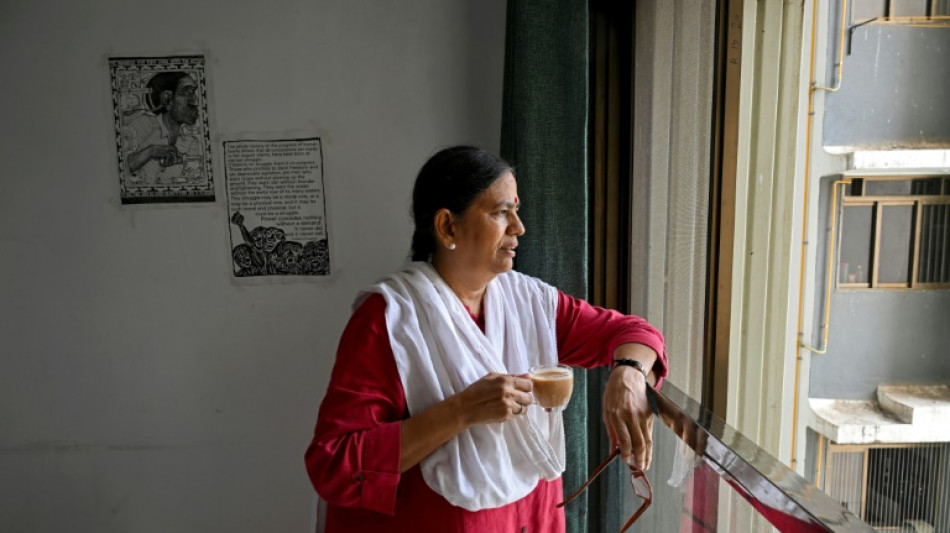
'Sea of misery': Indian rights lawyer spotlights plight of jailed women / Photo: Indranil MUKHERJEE - AFP

 Ronaldo handed 30-day suspension after walking out on Portugal

 Netanyahu basks in Trump endorsement week before election
 Saudi airport closure disrupts life in kingdom's capital

 Ramaphosa tells South Africa to prepare for loss of US-Africa trade deal

 France presses resale platforms to remove 'stolen' goods after unrest

 Yamal v PSG: Ballon d'Or backdrop to Champions League showdown
 Araujo says too soon to talk about permanent Liverpool move

 US wants to be 'strong partner' for central Asia: Rubio

 'Special' to face friend Perez in Champions League, says Liverpool's Iraola

 Monitor says Indonesia fires have burned nearly two million hectares

 French PM says could declare state of emergency over unrest 'if needed'

 Albanian PM warns of 'red line' after days of unrest
 Putin, Xi and Trump could meet at APEC summit: Kremlin

 Microsoft exits data centre deal in blow to UK AI ambitions
 European stocks retreat as France violence spreads

 North Korea warns 'grave situation' prevailing along border

 Raya proud of Arsenal's 'incredible' reaction after third straight win

 Indonesia fires have burned nearly two million hectares: monitor

 Australian lawmaker 'critically' hurt in attack, officials say

 Indonesia fires burned over 1.9 mn hectares through September: monitor

 Asian tech stocks mixed after Wall St losses, eyes on earnings

 China's third-quarter growth narrowly beats forecasts

 Asian stocks start week on back foot, tracking tech-led Wall St losses

 China growth narrowly beats forecasts

 Faith and fury: Texas Senate rivals offer contrasting visions

After three years in detention experiencing the "sea of misery" endured by women in Indian jails, one of the nation's best-known rights lawyers warns that society's prejudices are amplified behind bars.
Unable to raise funds or complete complicated paperwork for bail, many women are incarcerated for years while awaiting trial in India's glacial judicial process -- especially those at the bottom of the country's millennia-old caste hierarchy, said Sudha Bharadwaj.
"The legal aid system has more or less failed most of the poor prisoners", said the activist, who was herself released last year.
"The patriarchal bias goes very deep," she told AFP in an interview.
Women make up less than five percent of India's prison population.
Of them, more than two-thirds are yet to be convicted and are in detention awaiting trial, according to government statistics from 2015, the latest available.
- 'Prejudices and discriminations'-
"All the dynamics which play out in society are reflected even more sharply in the prison," the 61-year-old said.
"So whatever prejudices and discriminations you see outside in the society, they are very much reflected there."
US-born Bharadwaj, a committed lawyer of the poor, moved to India and renounced her US citizenship to support underprivileged communities in Chhattisgarh.
But the trade unionist was arrested in 2018 and accused of giving speeches that allegedly incited violence, charges she has denied.
"I was still a much more privileged person than most of the people around me," she told AFP from her home in Mumbai.
"Most of them were of course poor, and a lot of them were uneducated -- some of them were completely illiterate.
"They didn't know what was happening. They were abandoned by their families most of the time. So, I was really in a sea of misery".
Three bail applications were denied before Bharadwaj was released under strict conditions that barred her from discussing her case.
But in a book researched while behind bars, she has detailed the situation of the women she met and tried to help.
Titled "From Phansi Yard", or, the "hanging" yard, the book details stories from inmates at Yerwada jail in Pune.
There were many cases where the women she wrote about could have been granted bail.
"Either they were too poor to afford a good lawyer, or the legal aid lawyer didn't really bother to even come in meet them," she said.
Bharadwaj wrote "hundreds" of applications for older women in poor health, but all were rejected.
"Only those who you very much require to be in jail should be in jail," she said, adding that bail should be "the rule and jail the exception".
Bharadwaj wrote of jailed women being treated as second-class citizens, and within that, those who are members of India's 200-million-strong Dalit castes -- once subject to the discriminatory practice of "untouchability" -- facing an extra challenge.
- 'Much harsher' -
Among the people she met was a Dalit woman jailed after her employer accused her of stealing jewellery.
One woman was accused of murdering her landlord, despite no clear evidence provided and her pleas of innocence.
Another was arrested for the suicide of her daughter-in-law simply because she was in the house when she died.
A widow was arrested after her son allegedly killed her lover in a fit of rage. The son was bailed, but not his mother.
Bharadwaj also wrote of how the Pardhi people, stereotyped as troublemakers by police, were often picked up for a minor offence, then charged with more serious crimes.
"The police are trained to basically round up all the Pardhis around whenever there is a crime which has not been solved," she said.
"You could see that the sentencing appeared to be much harsher when it came to lower caste people."
F.AbuShamala--SF-PST