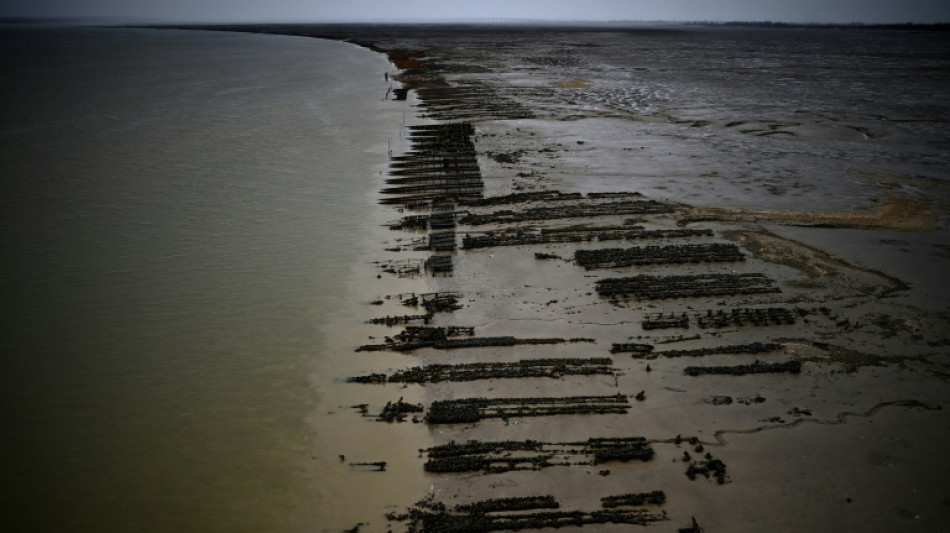
Climate change gets in the way of French oyster culture / Photo: Christophe ARCHAMBAULT - AFP

 US to auction deep sea mining leases off American Samoa

 Australian lawmaker hurt in car attack underwent surgery overnight: PM

 Japan launches rocket for potential world first Mars moon mission

 Ethiopia PM warns Eritrea of 'severe consequences' if supports enemies

 Boland grabs opportunity for Australia as South Africa struggle in second Test

 Ronaldo handed 30-day suspension: Portuguese federation

 France announces curfews as government grapples with unrest

 Boland sets pace as South Africa struggle

 Ukraine on back foot as Kremlin moots US, China meeting

 'Stay home!': Tourists find themselves in a France convulsed by protests

 Kenyan cult leader guilty on all charges over 191 starvation deaths

 Eagles star Hurts to miss rest of NFL season: reports

 Oil-rich Alberta votes on Canada breakup

 Israel announces arrests after West Bank settler attacks on Westerners
 Guehi insists players have 'trust and belief' in Man City after charges

 UN climate panel head wants swift end to deadlock over key scientific report

 PM calls for curfews in France as govt grapples with unrest

 Man City's Semenyo out for up to eight weeks

 Australian lawmaker critically hurt in 'violent' vehicle attack

 England women's coach Wiegman signs two-year contract extension
 Louvre blocked as France grapples with unrest

 Bollywood actor Tiger Shroff shot at in Mumbai, three suspects held: police
 UN biodiversity summit opens with nature goals off track

 'Physical hell': Hong Kong hosts gruelling underwater hockey tournament
 Police 'lost control' during French protests, says interior minister

Rising sea temperatures due to climate change are forcing oyster farmers in France's southwest to take a break from summer maturation, traditionally a key step in the production of the tasty molluscs.
Starting next year, producers in Marennes Oleron, France's biggest oyster bay, will no longer be able to steep oysters in shallow clay beds in salt marshes, known as "claires", during the summer months.
Oyster farmers in this region traditionally keep oysters in the oyster beds for the final weeks before their sale, a treatment that gives them a less salty and iodic taste than if they had come straight from the sea, and earns them the "fine" label, recognised by the EU's protected geographical indication (PGI) category.
But climate change is negating the effects of the oyster beds.
Scientists have found that because of fast-evaporating water, the salt concentration has become too high between early June and late August, leading to the ban during those months.
Human consumption of oysters, which are animals, goes back thousands of years. They come in a wide variety of flavours and textures depending on water salinity, alkalinity, mineral content and nutrition.
"We're going to have to accept change," said Henry Schaller, a local farmer using the "claire" method for which the Marennes Oleron oyster region is famous.
But the 37-year-old, in the business since 2010, said he had already cut down on summer maturation even before the new rule. "The oysters had become too salty," he said. "We had a weaker, lower-quality product."
- On the frontline -
The water temperature in the clay oyster beds, filled with sea water thanks to the tides and rhythm of the ocean, can now reach 35 Celsius (95F) in the summer months, well above the comfort zone of 32C for oysters, which cannot regulate their temperature.
This puts them more on the "frontline" of climate change suffering than ocean mammals or fish, said Fabrice Pernet, a scientist at the Ifremer oceanic research centre.
"There is as much reason for concern for oysters as there is for corals. Their fragility is similar," he said.
Producers in the Marennes Oleron sell up to 60,000 tonnes of oysters per year, of which 17,000 tonnes are of the "fine" variety.
Rising ocean temperatures, which in July set a new world record at 20.96C, make oysters more vulnerable to disease, and expose them to falling oxygen content in the water and rising acidity.
"We noticed, because of a changing climate, that the maturation could no longer be carried out in the same way," said Laurent Chiron, an oyster farmer and president of the GQHMO association that awards the industry's quality label.
According to the new rules, farmers are encouraged to go beyond the traditional winter and summer methods for oyster bed maturation, adopting a more flexible approach.
"We are telling oyster farmers: based on how you perceive the climate, you can operate one maturation method or another," Chiron said.
Philippe Morandeau, president of the oyster industry committee in Poitou-Charentes which includes Charente-Maritime, said he believed any impact on sales figures would be small, given that most oysters are sold for end-of-year festivities when ocean temperatures are low.
T.Samara--SF-PST