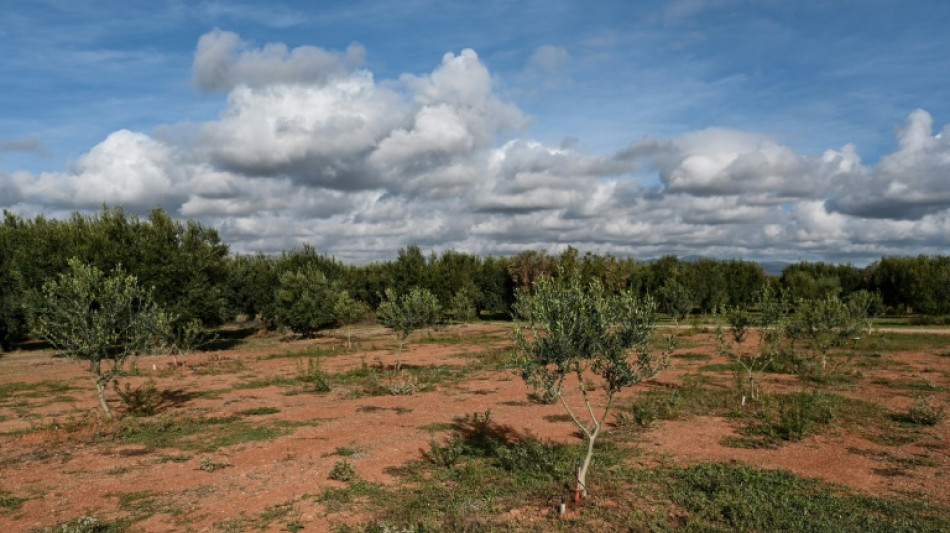
Winter isn't coming: climate change hits Greek olive crop / Photo: Sakis MITROLIDIS - AFP

 US to auction deep sea mining leases off American Samoa

 Australian lawmaker hurt in car attack underwent surgery overnight: PM

 Japan launches rocket for potential world first Mars moon mission

 Ethiopia PM warns Eritrea of 'severe consequences' if supports enemies

 Boland grabs opportunity for Australia as South Africa struggle in second Test

 Ronaldo handed 30-day suspension: Portuguese federation

 France announces curfews as government grapples with unrest

 Boland sets pace as South Africa struggle
 Ukraine on back foot as Kremlin moots US, China meeting

 'Stay home!': Tourists find themselves in a France convulsed by protests

 Kenyan cult leader guilty on all charges over 191 starvation deaths

 Eagles star Hurts to miss rest of NFL season: reports

 Oil-rich Alberta votes on Canada breakup

 Israel announces arrests after West Bank settler attacks on Westerners
 Guehi insists players have 'trust and belief' in Man City after charges

 UN climate panel head wants swift end to deadlock over key scientific report

 PM calls for curfews in France as govt grapples with unrest

 Man City's Semenyo out for up to eight weeks

 Australian lawmaker critically hurt in 'violent' vehicle attack
 England women's coach Wiegman signs two-year contract extension
 Louvre blocked as France grapples with unrest

 Bollywood actor Tiger Shroff shot at in Mumbai, three suspects held: police
 UN biodiversity summit opens with nature goals off track

 'Physical hell': Hong Kong hosts gruelling underwater hockey tournament
 Police 'lost control' during French protests, says interior minister
Greek organic farmer Zaharoula Vassilaki looks with admiration at a huge olive tree on her property believed to be over two centuries old, still yielding despite a direct lightning hit years ago.
But climate change -- in this case, the absence of deep winter -- is proving too much for even this gnarled veteran to cope with.
"The climate has changed and the trees cannot cope with these big changes. We no longer have winter at all," she told AFP.
In mid-November, the temperature in the Halkidiki region of Polygyros, northern Greece, was still over 15 degrees Celsius (59 degrees Fahrenheit).
"I consider climate change the main challenge this season," noted Nikos Anoixas, a board member of Doepel, the Greek national interprofessional organisation for table olives.
"At this time, temperatures should be 10 degrees Celsius... the year is already lost, and we fear next year will be similar. I don't even want to think what will happen if another such year follows," Anoixas said.
Vangelis Evangelinos has been growing edible olives on his family land in Halkidiki, northern Greece since he was a child.
At 62, he does not recall adverse weather conditions such as his area has endured this year -- or such a poor crop -- ever before.
"We've never had a year such as this," Evangelinos told AFP, two months after the Thessaly region, to the south, was devastated by massive floods.
"The rainfall is intense and brief," the opposite of what is needed to enrich the soil," he said.
The warm weather has affected some six million trees in the region, according to producers and experts.
"This year the phenomenon of 'fruitlessness' was very intense, but it is an issue that we have noticed mainly in the last five years," said Vassilaki, 48.
The European Union's olive production giants Italy and Spain have faced similar problems, pushing up prices.
Spain, the world's biggest producer of olive oil, suffered a very difficult year in 2022 and drought this year has compounded the problem.
In Italy, this year's olive harvest is down by an estimated 80 percent, according to producers.
The EU estimates global olive oil production will fall more than 26 percent in 2022-2023 compared to a year earlier, to just over 2.5 million tonnes.
In the EU itself, production is expected to drop 39 percent.
- 'No winter at all' -
"The old growers here say it is very important for the trees to rest in the winter. It takes about one to two months of good cold weather for the tree to rest... so that it can yield later," Vassilaki said.
Athanassios Molassiotis, an agronomist and head of the arboriculture lab of Thessaloniki's Aristotelio University, said his team recorded an increase in temperature of two degrees during October, November and December 2022 compared to a year earlier.
This affected the olive buds "because we know that the tree bears fruit after cold winters, especially the Halkidiki variety, which has high requirements at low temperatures in winter," he said.
"We found that in many trees, there was no flowering and therefore no fruit afterwards," Molassiotis said.
Halkidiki accounts for around half of edible table olives produced in Greece.
According to the regional chamber of commerce, more than 20,000 local producers cultivate 330,000 acres of olive trees in the area, generating an average of 120,000 to 150,000 tonnes of edible table olives annually.
More than 150 companies are active in olive processing and marketing, and more than 90 percent of the products produced are exported the world over, as far as Brazil, China and Australia.
This year, however, the crop shortage has in some cases exceeded 90 percent, plunging sector entrepreneurs into despair.
- 'Things will get worse' -
"I'm afraid things will get worse in the future," said chamber president Yiannis Koufidis, noting the economic impact on growers has been "huge" with a loss of some 200 million euro ($) just in Halkidiki prefecture alone.
In many cases, growers did not deem it worth the trouble to harvest their estates.
At the local olive processing unit, which also handles intake from across the country, management says production is down at least 60 percent.
A climate change study for the Halkidiki area in January showed the local average temperature is expected to increase by 1.5-2 degrees Celsius in coming years, according to the best-case scenario.
At worst, it could be three degrees.
The Aristotelio University study also predicts less rain.
The overall "thermal stress" is ultimately expected to impact fruit quality, it warned.
And because Halkidiki is also one of Greece's main tourism destinations, there is an added draw on the area's water resources, said study author Christina Anagnostopoulou.
"Climate changes will happen. We need to learn and prepare so that we can reduce the effects," the climatology professor told AFP.
Koufidis said the Halkidiki chamber is working with the university to create a variant of the local olive variety that requires less wintry weather.
"It's a very difficult project. But we can't stand idly by," he said.
burs-str/jph/bp
G.AbuGhazaleh--SF-PST