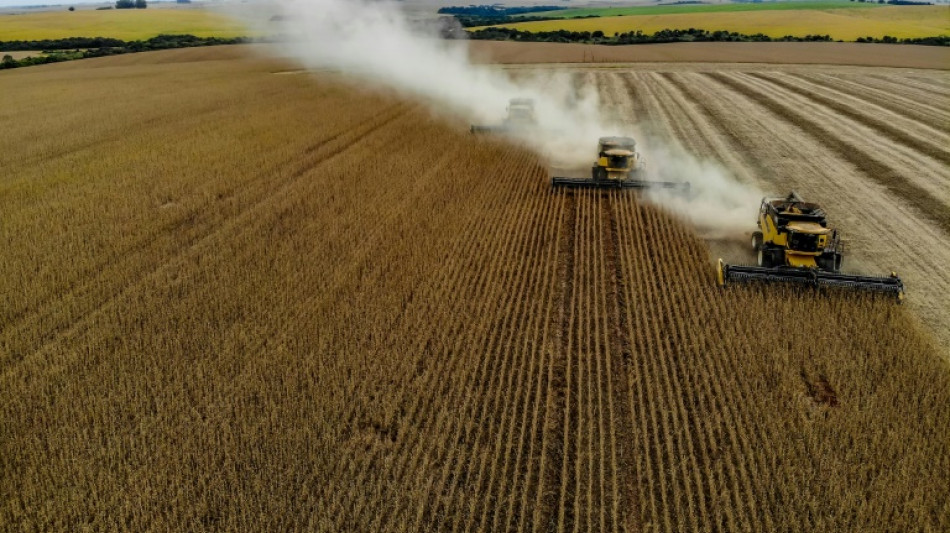
Brazil's booming ag sector draws cash and controversy / Photo: SILVIO AVILA - AFP

 Australian police charge man over 'targeted' attack on lawmaker

 Rubio lands in India for 'trade diplomacy'
 China opposes US ban on govt agencies from using DeepSeek

 Near miss: Indonesia probes crash of suspected Chinese rocket fragment

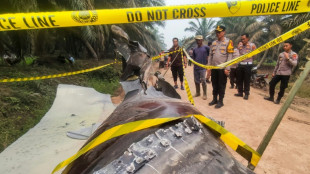 Indonesia investigates crash of suspected Chinese rocket fragment

 South Korea to withdraw some Ukraine embassy staff after POW row

 S. Korea warns of 'firm' response after North threatens fresh measures near border

 Ukraine claims US missile holdup ahead of reported talks

 Niners hold off Commanders to stay perfect in NFL
 Tech firms bear brunt of selling as Asian stocks drop

 Reese scores 30 as Dream stun Valkyries to level WNBA finals

 Horror and disbelief after lawmaker attacked in rural Australia

 Ukraine races to secure energy supplies ahead of winter

 Vote count begins in Alberta secession referedum, testing Canada unity

 Ukraine claims US missile holdup as Trump floats summit without Zelensky

 Detained Suu Kyi receives UK royal package: Myanmar govt

 Japan successfully launches probe in historic Mars moon mission

 US to auction deep sea mining leases off American Samoa

 Australian lawmaker hurt in car attack underwent surgery overnight: PM
 Japan launches rocket for potential world first Mars moon mission

 Ethiopia PM warns Eritrea of 'severe consequences' if supports enemies

 Boland grabs opportunity for Australia as South Africa struggle in second Test

 Ronaldo handed 30-day suspension: Portuguese federation

 France announces curfews as government grapples with unrest

 Boland sets pace as South Africa struggle
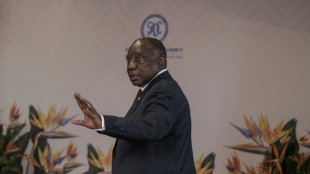
With its massive output of soybeans, beef, cotton and now corn, Brazil has become one of the world's top agricultural powers. But its agribusiness industry also faces criticism, especially over destruction of the Amazon rainforest.
Here is an overview of the South American ag giant, which, more than a decade after passing the United States as the world's biggest soy and beef exporter, is set to overtake US corn exports this year and is now eying the cotton crown.
- Big and growing -
Brazil's agriculture ministry triumphantly announced recently the sector's output will hit a record 1.15 trillion reais ($230 billion) this year.
The country -- the world's fifth-largest by surface area -- is the top producer and exporter of sugar, coffee and soy.
It is also the world's top supplier of chicken and beef, and second in cotton, after the United States.
Agribusiness accounts for nearly one-fourth of Brazil's economy, and half its exports in the first half of the year.
- Roots of the boom -
Brazil's emergence as an agricultural giant goes back to Portuguese colonial times. Fortunes were made here on a succession of commodities: sugarcane, then cotton, rubber and finally coffee, which reigned supreme for more than a century.
But the turning point came in the 1960s and 70s, when Brazil's then military regime ushered in the so-called "green revolution" and encouraged the expansion of agriculture to the Amazon and Cerrado savanna.
Fueled by Chinese demand, Brazil would go on to become the dominant producer of soy, a widely used ingredient in animal feed worldwide.
"Research on genetic improvements, techniques to correct soil acidity and fertilizers" -- plus pesticide development -- have allowed Brazil to expand soy, corn and cotton production into tropical regions, state agricultural research company Embrapa told AFP.
Brazil is able to harvest two and sometimes three crops a year, thanks to its climate and the development of zero till planting and genetically modified (GMO) crops -- which today account for 80 to 90 percent of the country's soy, corn and cotton output.
Production of all three has tripled in the past two decades.
- Price of success -
But the boom has come with controversy.
The agribusiness industry has helped fuel deforestation in the Amazon, which President Luiz Inacio Lula da Silva has vowed to halt.
Polemics over high rates of deforestation, pesticides and GMO use have hurt Brazil's brand in some places, including the European Union, which has held off ratifying a free-trade deal with South American bloc Mercosur over environmental issues.
The agro sector's image has also paid a price internationally for its close association with controversial far-right ex-president Jair Bolsonaro, who was in office from 2019 to 2022.
- Under pressure -
Lula will have to come to terms with the powerful agribusiness lobby if he wants to keep his promise to stop Amazon deforestation by 2030, after a surge in destruction under Bolsonaro.
The veteran leftist, who needs the sector's help to keep the economy growing, is looking to open new markets for Brazilian producers via trade deals, notably with top buyer China.
For its part, the ag sector is keen to polish its image, with international clients increasingly demanding deforestation-free products.
"Meat companies are working particularly hard to make their supply chains traceable, which is fundamental for export value," said Luiz Carlos Correa Carvalho, president of the Brazilian Agribusiness Association.
Grain producers meanwhile tout the recent adoption of a sustainable farming deal aimed at protecting the Cerrado.
Environmentalists say that is not enough.
"Real progress would be zero deforestation," said Cristiane Mazzetti of Greenpeace Brazil, who called for new production models that protect biodiversity.
The issue is urgent, especially since climate change is already starting to hit agricultural output.
"We have to evolve toward a more sustainable model," said Britaldo Soares Filho, a researcher on environmental modeling at the University of Minas Gerais.
"When agribusiness harms the environment, it's shooting itself in the foot."
B.Khalifa--SF-PST