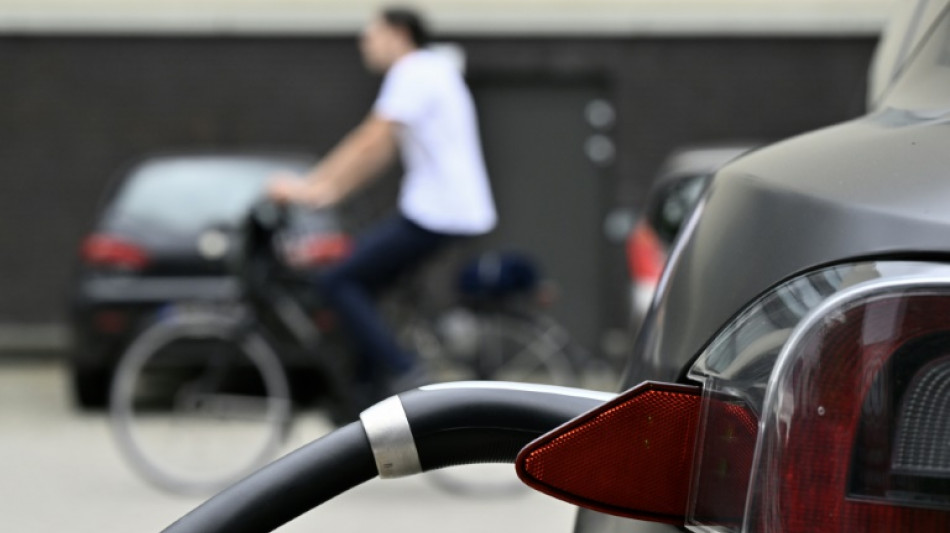
Charging ahead: Dutch eye boost to 'fast charger' EV network / Photo: JOHN THYS - AFP

 Australian police charge man over 'targeted' attack on lawmaker

 Rubio lands in India for 'trade diplomacy'

 China opposes US ban on govt agencies from using DeepSeek

 Near miss: Indonesia probes crash of suspected Chinese rocket fragment

 Indonesia investigates crash of suspected Chinese rocket fragment
 South Korea to withdraw some Ukraine embassy staff after POW row

 S. Korea warns of 'firm' response after North threatens fresh measures near border

 Ukraine claims US missile holdup ahead of reported talks

 Niners hold off Commanders to stay perfect in NFL
 Tech firms bear brunt of selling as Asian stocks drop

 Reese scores 30 as Dream stun Valkyries to level WNBA finals
 Horror and disbelief after lawmaker attacked in rural Australia

 Ukraine races to secure energy supplies ahead of winter

 Vote count begins in Alberta secession referedum, testing Canada unity

 Ukraine claims US missile holdup as Trump floats summit without Zelensky

 Detained Suu Kyi receives UK royal package: Myanmar govt

 Japan successfully launches probe in historic Mars moon mission

 US to auction deep sea mining leases off American Samoa

 Australian lawmaker hurt in car attack underwent surgery overnight: PM

 Japan launches rocket for potential world first Mars moon mission

 Ethiopia PM warns Eritrea of 'severe consequences' if supports enemies

 Boland grabs opportunity for Australia as South Africa struggle in second Test

 Ronaldo handed 30-day suspension: Portuguese federation
 France announces curfews as government grapples with unrest

 Boland sets pace as South Africa struggle
At a service station near Amsterdam's Schiphol Airport, a steady stream of motorists charge up their electric vehicles at "ultra-fast" power points. The whole process takes less than 20 minutes.
"It's really great in the Netherlands. When you leave the Netherlands, the network is a lot thinner," Jeroen Vever, a 37-year-old software developer fuelling up his EV, told AFP by the charging "plug".
Famed globally for an obsession with bikes and especially vulnerable to climate change due to its low-lying location, the Netherlands is proud of its "World Champion" status for EV charging points, with the EU's densest network.
The small country has 145,000 public charging points -- one third of the whole European total -- with streets in major Dutch cities lined with grey metal power points seemingly posted every few metres.
In addition to this are hundreds of thousands of private chargers, much less powerful and therefore slower to "fill up" vehicles.
But only around 6,000 of these are "fast" or "ultra-fast" chargers.
While an impressive total in absolute terms, this leaves the Netherlands proportionally behind the Baltic states or countries in Central and Eastern Europe, which started later but jumped directly to fast chargers, according to the ChargeUp Europe association.
The Netherlands is scrambling to maintain its lead, but there are concerns the electric grid may not cope with a rapid expansion of the energy-gobbling fast chargers.
Electrifying car transport, well advanced in Europe and China, is one of the key pillars of a transition to a carbon-free world and will be a critical topic at the Dubai COP28 summit.
But as the Netherlands shows, EV sales go hand in hand with an efficient charging network.
"It's chicken and egg," said Michiel Langezaal, CEO and co-founder of Dutch firm Fastned, which installs ultra-fast points along European motorways.
"If there's an ample and sufficient charging infrastructure, that helps people shift to sustainable mobility."
The Dutch government wants all new cars to be electric by 2030 but even the current dense charging network would not be able to service such a fleet.
The answer: "It will be necessary to build more fast-charging stations", according to Langezaal.
With the current number of electric vehicles, a total network of around 700 fast-charging stations -- roughly one every 40 kilometres -- is sufficient, Langezaal told AFP.
- 'Fully charged' -
How has the Netherlands managed to roll out such a strong network? According to Auke Hoekstra, a sustainable mobility expert, the Dutch tradition of political consensus played a big part.
The central government worked closely with local officials, network operators, and private firms to create a single charging system, he told AFP.
The absence of a powerful home-grown car manufacturer also helped, he added, saying this often puts a brake on progressive policies in other countries.
The development of fast chargers is key, as the "slow" charging systems can take several hours -- often overnight while the driver sleeps.
"Usually, I just charge up at home in the evening. The next day, the car is fully charged," said Marrit Zylstra, a 33-year-old IT consultant powering up at the Schiphol charging centre.
Another explanation for the rapid rise of the charging network was government bonuses and tax breaks, said Hoekstra.
But it's not all plain sailing in the Netherlands, where one third of the land is below sea level but which is one of Europe's worst polluters.
Many of the tax breaks for electric vehicles will disappear in 2025 and Hoekstra warned about losing the early Dutch advantage.
"The Netherlands is always very good at making something a success and then stopping doing it once it's become too much of a success. We did it in the past in windmills," he told AFP.
While 26 percent of new cars in the Netherlands were electric in 2022, they still make up only five percent of the total cars on the road in the country.
Private cars account for nearly 10 percent of the total greenhouse gas emissions in the Netherlands.
Rising electricity costs and the end of tax advantages mean EV driving is entering "a very different era", said Harry Chua, a restaurant manager charging up on the motorway.
"Electricity is going up, we'll have to pay road taxes. So, I don't know whether driving an electric vehicle is advantageous. We'll see in the future," the 43-year-old told AFP.
But electric or not, some things never change.
"I sat in a traffic jam for two hours and I was late for work," he said, admitting that he was going too fast.
"I got stopped by the police. They gave me a warning."
A.AbuSaada--SF-PST