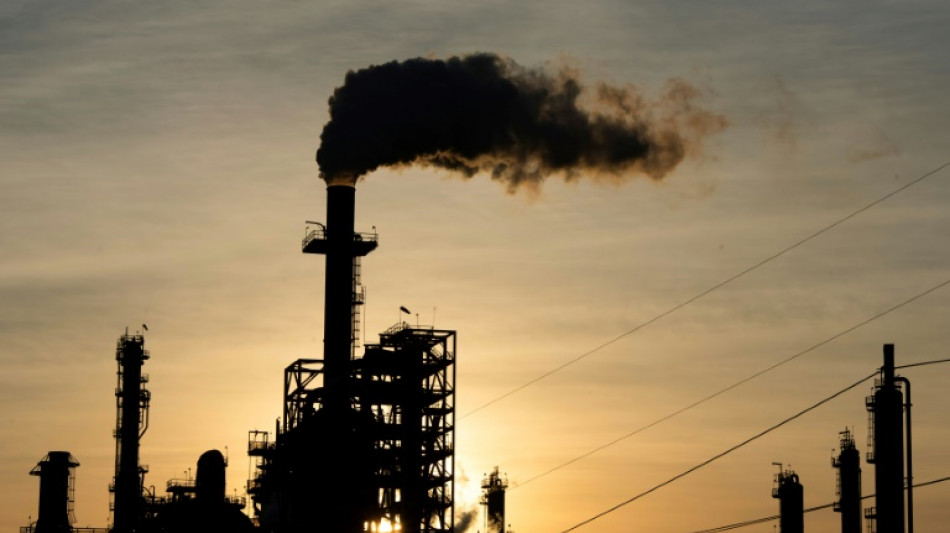
Israel-Hamas war: What risks face the energy sector? / Photo: Mark Felix - AFP/File

 O'Connor, Sivakov join Seixas at Decathlon CMA CGM

 Faletau left out of Wales squad for Nations Championship

 Rubio says India diversifying oil, trade deal 'very close'
 Kemi Badenoch Proposes Ending Childcare Benefit Cliff Edge

 More Than 52,000 West Midlands Families Use Tax-Free Childcare

 Commanders Fear Serious Knee Injury for Terry McLaurin

 Rays Beat Guardians 7-3 to Secure World Series Place

 Veteran Character Actor Richard Riehle Dies at 78

 Hardik Pandya Meets Fan Who Walked 2,390 Kilometres Across India

 Erling Haaland Buys Villa at Abu Dhabi’s Jacob & Co Beachfront Living

 Analysts Stay Positive on Vedanta After Hindustan Zinc’s Strong Quarter

 World Gold Council Sees Digital Gold Market Tripling by 2031

 Industry Groups Outline Four Steps to Help Women Farmers Reach Markets

 Tamil Nadu and Puducherry Face Return of Very Heavy Rain

 Tamil Nadu Adds 25 State-Funded Workdays for Eligible Rural Households

 Tonbo Imaging IPO Draws Nearly 136 Times the Shares Offered

 James Maddison Leads Tottenham to First League Victory of Season

 October 20 Milestones Trace Decades of Kuwait’s Development

 Spain Housing Dispute Puts Landlords at Centre of Election Debate

 Qatar Prime Minister Opens Eighth Global Security Forum

 US Midterms Put Control of Congress and Key States at Stake

 QNB and Qatar Airways Forge Worldwide Digital Payments Alliance

 Alaraby Television Network Earns Five GEMA Award Nominations

 UN says 19 mn Afghans facing acute food insecurity by April

 An unhappy republic: France's troubles extend beyond the street

The escalation of hostilities between Israel and Hamas could further strain global oil and gas supplies, already disrupted by Russia's invasion of Ukraine, experts have warned.
Increases in oil prices in response to the conflict, triggered by the bloody attack by Hamas in Israel on October 7, have so far been relatively mild.
Brent, the European benchmark, has gained around 10 percent, while its American equivalent has gained around 9 percent.
Prices are around $90 per barrel, still far from their historical highs.
"Israel is not an oil producer and no major international oil infrastructure runs close to the Gaza Strip or southern Israel," Edoardo Campanella, analyst at UniCredit, told AFP.
However, investors are conscious of the "Middle East tinder box's inherent risk to global oil supply. Hence they have been diving into contracts compounding matters," explained Stephen Innes, analyst at SPI AM.
The prospect of Iran, a supporter of Hamas and sworn enemy of Israel, being drawn into the conflict presents one of the main risks for the energy market.
The OPEC member has seen its production and exports damaged by years of international sanctions, but has nevertheless increased its production over the last year and is suspected of smuggling barrels onto the market.
This has helped contain global prices despite rising demand and tight supply, leading the Biden administration in the US to "turn a blind eye," according to Helge André Martinsen, analyst at DNB.
Even if Tehran stays out of the conflict, "the West might decide to tighten sanctions on Iran or simply to enforce existing sanctions more effectively," said Campanella.
Iran could respond by blocking the Strait of Hormuz, the most important oil transit zone in the world, with a daily flow of more than 17 million barrels -- 30 percent of all oil traded by sea --, according to Seb Research.
Only Saudi Arabia and the United Arab Emirates have pipelines to bypass the Strait of Hormuz when shipping crude oil outside of the Gulf, explained Campanella.
- Gas threat -
The worst-case scenario, unlikely but not impossible according to analysts, would be stronger sanctions leading Iran to retaliate by attacking oil installations in Saudi Arabia, one of the world's main producers and exporters.
Attacks on its infrastructure in September 2019, claimed by Yemeni Houthi rebels supported by Tehran, caused Saudi to temporarily halve production, leading the price of Brent to jump by almost 20 percent in one day.
Experts recall previous oil shocks, such as the OPEC embargo against Israel's allies in the midst of the Yom Kippur War 50 years ago, and then in the wake of the Iranian revolution in 1979.
The shocks led to crude prices jumping within a few months, bringing developed economies to their knees.
But they are less exposed this time around given the rise of the US as a producer and an OPEC that claims to be less political.
On the gas side, the effects are more immediate.
The price of TTF, the European benchmark for natural gas, was up by a third in mid-October compared to before the October 7 attack.
The war "seriously threatens the regional natural gas market and could impact Europe's LNG (liquefied natural gas) supply as winter approaches," warned Innes.
"While European gas inventories are almost full, they are not sufficiently high to get through the winter in case all imports stop," said Giovanni Staunovo, of UBS.
US giant Chevron has suspended activities at its Tamar platform, off the Israeli coast, on instructions from the country's authorities.
This gas field represents "around 1.5 percent of global LNG supply", said Innes, mainly supplying the domestic market, then Egypt and Jordan.
If Leviathan, Israel's largest gas field, were to close, the consequences would be much more worrying, say analysts, who recall prices surging to a historic high of 345 euros per MWh at the start of the war in Ukraine.
H.Nasr--SF-PST