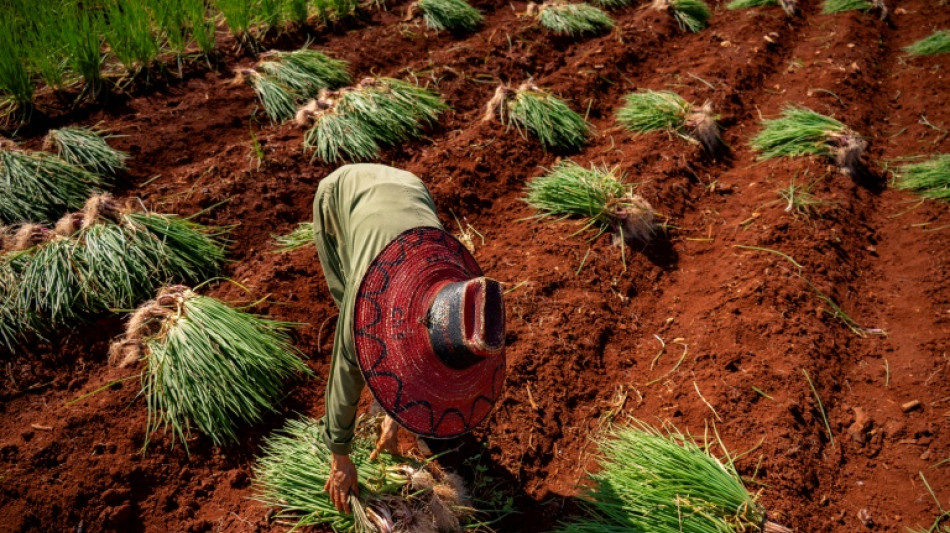
Fertile Cuba relies on food imports as farmers lack seeds, fuel / Photo: Yamil LAGE - AFP

 All-rounder Minhas stars as Pakistan crush England in tri-series

 Bavuma hits 179, Rabada strikes as South Africa dominate
 Allrounder Minhas stars as Pakistan crush England in tri-series
 Albania PM blames 'hybrid war' for week of unrest

 Bavuma hits 179 to lead South African fightback

 Solid GM results overshadowed by latest jump in commodity costs

 Houthi attacks undermine Saudi Arabia's economic ambitions
 French PM vows 'massive' police deployment for new demonstrations

 Power outage hits Google Cloud services, disrupting UK banks

 AI challenges maths by solving the unsolvable

 Turkey troops to stay in Syria, Iraq 'until border security ensured', defence minister tells AFP

 Kulusevski a 'different man' after emotional Spurs return

 Nawaz and Minhas lift Pakistan to 302-9 in England ODI

 Mourinho warns no 'untouchable' stars at Real Madrid

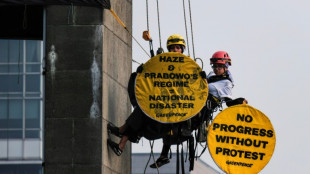 Indonesian anger builds over wildfires, toxic haze

 Late Okafor Penalty Earns Alvechurch FA Cup Replay

 Low-Cost Homemade Ideas Offer Alternatives for Halloween Costumes

 Christiane Amanpour Plans CNN Departure After 43 Years

 Richard Riehle, Prolific Film and Television Actor, Dies at 78

 Unverified Kim Jong Un Rumours Put Kim Yo Jong Back in Focus

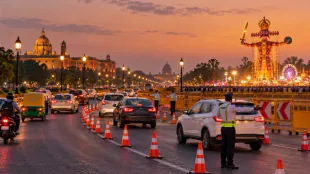 Delhi Issues Dussehra Traffic Curbs and Diversions for October 20

 iQOO Neo 12 Set for October 28 China Launch With 144Hz Display

 India Warns Unpaid Assessments Are Deepening UN Cash Strain

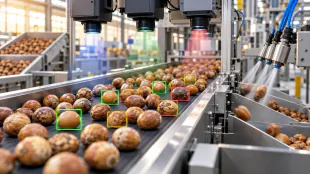 Agrograde Introduces AI Optical Sorter for Arecanut Processing
 Paras Healthcare Raises ₹652.5 Crore From IPO Anchor Investors
Crop production has plummeted in fertile Cuba as aid for farmers from a government grappling with tough sanctions and the worst economic crisis in decades has dried up.
The country today imports almost all its basic foodstuffs, up from an already high 80 percent before the coronavirus pandemic, according to official figures.
In Artemisa, an agricultural province, a farmer in his 60s told AFP his land was "splendid" but a lack of fertilizer and seeds made his task impossible.
The farmer, who asked not to be named in a country where the government does not take kindly to criticism, belongs to a cooperative that used to receive all its basic materials from the state.
But now "we have nothing, they don't give anything," he said.
"We have bad tractors. We have no resources. There is no fuel. We are not receiving oil or tires. We have to till the land with a team of oxen," said the farmer.
Artemisa was formerly a breadbasket of the island nation, where most sectors are still under the control of the one-party state.
In the past, each of Artemisa's municipalities had a center to store crops and market them, but these are now "all but non-existent. There is no way to market or transport the crops," said the farmer.
According to official figures, Cuban agricultural production fell 35 percent between 2019 and 2023.
Production of sugar, once the country's emblematic product, plummeted from 816,000 tons in the 2020-2021 season to 470,000 in 2021-2022, and most of the rice and beans -- Cuban staples -- are arriving from abroad.
- Importing 'practically 100 percent' -
In September, Economy Minister Alejandro Gil said the government now imports "practically 100 percent of family food essentials."
Adding to the structural weaknesses of the Cuban economy is a slow recovery for tourism -- the second source of foreign currency earnings before the pandemic -- and the tightening of US sanctions since 2021.
The government already distributes much of the food on the island at subsidized prices through a rationing system for Cuba's 11 million people.
Elsewhere in Artemisa, small-scale farmer Jesus, who did not want to give his full name either, said the yield of malanga, a tuber highly favored by Cubans, has fallen by half.
This plantation "gives four to six bags per furrow, before it was double. But now the harvest is truly a matter of luck," said Jesus, standing barefoot in the field he has worked for 40 years.
- 'There is a risk' -
World Food Program (WFP) representative Etienne Labande told AFP the threat of food insecurity is real.
"There is a shortage of locally-produced food and it is well known that importing to Cuba is very complicated" due to the US embargo in force since 1962. "So there is a risk," he said.
The problems have worsened since a monetary reform in 2021 saw inflation rise to 45.8 percent between January and May that year and 39 percent in 2022, according to official figures.
Some analysts say inflation has likely reached triple digits.
A recent WFP report said higher prices of basic goods and services have increased "households’ vulnerability to food insecurity."
According to the UN's Food and Agriculture Organization, "a person is food insecure when they lack regular access to enough safe and nutritious food for normal growth and development and an active and healthy life."
When he took power in 2008, then-president Raul Castro initiated an agricultural reform to stimulate food production.
It allowed farmers to till idle lands that did not belong to them, shuttered unproductive state farms and authorized direct food sales to the tourist sector.
But Pavel Vidal, a Cuban economist and academic at the Pontificia Universidad Javeriana in Cali, Colombia, said that if the government "does not rely on market logic (the reforms) will not bear fruit."
Official figures show that imports in the first half of 2023 reached $4.3 billion, of which $1.6 billion was for food and a large part of the rest spent on oil. Exports were worth only $1.28 billion.
"We cannot, with available land and the capacity to produce, (wait) for the rice ship to come from abroad, nor the bean ship," Gil, the economy minister, warned in July.
In early October, the Cuban agency Prensa Latina announced that eggs and coffee would be arriving soon from Costa Rica.
Q.Bulbul--SF-PST