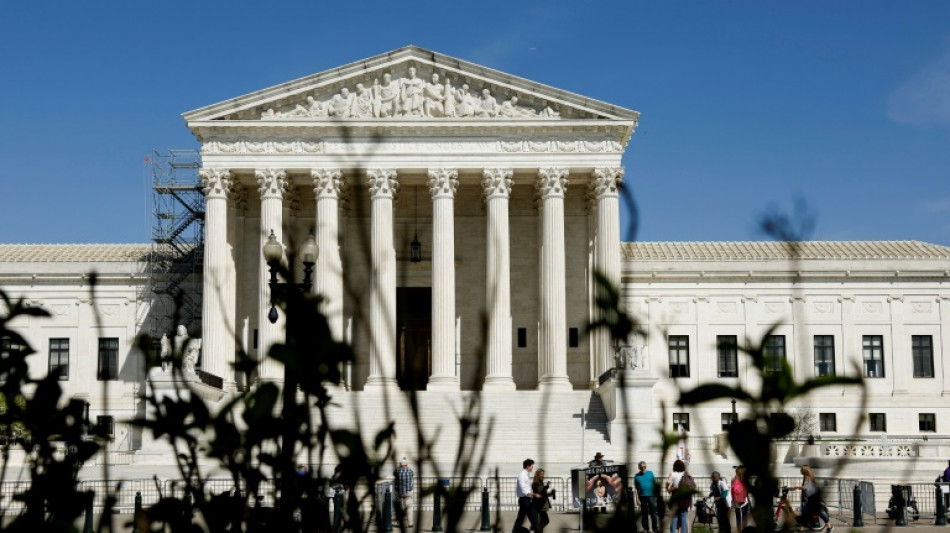
Top US court weighs major curbs to power of federal regulators / Photo: Anna Moneymaker - GETTY IMAGES/AFP

 Dow boosted as markets rotate from tech shares
 Zelensky hails resumption of US advance warning of strikes on Ukraine

 Carrick says only wins can ease doubts over Man Utd future

 Top NBA Draft pick Dybantsa to miss opener with ankle sprain
 Italy sends troops, toughens security laws after Milan clashes
 Alberta separatists vow to fight on, risking turmoil for Canada

 Two men re-arrested for suspected spying for Iran in airbase scare: UK police

 Guatemalan man gets 30 years for truck smuggling deaths of 53 migrants
 'Clayface' gets under the skin of the superhero genre

 Zelensky, US envoys hold Oslo talks as Ukraine claims US missile holdup
 All-rounder Minhas stars as Pakistan crush England in tri-series

 Bavuma hits 179, Rabada strikes as South Africa dominate
 Allrounder Minhas stars as Pakistan crush England in tri-series
 Albania PM blames 'hybrid war' for week of unrest

 Bavuma hits 179 to lead South African fightback
 Solid GM results overshadowed by latest jump in commodity costs
 Houthi attacks undermine Saudi Arabia's economic ambitions

 French PM vows 'massive' police deployment for new demonstrations

 Power outage hits Google Cloud services, disrupting UK banks

 AI challenges maths by solving the unsolvable
 Turkey troops to stay in Syria, Iraq 'until border security ensured', defence minister tells AFP

 Kulusevski a 'different man' after emotional Spurs return

 Nawaz and Minhas lift Pakistan to 302-9 in England ODI

 Mourinho warns no 'untouchable' stars at Real Madrid

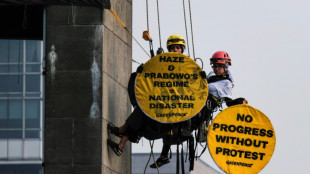 Indonesian anger builds over wildfires, toxic haze

The US Supreme Court on Tuesday began hearing a series of cases that could result in a generational contraction in the power of federal agencies to regulate businesses and corporate fraud.
The first case before the conservative-dominated court seeks to eliminate one agency completely, the Consumer Financial Protection Bureau (CFPB), which was created by Congress in the wake of the 2008 global financial crisis.
If the justices side with the plaintiffs -- payday lending groups -- it could throw into doubt a raft of regulations enforced by the watchdog agency in the past 12 years on issues ranging from mortgages to credit cards to student loans.
The CFPB receives its funding, currently around $600 million a year, from the US Federal Reserve instead of through annual appropriations from Congress.
The case ended up in the nation's highest court after a conservative-controlled appeals court ruled the funding mechanism was unconstitutional, violating the appropriations clause of the Constitution which gives the power of the purse to Congress.
"Congress has not determined the amount that this agency should be spending," said Noel Francisco, representing the Community Financial Services Association of America which brought the case. "Instead, it has delegated to the director, the authority to pick his own appropriation."
Francisco's arguments appeared to be met with skepticism by a majority of the nine justices on the court, where conservatives outnumber liberals by six to three.
Justice Ketanji Brown Jackson, a liberal, expressed concern about the courts meddling in what is traditionally Congress's turf.
"I'm a little worried I think about a separation of powers problem that may occur if the judiciary gets involved with telling Congress when and under what circumstances it can exercise its own prerogatives concerning funding," Jackson said.
"How do we avoid the judiciary becoming suddenly a super legislator, just telling Congress, agency by agency, whether it's a thumbs up or thumbs down?"
- 'Rounding error' -
Justice Sonia Sotomayor, another liberal, said that at $600 million the annual budget of the CFPB is just a "rounding error in the federal budget."
Justice Brett Kavanaugh, a conservative, said it was Congress itself that set up how the CFPB is funded and the legislature can always "change it tomorrow."
Senator Elizabeth Warren, the architect of the CFPB, said the case could have far-reaching consequences for other agencies and welfare programs that are similarly funded.
"The future of Social Security, Medicare, and every federal banking regulator is under grave threat if payday lenders and Wall Street banks get the Supreme Court to undermine the CFPB," the Democrat from Massachusetts said in a statement.
"The CFPB is under attack because it's an effective watchdog, returning over $17 billion back into the pockets of hard working Americans who were cheated," she said.
- Herring fishermen -
The CFPB case is one of three the court will hear during the current term that challenge the regulatory authority of federal agencies when it comes to banking, business, industry or the environment.
The conservative-majority court has previously ruled that the government's key environmental agency cannot issue broad limits on greenhouse gases, sharply curtailing the power of President Joe Biden's administration to battle climate change.
One of the upcoming cases stems from a requirement that herring fishermen in New England provide space onboard their vessels for observers from the National Marine Fisheries Service (NMFS).
Several fishing companies complained that they are being effectively forced to pay for the federal observers who are monitoring their operations.
A split appellate court ruled that the NMFS program was authorized under a 1984 ruling by the Supreme Court known as the "Chevron Doctrine" that says courts should defer to government agencies' interpretation of ambiguous federal laws.
The other case on the docket would curtail the power of the Securities and Exchange Commission (SEC) to adjudicate violations of federal securities laws.
The Supreme Court will issue its rulings in the cases by the end of June.
O.Mousa--SF-PST