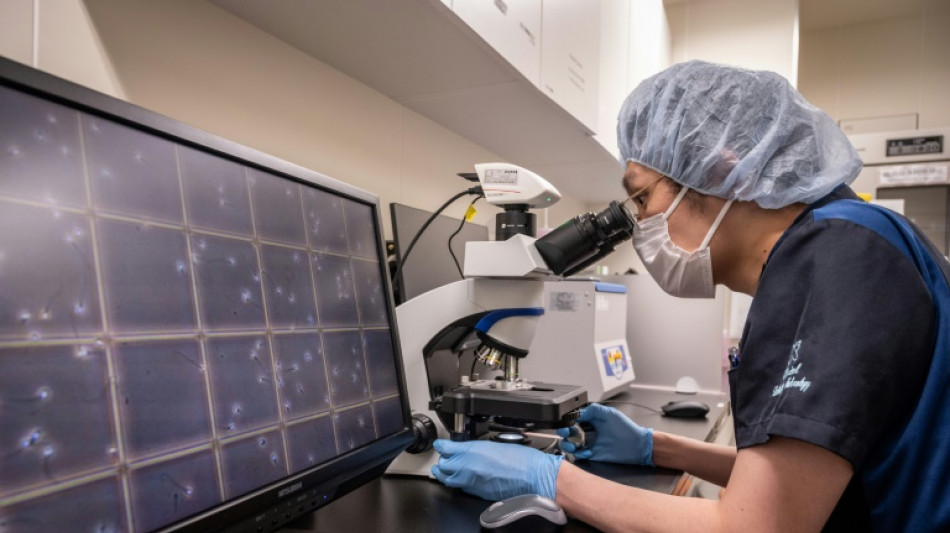
New rights for UK donor babies as they turn 18 / Photo: Yuichi YAMAZAKI - AFP

 Dow boosted as markets rotate from tech shares

 Zelensky hails resumption of US advance warning of strikes on Ukraine

 Carrick says only wins can ease doubts over Man Utd future

 Top NBA Draft pick Dybantsa to miss opener with ankle sprain

 Italy sends troops, toughens security laws after Milan clashes
 Alberta separatists vow to fight on, risking turmoil for Canada

 Two men re-arrested for suspected spying for Iran in airbase scare: UK police

 Guatemalan man gets 30 years for truck smuggling deaths of 53 migrants
 'Clayface' gets under the skin of the superhero genre

 Zelensky, US envoys hold Oslo talks as Ukraine claims US missile holdup

 All-rounder Minhas stars as Pakistan crush England in tri-series

 Bavuma hits 179, Rabada strikes as South Africa dominate

 Allrounder Minhas stars as Pakistan crush England in tri-series

 Albania PM blames 'hybrid war' for week of unrest

 Bavuma hits 179 to lead South African fightback

 Solid GM results overshadowed by latest jump in commodity costs

 Houthi attacks undermine Saudi Arabia's economic ambitions

 French PM vows 'massive' police deployment for new demonstrations

 Power outage hits Google Cloud services, disrupting UK banks

 AI challenges maths by solving the unsolvable

 Turkey troops to stay in Syria, Iraq 'until border security ensured', defence minister tells AFP

 Kulusevski a 'different man' after emotional Spurs return

 Nawaz and Minhas lift Pakistan to 302-9 in England ODI

 Mourinho warns no 'untouchable' stars at Real Madrid

 Indonesian anger builds over wildfires, toxic haze

Around 30 young adults conceived via sperm or egg donation in the UK will soon be able to discover the identity of their biological parent.
The new rights come as rising numbers of children are being conceived using the technology, posing a range of challenges for the children, their families and donors.
The UK law removed the anonymity of egg and sperm donors in 2005 and gave children the right to receive basic information about them when they reached 18.
With the first children covered by the legislation turning 18 this month, they will finally be able to request details such as the donor's full name, date of birth and last known address.
Advances in fertility treatment methods and changing social attitudes have seen an increasing number of donor-conceived children being born -- not just to people facing fertility challenges but also same-sex couples and women in their late forties and even fifties.
Initially the numbers of children who will have the right to know will be small, with just 30 people becoming eligible between now and December this year.
Data from the UK's Human Fertilisation and Embryology Authority (HFEA) shows that will rise to more than 700 people by the end of 2024, increasing to 11,400 by 2030.
According to the latest available figures from the regulator of fertility treatment and research using human embryos, 4,100 UK births -- around one in 170 -- were the result of donor conception in 2019.
- Few months off -
The cut-off point for the legislation has left some donor-conceived people disappointed that the identity of their donors will remain a mystery.
"I'm happy for the people who want to find out but I'm also a little annoyed that I was a couple of months off, so I won't have the chance," 19-year-old student Jamie Ruddock, from Brighton on England's south coast, told AFP.
Ruddock said he had known for as long as he could remember that he had been donor-conceived and while he was not looking for another father figure he was still curious.
His older brother along with their father had begun looking for the donor via a DNA ancestry testing service but had not had any success.
"My brother definitely has a bigger sense of curiosity than I do but... if my brother finds him I would like to have a conversation with him," he said.
Nina Barnsley, director of the UK's Donor Conception Network, said many of those eligible to ask for the information might not even be aware of how they were conceived.
When new techniques such as artificial insemination and in vitro fertilisation (IVF) were first introduced some four decades ago, infertility was something of a taboo subject and parents often did not tell children how they were conceived.
But for many years now, psychologists have advised families to be open with the information as early as possible.
Others might not have realised the significance of the legislation or have other priorities.
- 'Incredible gift' -
"Certainly in terms of our donor-conceived young people, many have got far more important things going on in their lives with exams and girlfriends and boyfriends, travel and work and other challenges," said Barnsley.
"Being donor-conceived may well just be low on the list of interests."
Having the right to access the information, however, could still be important to them in the longer term, even if it also brought potential challenges.
Some parents would inevitably be "anxious about making the donor into a real person in their lives... and how their children would feel," she said.
At the same time many were also "curious about these donors and wanted to thank them... to acknowledge their contribution towards helping them make their families," she added.
Donors are being urged to get in contact with the clinic where they donated and make sure their details are up to date.
"This is a very important time for young adults who were conceived by the use of donor sperm or eggs. Many will hope to find out more about their donors as they reach 18," said Professor Jackson Kirkman-Brown, chair of the Association for Reproductive and Clinical Scientists (ARCS).
He said it was important that donors too reach out for support and guidance to help them navigate any approaches.
"Being a donor is an incredible gift and alongside the sector ARCS are keen to recognise and support those who enable people to have the families they desire," he added.
H.Nasr--SF-PST