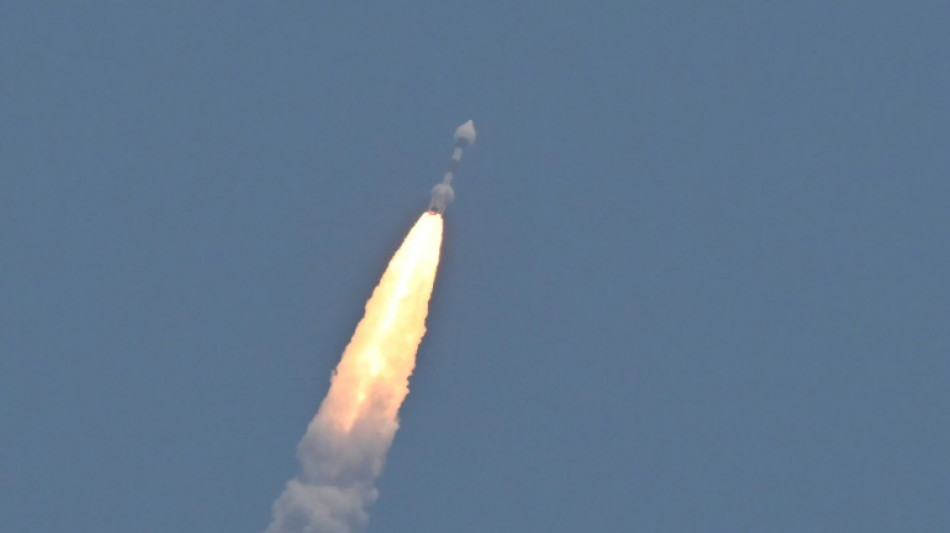
India's private space sector skyrockets / Photo: R. Satish BABU - AFP/File

 Dow boosted as markets rotate from tech shares

 Zelensky hails resumption of US advance warning of strikes on Ukraine

 Carrick says only wins can ease doubts over Man Utd future

 Top NBA Draft pick Dybantsa to miss opener with ankle sprain
 Italy sends troops, toughens security laws after Milan clashes

 Alberta separatists vow to fight on, risking turmoil for Canada

 Two men re-arrested for suspected spying for Iran in airbase scare: UK police

 Guatemalan man gets 30 years for truck smuggling deaths of 53 migrants

 'Clayface' gets under the skin of the superhero genre

 Zelensky, US envoys hold Oslo talks as Ukraine claims US missile holdup

 All-rounder Minhas stars as Pakistan crush England in tri-series

 Bavuma hits 179, Rabada strikes as South Africa dominate

 Allrounder Minhas stars as Pakistan crush England in tri-series

 Albania PM blames 'hybrid war' for week of unrest

 Bavuma hits 179 to lead South African fightback
 Solid GM results overshadowed by latest jump in commodity costs

 Houthi attacks undermine Saudi Arabia's economic ambitions

 French PM vows 'massive' police deployment for new demonstrations

 Power outage hits Google Cloud services, disrupting UK banks

 AI challenges maths by solving the unsolvable
 Turkey troops to stay in Syria, Iraq 'until border security ensured', defence minister tells AFP

 Kulusevski a 'different man' after emotional Spurs return

 Nawaz and Minhas lift Pakistan to 302-9 in England ODI

 Mourinho warns no 'untouchable' stars at Real Madrid
 Indonesian anger builds over wildfires, toxic haze

When Indian entrepreneur Awais Ahmed founded his satellite startup in Bangalore in 2019, his country was still a year away from opening the space industry to the private sector.
"When we started, there was absolutely no support, no momentum," said Ahmed, who was 21 when he founded Pixxel, a company deploying a constellation of Earth imaging satellites.
Since then, the private space sector has taken off in India, joining a rapidly growing global market.
There are now 190 Indian space start-ups, twice as many as a year earlier, with private investments jumping by 77 percent between 2021 and 2022, according to Deloitte consultancy.
"A lot of Indian investors were not willing to look at space technology, because it was too much of a risk earlier," Ahmed said in an interview with AFP.
"Now you can see more and more companies raising more investment in India, and more and more companies have started coming up now," he added.
Pixxel makes hyperspectral imaging satellites -- technology that captures a wide spectrum of light to provide details that are invisible to ordinary cameras.
The company says it is on a mission to build "a health monitor for the planet": it can track climate risks such as floods, wildfires or methane leaks.
Pixxel had initially sought to use rockets from the state-run Indian Space Research Organisation (ISRO).
"I remember having a conversation with with someone in ISRO. We were trying to book a launch and they said, 'Look, we don't even have a procedure to launch an Indian satellite. But if you were a foreign company, then basically there's a process', which didn't make sense when we started," Ahmed said.
Pixxel ended up having to hire US rocket firm SpaceX to launch its first two satellites.
Pixxel has raised $71 million from investors, including $36 million from Google, which will allow the company to launch six more satellites next year.
The start-up has also won a contract with a US spy agency, the National Reconnaissance Office, to provide hyperspectral images.
- Modest budget -
Prior to the 2020 opening up of the sector, "all Indian space activity was under the supervision of the ISRO space agency, which managed absolutely everything," said Isabelle Sourbes-Verger, an Indian space sector expert at France's National Scientific Research Centre.
The ISRO budget remains relatively modest at $1.9 billion in 2022, six times smaller than the Chinese space programme.
Despite its limited resources, India's space programme has made huge strides, culminating with the landing of a rover on the Moon's unexplored south pole in August.
The country also launched a probe towards the Sun at the start of this month and is preparing a three-day crewed mission into Earth's orbit next year.
Before the reform, private companies could only act as suppliers for the agency.
"It was no longer tenable because there is too much to do," Sourbes-Verger said.
India deepened its reform of the sector in April, unveiling a new space policy that limits the ISRO's work to research and development while promoting "greater private sector participation in the entire value chain of the Space Economy".
India says it accounts for two percent of the $386 billion global space economy, a share it hopes to increase to nine percent by 2030. The market is expected to grow to $1 trillion by 2040.
- 'Some limits' -
Indian companies have an edge when it comes to costs as the country boasts a large number of highly qualified engineers with lower salaries than their counterparts abroad.
Other Indian start-ups that have emerged in recent years include Skyroot Aerospace, the first Indian company to launch a private rocket.
Dhruva Space is developing small satellites while Bellatrix Aerospace specialises in propulsion systems for satellites.
"Will this really create a dynamic and profitable industrial fabric? Probably, but undoubtedly with some limits," Sourbes-Verger said.
India is not done reforming the sector. Another law is expected to pass in the coming weeks to open the industry to foreign investments.
A.Suleiman--SF-PST