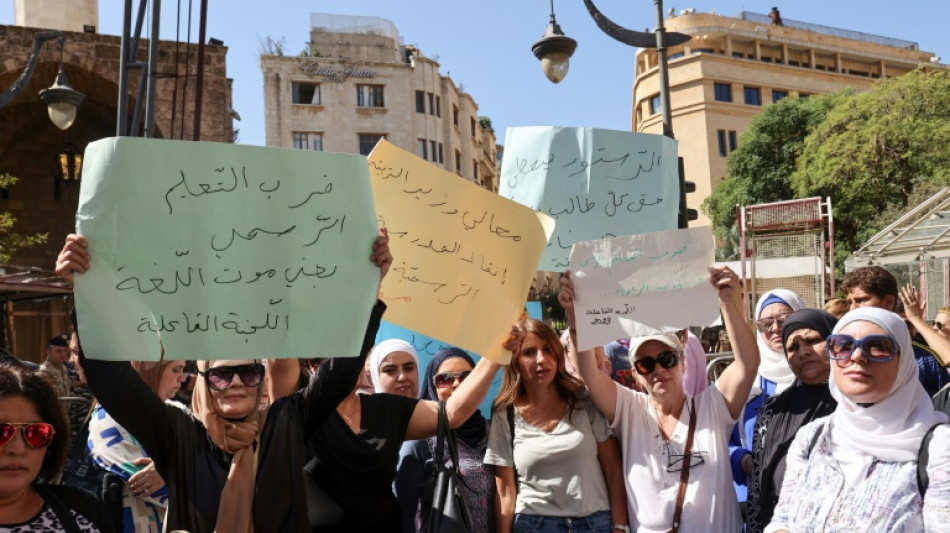
Lebanese children 'miss out' on education as crisis takes toll / Photo: ANWAR AMRO - AFP

 Zelensky, US hail 'productive' talks to end Trump feud

 'Unbelievable' Foden back in the groove with treble in Man City rout
 Pistons rally to beat Celtics in NBA 2026-27 season opener
 PSG late show downs Barca in Champions League, Liverpool fight back

 Liverpool strike back to beat Villarreal in seven-goal thriller

 Dow boosted as markets rotate from tech shares

 Zelensky hails resumption of US advance warning of strikes on Ukraine
 Carrick says only wins can ease doubts over Man Utd future

 Top NBA Draft pick Dybantsa to miss opener with ankle sprain
 Italy sends troops, toughens security laws after Milan clashes

 Alberta separatists vow to fight on, risking turmoil for Canada

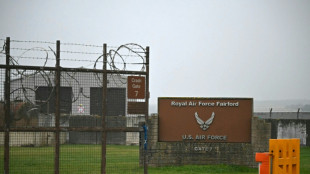 Two men re-arrested for suspected spying for Iran in airbase scare: UK police

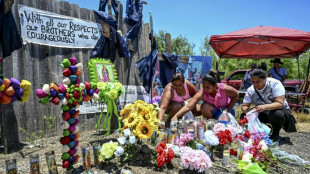 Guatemalan man gets 30 years for truck smuggling deaths of 53 migrants

 'Clayface' gets under the skin of the superhero genre

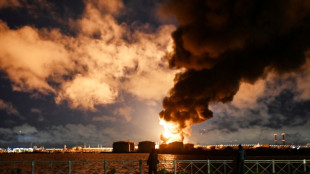 Zelensky, US envoys hold Oslo talks as Ukraine claims US missile holdup
 All-rounder Minhas stars as Pakistan crush England in tri-series
 Bavuma hits 179, Rabada strikes as South Africa dominate
 Allrounder Minhas stars as Pakistan crush England in tri-series
 Albania PM blames 'hybrid war' for week of unrest
 Bavuma hits 179 to lead South African fightback
 Solid GM results overshadowed by latest jump in commodity costs
 Houthi attacks undermine Saudi Arabia's economic ambitions
 French PM vows 'massive' police deployment for new demonstrations

 Power outage hits Google Cloud services, disrupting UK banks
 AI challenges maths by solving the unsolvable
Rana Hariri doesn't know when she'll be able to send her children back to school, as Lebanon's grinding economic crisis thrusts the fate of public education into uncertainty.
Lack of funding for the school system has precipitated repeated teachers' strikes and school closures, resulting in children being increasingly pulled out of the formal learning system, and in some cases being forced to work.
Hariri, 51, says her nine-year-old daughter Aya "repeatedly asks me: 'When will I go back to school?' But I do not know what to tell her."
Lebanon's public institutions have been crumbling since the economy collapsed in late 2019, pushing most of the population into poverty and dealing a heavy blow to state schools.
Public sector workers, including teachers, have repeatedly gone on strike as the value of their salaries crashed after the Lebanese pound lost more than 98 percent of its worth against the dollar.
"My children stayed at home for three months last year due to the strikes," said Hariri.
She had hopes that her 14-year-old daughter Menna would someday become a doctor.
But now, "I just hope she'll be able to go to school in the first place," she said, sitting at her friend's house surrounded by her four children.
"For the past four years, teachers have failed to secure their rights, while our children miss out on basic education."
Public sector teachers earn the equivalent of $150 to $300 per month, while the education ministry has sounded the alarm over lack of funding.
Hariri took her anger to the streets, protesting alongside teachers who demanded better wages at a sit-in in September.
The school year is due to begin in early October, but amid uncertainty over the start date, her two sons, aged 13 and 17, have taken up work with their father, a plumber.
Her daughters have meanwhile been forced to wait at home.
"I want them to have a degree... but this country is killing their future," she said with a sigh.
- Public education 'in danger' -
Since 2019, children have "experienced devastating disruption to their education", according to the United Nations' children's agency.
The disruptions were attributed to the economic crisis, the coronavirus epidemic, a deadly 2020 blast that rocked Beirut's port and strikes that forced school closures.
"A growing number of families" can no longer afford "the cost of education including transport to school, food, textbooks, stationery, and clothes", UNICEF Lebanon said.
At least 15 percent of households have pulled their children out of schools, UNICEF found in a June report, up from 10 percent a year ago.
And one in 10 families have been forced to send children, sometimes as young as six years old, to work to make ends meet, the report said.
"Being out of school exposes children... to violence,... poverty," and increases risks of child marriage in girls, said Atif Rafique, chief of education at UNICEF Lebanon.
Education Minister Abbas Halabi has repeatedly complained of funding problems, warning in September that "public education is in danger".
"The most urgent problem today is financial," he said, adding that his ministry was still working on securing funding for the upcoming school year.
The education ministry mostly relies on government credit lines and donor funding, mainly from the World Bank and the UN, to educate the more than 260,000 Lebanese pupils and over 152,000 Syrians enrolled in public schools.
But Halabi said donors had informed him they could not afford to give more money to public school employees.
- 'Catastrophic' -
According to a recent Human Rights Watch report, the education ministry has slashed the number of teaching days from 180 in 2016 to about 60 in the past two years, "citing financial constraints".
Year after year, the ministry has had "no plan" to secure the funds needed for schools to remain open without interruption, said Ramzi Kaiss, HRW's Lebanon researcher.
"If we're going to have a fifth year that is lost or interrupted, it's going to be catastrophic," he told AFP.
But despite the setbacks, more pupils have poured into Lebanon's public schools as families can no longer afford private education.
Homemaker Farah Koubar, 35, said she fears she one day won't even be able to afford sending her three young children to public school.
"I'm afraid they will miss out on their education," she told AFP from her small home in Beirut.
"Every year life becomes more difficult," she said, holding back tears as she recalled how she has had to ask acquaintances for financial help to secure her family's survival.
"Everything is expensive, food, water, gasoline -- even bread."
J.Saleh--SF-PST