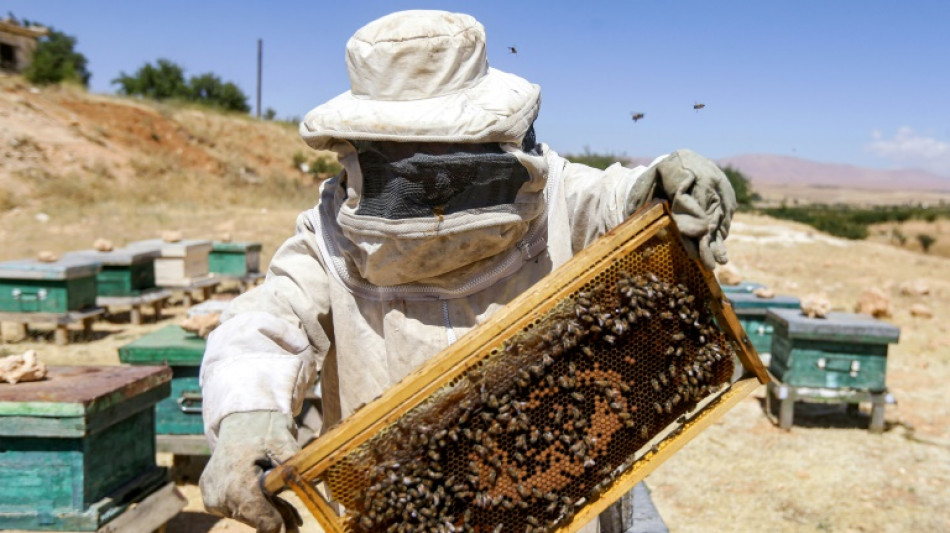
Syrian beekeepers battle both war and climate change / Photo: LOUAI BESHARA - AFP

 Zelensky, US hail 'productive' talks to end Trump feud

 'Unbelievable' Foden back in the groove with treble in Man City rout

 Pistons rally to beat Celtics in NBA 2026-27 season opener

 PSG late show downs Barca in Champions League, Liverpool fight back

 Liverpool strike back to beat Villarreal in seven-goal thriller

 Dow boosted as markets rotate from tech shares

 Zelensky hails resumption of US advance warning of strikes on Ukraine

 Carrick says only wins can ease doubts over Man Utd future

 Top NBA Draft pick Dybantsa to miss opener with ankle sprain

 Italy sends troops, toughens security laws after Milan clashes

 Alberta separatists vow to fight on, risking turmoil for Canada

 Two men re-arrested for suspected spying for Iran in airbase scare: UK police

 Guatemalan man gets 30 years for truck smuggling deaths of 53 migrants

 'Clayface' gets under the skin of the superhero genre

 Zelensky, US envoys hold Oslo talks as Ukraine claims US missile holdup

 All-rounder Minhas stars as Pakistan crush England in tri-series

 Bavuma hits 179, Rabada strikes as South Africa dominate

 Allrounder Minhas stars as Pakistan crush England in tri-series
 Albania PM blames 'hybrid war' for week of unrest

 Bavuma hits 179 to lead South African fightback

 Solid GM results overshadowed by latest jump in commodity costs

 Houthi attacks undermine Saudi Arabia's economic ambitions
 French PM vows 'massive' police deployment for new demonstrations

 Power outage hits Google Cloud services, disrupting UK banks

 AI challenges maths by solving the unsolvable

Syrian beekeeper Ibrahim Damiriya struggles to produce honey from his hives on parched land near the capital Damascus after years of war, economic collapse and worsening climate change impacts.
"The war bled us dry. We could barely keep our beekeeping business afloat, and then the insane weather made things worse," the 62-year-old in a beekeeping suit told AFP as he examined meagre honey stocks inside the hives.
Before Syria's conflict erupted in 2011, Damiriya owned 110 hives in Rankus, a village near Damascus that was once filled with apple orchards.
But now a combination of fighting, severe drought and a gruelling economic crisis have left him with a mere 40 hives in semi-arid lands, decimating his honey yield.
Rankus was once renowned for its honey, but was hard hit by fighting between government forces and rebels that caused widespread destruction, pushing many residents to flee.
Damiriya can barely afford to tend to his hives, donated by the International Committee for the Red Cross (ICRC) to help Syrian beekeepers.
"If we keep suffering from climate change and rising prices, I might have to abandon my profession," Damiriya said with a sigh.
Since 2011, Syria's war has killed more than half a million people and caused an acute economic crisis, exacerbated by severe Western sanctions.
Recent years have also battered Syria with heatwaves, low rainfall and more forest fires.
- 'Extreme weather' -
A 2019 United Nations report found that fighting had practically wiped out hives, with bombs contaminating the environment and pesticide misuse and a proliferation of parasites speeding up their decline.
Syria used to be home to 635,000 hives before the war, but their numbers had dwindled to about 150,000 at the height of the conflict in 2016, said Iyad Daaboul, the Damascus-based president of the Arab Beekeepers Union.
Today that number has risen back up to 400,000, he said. However, the hives yield only 1,500 tonnes of honey per year -- half of the country's pre-war production.
Unusually cold springs and drought have had an adverse effect on the flowers that bees feed on.
"Extreme weather conditions have greatly affected bees, especially during spring -- the most important time in their life cycle," said Daaboul.
The number of beekeepers has nearly halved from 32,000 before the war to around 18,000 today, he said.
Another threat to the bees is the forest fires which have become more common as temperatures rise.
Fires "have destroyed more than 1,000 hives on Syria's coastal mountains and stripped bees of large foraging areas", Daaboul said.
- 'Unusually cold' -
Rising temperatures and desertification have taken a toll on Syria's greenery, destroying many of the plants on whose flowers the bees feed and squeezing the once-thriving agriculture sector.
Damascus ICRC spokesperson Suhair Zakkout told AFP that "Syria's agricultural production has fallen by approximately 50 percent over the last 10 years" because of war and climate change.
Despite being one of the countries most badly affected by global warming, Syria has lacked the funds it needs to tackle environmental issues, Zakkout said.
Climate change has devastated farmer Ziad Rankusi's apple orchards, which have also been greatly thinned by illegal logging as people struggle to keep warm during the winter amid recurrent fuel shortages.
Rankusi, who is in his 50s, used to tend more than 1,000 trees on his land, but just 400 survive, and they are drying out in the heat.
"For about five years, we have had unprecedented droughts and desertification, and this year the spring was unusually cold. The fruit perished," said the farmer.
"When trees and flowers disappear, bees can no longer feed. They either migrate or die."
N.Shalabi--SF-PST