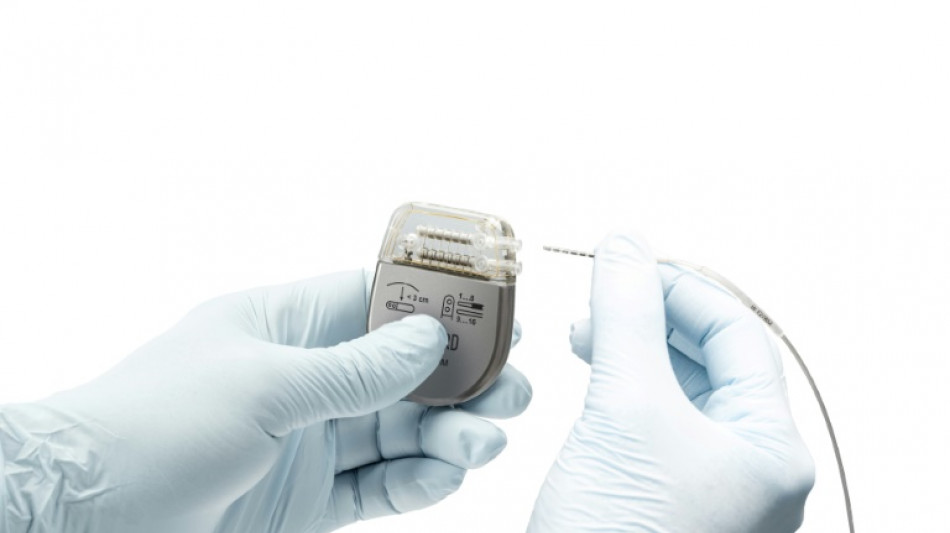
Brain implants could restore paralyzed patients' arm movements / Photo: Marc AMIGUET - ONWARD Medical/AFP

 Zelensky, US hail 'productive' talks to end Trump feud

 'Unbelievable' Foden back in the groove with treble in Man City rout

 Pistons rally to beat Celtics in NBA 2026-27 season opener
 PSG late show downs Barca in Champions League, Liverpool fight back

 Liverpool strike back to beat Villarreal in seven-goal thriller

 Dow boosted as markets rotate from tech shares

 Zelensky hails resumption of US advance warning of strikes on Ukraine

 Carrick says only wins can ease doubts over Man Utd future

 Top NBA Draft pick Dybantsa to miss opener with ankle sprain
 Italy sends troops, toughens security laws after Milan clashes

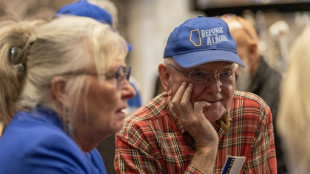 Alberta separatists vow to fight on, risking turmoil for Canada

 Two men re-arrested for suspected spying for Iran in airbase scare: UK police

 Guatemalan man gets 30 years for truck smuggling deaths of 53 migrants

 'Clayface' gets under the skin of the superhero genre

 Zelensky, US envoys hold Oslo talks as Ukraine claims US missile holdup

 All-rounder Minhas stars as Pakistan crush England in tri-series

 Bavuma hits 179, Rabada strikes as South Africa dominate

 Allrounder Minhas stars as Pakistan crush England in tri-series

 Albania PM blames 'hybrid war' for week of unrest

 Bavuma hits 179 to lead South African fightback
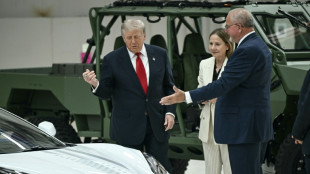 Solid GM results overshadowed by latest jump in commodity costs

 Houthi attacks undermine Saudi Arabia's economic ambitions

 French PM vows 'massive' police deployment for new demonstrations
 Power outage hits Google Cloud services, disrupting UK banks

 AI challenges maths by solving the unsolvable
A paralyzed Swiss man has become the first person to test a new technology that reads his thoughts using AI and then transmits signals through his own nervous system to his arms, hands and fingers in order to restore movement.
The treatment, a combination of a brain-computer interface and a spinal implant, had previously allow a paraplegic patient to walk again, a breakthrough that was published in the scientific journal Nature in May.
But this is the first time it's being used for "upper extremity function," Onward, the Dutch company behind it, said Wednesday.
"The mobility of the arm is more complex," surgeon Jocelyne Bloch, who carried out the implantation procedures, told AFP.
Though walking comes with its own challenges -- notably balance -- "the musculature of the hand is quite fine, with many different small muscles activated at the same time for certain movements," she said.
The patient, who wishes to remain anonymous, is a 46-year-old who lost the use of his arms after a fall. Two operations were carried out last month at the Lausanne University Hospital in Switzerland.
The first involved removing a small piece of cranial bone and inserting in its place the brain implant, which was developed by the French group CEA-Clinatec and measures a few centimeters in diameter.
In the second, surgeons placed a stimulator roughly the size of a credit card developed by Onward inside the patient's abdomen, and connected it through electrodes to the top of his spinal column.
The brain-computer interface (BCI) records brain signals and decodes them using artificial intelligence to make sense of the patient's intentions, acting as a "digital bridge" to send these instructions on to the spinal cord stimulator.
"It's going well so far," said Bloch, who co-founded Onward and is a consultant for the company. "We are able to record brain activity, and we know that the stimulation works," she said.
"But it is too early to talk about what progress he has made. "
- Still in training -
The patient is still in the training phase, teaching his brain implant to recognize the different desired movements.
The movements will then have to be practiced many times before they can become natural. The process will take a few months, according to Dr. Bloch.
Two more patients are scheduled to participate in this clinical trial, and the full results will be published later.
Spinal cord stimulation has already been used in the past to successfully move paralyzed patients' arms, but without reading their thoughts by pairing it with a brain implant.
And brain implants have already been used so that a patient can control an exoskeleton. The Battelle research organization used a brain implant to restore movement in a patient's arm -- through a sleeve of electrodes placed on the forearm, stimulating the muscles required from above.
"Onward is unique in our focus on restoring movement in people who have paralysis by stimulating the spinal cord," the company's CEO Dave Marver told AFP, adding the technology could be commercialized by the end of the decade.
Brain implants were long trapped in the realm of science fiction, but the field is now rapidly growing thanks to firms like Synchron and Elon Musk's Neuralink.
They are working on having paralyzed patients to control computers through thought, restoring for example the ability to write.
A.AlHaj--SF-PST