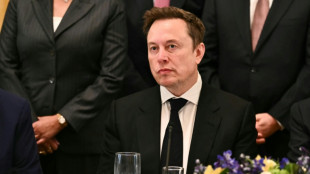
What happens if US government enters a shutdown? / Photo: CHIP SOMODEVILLA - GETTY IMAGES NORTH AMERICA/AFP

 Zelensky, US hail 'productive' talks to end Trump feud

 'Unbelievable' Foden back in the groove with treble in Man City rout
 Pistons rally to beat Celtics in NBA 2026-27 season opener

 PSG late show downs Barca in Champions League, Liverpool fight back

 Liverpool strike back to beat Villarreal in seven-goal thriller

 Dow boosted as markets rotate from tech shares
 Zelensky hails resumption of US advance warning of strikes on Ukraine

 Carrick says only wins can ease doubts over Man Utd future

 Top NBA Draft pick Dybantsa to miss opener with ankle sprain

 Italy sends troops, toughens security laws after Milan clashes

 Alberta separatists vow to fight on, risking turmoil for Canada

 Two men re-arrested for suspected spying for Iran in airbase scare: UK police

 Guatemalan man gets 30 years for truck smuggling deaths of 53 migrants

 'Clayface' gets under the skin of the superhero genre

 Zelensky, US envoys hold Oslo talks as Ukraine claims US missile holdup

 All-rounder Minhas stars as Pakistan crush England in tri-series

 Bavuma hits 179, Rabada strikes as South Africa dominate
 Allrounder Minhas stars as Pakistan crush England in tri-series

 Albania PM blames 'hybrid war' for week of unrest

 Bavuma hits 179 to lead South African fightback

 Solid GM results overshadowed by latest jump in commodity costs

 Houthi attacks undermine Saudi Arabia's economic ambitions

 French PM vows 'massive' police deployment for new demonstrations

 Power outage hits Google Cloud services, disrupting UK banks

 AI challenges maths by solving the unsolvable

The United States is heading toward a government shutdown this weekend with no foreseeable way out of a deadlock in Congress over hardline Republican calls for deep spending cuts.
The new US fiscal year begins on October 1, but sharp disagreements in the Republican Party over the scale of federal debt has prevented passage of the bills needed to keep the government funded and open.
The credit ratings agency Moody's warned this week that a shutdown would be "credit negative" for US sovereign debt, threatening its top-tier rating and raising the prospect of higher borrowing costs.
With time running out, the Senate has released a simple bipartisan bill to extend funding and buy lawmakers more time.
But, faced with the threat of a leadership challenge from the right of his party, Republican House Speaker Kevin McCarthy has refrained from bringing a similar bill to the floor, making a shutdown increasingly probable.
Here's what is likely to happen beginning Sunday if the US government shuts down.
- Workers don't get paid -
Hundreds of thousands of federal employees would be furloughed without pay, while members of the military and other workers deemed to be essential would continue working without a paycheck.
The American Federation of Government Employees (AFGE) union estimates a full shutdown would mean almost 1.8 million federal workers would not be paid for the duration.
Around 850,000 non-essential workers would be furloughed, according to the non-partisan Committee for a Responsible Federal Budget.
Once a funding deal is reached these restrictions would be lifted and all affected employees would be paid retroactively, according to the AFGE.
- Government services stop -
Operations classified as essential will continue to operate.
In past shutdowns, this has meant that benefits checks have continued to be paid, while air traffic controllers, border patrol agents and hospital staff have remained on the job.
However, many services would likely be affected, including new applications for Social Security and Medicare, food and environmental site inspections, and national parks.
The longer a shutdown continues, the greater the impact would be.
- The economic impact -
Goldman Sachs economists have estimated that a shutdown would impact economic growth in the fourth quarter by 0.2 percentage points for every week it continues.
A stoppage could take two to three weeks to resolve, Goldman economists wrote in a recent note to clients, "as neither side seems likely to make immediate concessions."
"While some funding lapses have ended very quickly, the political environment going into the deadline is more reminiscent of the situation preceding longer shutdowns in the past," they added.
Assuming the shutdown ends before the year is out, Goldman estimates growth will increase early next year by the same amount it declined in the fourth quarter, while Oxford Economics researchers expect half of the loss to be made up.
The loss of government worker output would cost annual economic growth around 0.1 percentage points per week, and would be irreversible, according to Oxford Economics.
A shutdown could also have an indirect impact on the economy as federal workers without pay begin to curtail their spending.
The shutdown already appears to be having an impact on Wall Street, with major stock indexes losing steam as the deadline approaches.
- Federal data troubles -
Economists worry that a shutdown would also pause the publication of federal government data.
This is a real concern for the US Federal Reserve, which has said it will be guided by data as it decides interest rate policy going forward. The Fed recently slowed its aggressive pace of hikes as it tackles stubborn inflation.
Without fresh data, the central bank would be forced to make decisions with serious ramifications for the US economy without having a clear picture of where things stand.
While a short shutdown would have a limited long-term impact, it could become a significant issue if lawmakers fail to reach agreement swiftly.
B.Mahmoud--SF-PST