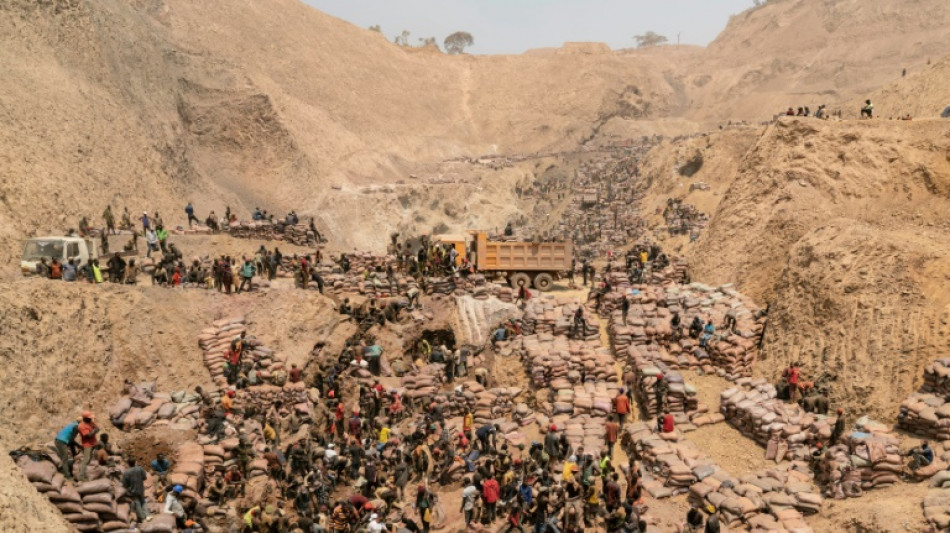
Need for critical metals poses dilemmas for investors / Photo: Junior KANNAH - AFP/File

 Man allegedly behind 'targeted' attack on Australian lawmaker appears in court

 Musk backs SpaceX-Tesla merger as rocket firm turns profit

 Zelensky, US hail 'productive' talks to end Trump feud

 'Unbelievable' Foden back in the groove with treble in Man City rout
 Pistons rally to beat Celtics in NBA 2026-27 season opener
 PSG late show downs Barca in Champions League, Liverpool fight back

 Liverpool strike back to beat Villarreal in seven-goal thriller

 Dow boosted as markets rotate from tech shares

 Zelensky hails resumption of US advance warning of strikes on Ukraine

 Carrick says only wins can ease doubts over Man Utd future

 Top NBA Draft pick Dybantsa to miss opener with ankle sprain

 Italy sends troops, toughens security laws after Milan clashes

 Alberta separatists vow to fight on, risking turmoil for Canada

 Two men re-arrested for suspected spying for Iran in airbase scare: UK police

 Guatemalan man gets 30 years for truck smuggling deaths of 53 migrants

 'Clayface' gets under the skin of the superhero genre

 Zelensky, US envoys hold Oslo talks as Ukraine claims US missile holdup

 All-rounder Minhas stars as Pakistan crush England in tri-series

 Bavuma hits 179, Rabada strikes as South Africa dominate

 Allrounder Minhas stars as Pakistan crush England in tri-series

 Albania PM blames 'hybrid war' for week of unrest

 Bavuma hits 179 to lead South African fightback
 Solid GM results overshadowed by latest jump in commodity costs

 Houthi attacks undermine Saudi Arabia's economic ambitions

 French PM vows 'massive' police deployment for new demonstrations

Soaring demand for the raw materials needed for the transition towards renewable energy is creating dilemmas for investors weighing the economic, environmental and human rights risks of such projects.
With demand for fossil fuels expected to peak by the end of the decade, the focus is shifting towards lithium, cobalt, copper and other materials that are extracted from the earth through heavy labour and leave scars in the environment.
Demand for lithium -- an essential component of car batteries -- could increase ninefold between 2022 and 2050, according to the International Energy Agency (IEA).
Lithium demand has already tripled in the past five years.
Lithium and other metals that the IEA calls "key to the clean energy transition" will be the topic of a summit hosted by the global energy watchdog in Paris on Thursday.
Demand for cobalt will have increased from 171,000 tonnes to 524,700 tonnes by 2050, according to the IEA, with nickel requirements set to soar 120 percent in the same timeframe.
The IEA said in a July report that investment in the mining sector is still insufficient to meet demand, and also flagged concerns that a high concentration of new projects were clustered in a small number of countries.
"This is a huge issue," said Jason Schenker, president of Prestige Economics. "We have massive shortfalls across commodities."
- 'A lot of money' -
Swedish management company AuAg Funds has developed an investment portfolio dedicated to "essential metals", where the money placed in the fund is invested in shares of mining companies, smelting, refining and other parts of the supply chain.
"We give exposure through equity to all metals: copper, silver, aluminium, lithium, uranium, cobalt," Christopher Svensson, founder and co-portfolio manager at AuAg Funds, told AFP.
To comply with financial regulations, however, it is not possible for them to invest directly in a specific project, only in the companies.
Schenker warns a lot of investment is needed in projects that will take a long time to deliver.
"The amount of additional mining, refining, smelting, and everything that's going to be needed to get us where we need to be in terms of supply is a number very difficult to come to, because every time you're opening a new mine, it involves a lot of money," he said.
"These are large capital investments and they take many years to put in place before you really begin to see that return and the number of mines," added Schenker.
Svensson said it needs "15-20 years to start a new mine".
- Compromise and sacrifice -
The mining sector also presents significant concerns around human rights and environmental pollution.
Cases where the lives of mine workers are endangered, natural habitat is destroyed or local populations are negatively impacted regularly steal headlines.
Others express concerns over carbon emissions from production and refining sites.
"If you feel passionately about sustainability, I imagine it's got to be pretty tough to hear that the future of clean energy requires a trade-off, as more mining and that's also going to have negative impacts," said Schenker.
Investors in environmental, social, and corporate governance (ESG) have to choose "do we sacrifice the S, or the G, or the E for the energy transition," said Margot Seeley, ESG analyst at ABN AMRO Investment Solutions.
AuAG claims to have a strict policy for selecting its portfolio companies, and Svensson said their structure allows institutional investors to get involved.
"We want companies that are extracting metals in the best environmental way," he added.
H.Nasr--SF-PST